What's inside
As an Amazon Associate I earn from qualifying purchases. This post may contain affiliate links at no extra cost to you.
For installing anchors in block walls, a compact hammer drill is often enough—but only for the smaller, occasional jobs. A full-size hammer drill gives you more speed, stability, and battery capacity, but it is heavier and can be unnecessary for hanging a few shelves or a hose reel.
The important distinction is that “full-size hammer drill” does not mean “rotary hammer.” Both tools use a chuck for standard drill bits, while a rotary hammer uses a different mechanism and is usually the better choice for repeated masonry work or larger holes. For typical plastic expansion anchors and small sleeve anchors in concrete block, the choice is mainly about workload and hole size.
As an Amazon Associate we earn from qualifying purchases at no extra cost to you.


Our Top Picks
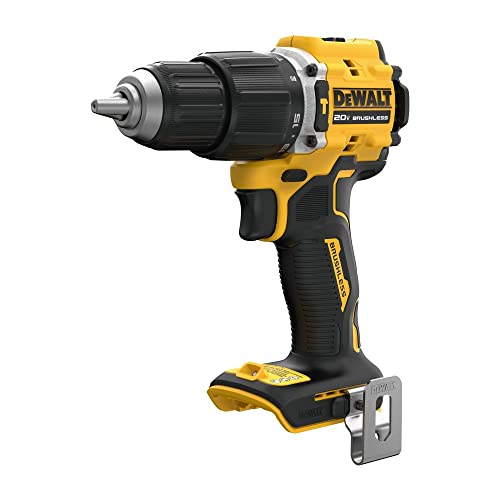
 DEWALT 20V MAX XR 1/2 Inch Brushless CordlessOne Size15.5 x 4 x 8.5 Inches4.96 PoundsCheck on Amazon


What the block wall does to the drill
Concrete block is less uniform than poured concrete. The face shell may be only about 1 to 1 1/2 inches thick before the bit reaches a hollow cavity. You may also hit a mortar joint, a filled cell, or a denser web inside the block. That makes drilling unpredictable: one hole can cut quickly while the next takes noticeably longer.
For small anchors, use a masonry bit and drill only deep enough for the anchor. A 1/4-inch hole for a small plastic anchor may be 1 1/2 to 2 inches deep, while a 3/8-inch sleeve anchor commonly needs roughly 2 1/2 to 3 inches of embedment, depending on the anchor design. Follow the anchor manufacturer’s diameter and depth requirements rather than sizing the hole by eye.
Hammer mode helps the carbide tip chip masonry instead of merely rubbing it. Keep the drill straight, clear dust from deep holes, and avoid using excessive pressure. A dusty hole or an oversized hole is a common reason an anchor spins or pulls out.
When a compact hammer drill is the better buy
A compact 12-volt or small 18-volt hammer drill is a good fit for a handful of holes up to about 3/8 inch in block. It is easier to hold overhead, fits between joists and cabinets, and is less tiring when you are installing light-duty anchors for signs, cable clips, shelves, or small brackets.
Its main limitation is drilling speed. Compact tools typically have less sustained power and smaller batteries. A few holes in the face shell are no problem, but drilling into a filled cell or a hard mortar joint can make the motor work continuously. The tool may slow down, overheat, or use most of a small battery before the job is finished.
For occasional household work, a 12V compact hammer drill kit is usually the sensible low-cost option. It is cheaper to own, easier to store, and capable of installing common 1/4-inch and 5/16-inch anchors when used correctly.
When a full-size hammer drill earns its space
A full-size 18- or 20-volt hammer drill is preferable when you have dozens of holes, need holes larger than 3/8 inch, or expect to encounter dense block and mortar. Its longer body and larger grip provide better control, while the higher-capacity battery maintains speed under load.
That extra power does not automatically make a bad installation good. A full-size drill can still produce an oversized hole if you wobble the bit, and it can damage the face shell if you lean on it aggressively. It is simply less likely to bog down and more comfortable for sustained drilling.
Choose a brushless 18V or 20V hammer drill kit if you regularly install hardware, drill several dozen masonry holes at a time, or also need the tool for large wood and metal bits. Brushless motors generally handle extended work better, although the battery and bit still determine much of the real-world performance.
| Factor | Compact hammer drill | Full-size hammer drill |
|---|---|---|
| Best hole range in block | About 1/4 to 3/8 inch | About 1/4 to 1/2 inch, with more margin |
| Practical workload | A few to roughly 10 holes | Several dozen holes |
| Handling | Light, compact, easier overhead | Heavier, steadier under pressure |
| Battery endurance | Limited with small packs | Better for continuous drilling |
| Main weakness | Slows in dense masonry and filled cells | More expensive and tiring for small jobs |
Match the drill to the anchor
Plastic expansion anchors are inexpensive and forgiving for light loads, but they should not be treated as structural fasteners. In hollow block, they may expand inside the void without gripping a solid surface. Toggle-style anchors can work better in hollow areas, provided there is enough room behind the face shell for the toggle to open.
Sleeve anchors and concrete screws are stronger choices for brackets and moderate loads. They need accurate holes and adequate embedment. A sleeve anchor placed partly in the thin face shell may crack the shell or pull out. If the anchor must carry a substantial load, locate a filled cell or use a fastening method specifically rated for hollow concrete block.
Common failure modes include drilling into a mortar joint, using a worn or undersized masonry bit, failing to remove dust, and over-tightening. A concrete screw that spins without biting has usually lost its thread path, encountered weak material, or been installed in an oversized hole. Stop and move the fastening point rather than repeatedly driving the screw.
When a rotary hammer is the right tool
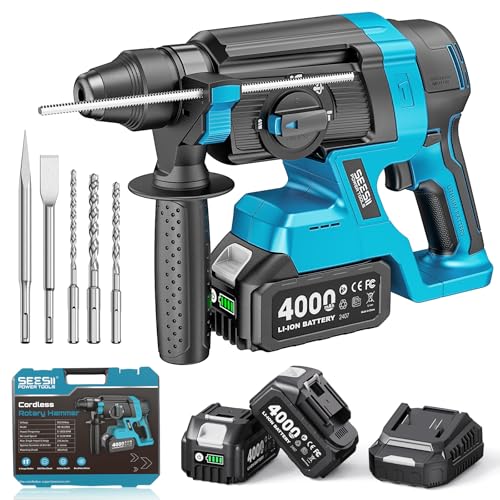
If you are drilling more than about 1/2 inch, installing many anchors, or working in hard, filled block, a rotary hammer is usually a better choice than either hammer drill. Its piston mechanism removes masonry faster and with less force from your hands. The trade-off is cost, weight, noise, and the need for SDS-Plus bits.
A cordless SDS-Plus rotary hammer makes sense for repeated anchor installation, but it is overkill for four 1/4-inch holes. For a one-day project, renting one may be cheaper than buying it. Do not use rotary-hammer impact for delicate tile or thin block face shells unless the anchor instructions specifically allow it.
A practical buying and installation checklist
Choose the compact drill when the job is light, the holes are small, access is tight, and you already own compatible batteries. Choose the full-size drill when you need longer runtime, more consistent speed, or one tool that also handles demanding wood and metal work. Choose a rotary hammer when masonry drilling is a recurring task rather than an occasional chore.
Use a sharp carbide masonry bit, mark the required depth with tape, and drill in hammer mode at moderate speed. Wear eye protection because block dust and chips are abrasive. Vacuum or blow out the hole, insert the anchor fully, and tighten only to the specified torque. If the block face cracks, the hole becomes loose, or the anchor will not seat firmly, relocate the fastener or select an anchor designed for hollow masonry instead of trying to rescue a bad hole.