What's inside
As an Amazon Associate I earn from qualifying purchases. This post may contain affiliate links at no extra cost to you.
Breaking down plywood looks simple until the sheet shifts, the cut wanders, or the saw binds halfway through. A cordless track saw and a plunge-cut circular saw can both make clean, controlled cuts, but they suit different levels of accuracy and different budgets. For most DIY sheet-goods work, the cheaper plunge-cut option is perfectly usable. A track saw earns its price when repeatability, dust control, and long straight cuts matter.
As an Amazon Associate we earn from qualifying purchases at no extra cost to you.



Our Top Picks


What each saw is designed to do
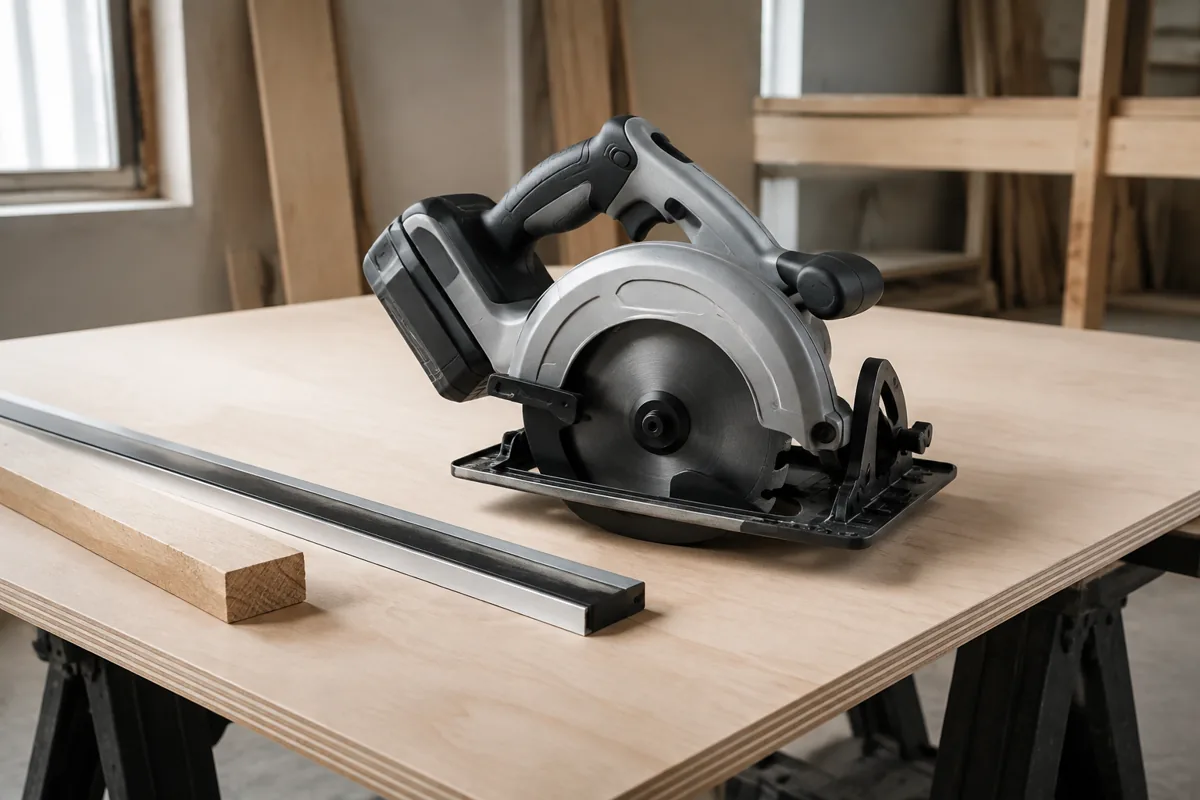
A cordless track saw runs on a guide rail. The saw’s base rides in a channel, so the blade follows a straight line even when the operator is not perfectly steady. You position the rail on the cut line, clamp or hold it in place, and plunge the blade into the plywood. The splinter guard on the rail also supports the edge of the top veneer.
A plunge-cut circular saw has a pivoting blade mechanism and a base that lowers into the material. It can start a cut away from an edge, which is useful for sink openings, access panels, and trimming installed plywood. However, unless the saw is paired with a separate guide rail or straightedge, the cut is controlled mainly by the operator. A conventional circular saw with a straightedge can perform much of the same work, but it does not plunge as neatly.
Cordless track saw vs plunge-cut circular saw
| Factor | Cordless track saw | Plunge-cut circular saw |
|---|---|---|
| Best use | Long, clean, repeatable sheet cuts | Plunge openings, occasional breakdown work, general cutting |
| Cut accuracy | Excellent with a properly positioned rail | Good with a guide; moderate freehand |
| Setup time | More time to position and secure the rail | Fast for short or rough cuts |
| Typical cut depth | About 2 inches at 90 degrees, depending on model and rail | Often about 2 to 2-1/8 inches at 90 degrees |
| Dust handling | Usually better, especially with a vacuum connected | Varies widely by design |
| Portability | Good, but rails add bulk | Better when carrying only the saw |
| Cost | Highest after adding rails and batteries | Usually lower, especially if you already own batteries |
Cut quality and accuracy
For cabinet parts, built-ins, and plywood panels that must meet cleanly, the track saw has the advantage. The rail eliminates most wandering, and its splinter strip helps reduce tear-out on the show face. A sharp, fine-tooth blade still matters: a 48-tooth or higher plywood blade generally leaves a cleaner edge than a coarse framing blade.
The track is not magic. If the rail is placed 1/8 inch off the layout line, the saw will make a perfectly straight wrong cut. Measure from the correct edge, account for the rail’s cutting reference, and check the first cut against a scrap piece. Rails can also move when cutting slippery melamine or long, heavy sheets. Use clamps when the surface is dusty or the cut is long.
A plunge-cut circular saw can produce equally clean results when guided by a straightedge. The catch is repeatability. You must position the guide accurately for every cut, and the saw may have more side-to-side play against an improvised guide. Freehand cuts are fine for subflooring and rough framing, but a 4-by-8-foot plywood sheet gives the blade plenty of opportunity to drift.
Breaking down full sheets safely
Support the plywood on a cutting table, foam insulation, or sacrificial strips so the sheet is supported on both sides of the cut. Do not let the offcut fall while the blade is still engaged. Falling material can pinch the blade, kick the saw back, or tear the veneer at the end of the cut.
For a full sheet, place supports roughly every 16 to 24 inches when practical, with extra support near the ends. Set the blade only slightly deeper than the plywood—around 1/8 inch below the sheet. Excessive depth increases the amount of exposed blade and can worsen tear-out. Keep the cord or battery side clear of the cut path, wait for the blade to reach full speed, and let the saw advance without forcing it.
A track saw is easier to keep straight across an 8-foot rip, particularly when the panel is awkward or you need several identical widths. A plunge saw is faster for one or two rough cuts, especially if you already have a reliable guide rail or a straight 1-by-4 clamped to the sheet.
When the cheaper option is enough
Choose a cordless plunge-cut circular saw if your plywood cuts will be hidden, if you are mainly building shop fixtures, or if you only break down a few sheets each year. Add a suitable guide rail or use a straightedge, and spend part of the savings on a quality plywood blade. For rough carpentry, a regular circular saw guide rail setup may be all you need.
The plunge saw is also the more flexible choice for cutouts. You can lower the blade inside a marked rectangle, stop before the corners, and finish them with a jigsaw. A track saw can do this too, but its rail is less convenient for small interior openings.
When a track saw is worth paying for
Buy a cordless track saw kit with rail when you regularly cut cabinet-grade plywood, need accurate long rips, or work alone with full sheets. It reduces the physical effort of steering the tool and makes repeated cuts more consistent. A second rail connector and longer rail can be worthwhile for 8-foot panels, though rail alignment must be checked carefully at the joint.
Battery capacity affects this job more than peak voltage claims. A large sheet can require a long continuous cut, and thick plywood or a dull blade increases the load. Keep a charged spare battery available if you are processing several sheets. If dust control is important, prioritize a model with a well-sealed blade housing and a usable vacuum port; a shop vacuum with a fine dust filter will outperform the small collection bag found on many circular saws.
The practical buying decision
For occasional DIY plywood breakdown, buy the plunge-cut saw, a straight guide, and a good blade. It is the better value and handles more types of work. For furniture, cabinetry, flooring panels, or repeated production cuts, choose the track saw. Its higher cost buys a controlled cutting system rather than just another motor and blade.
Whichever tool you choose, use the correct blade, support the sheet fully, and make a test cut before committing to an expensive panel. Most bad plywood cuts come from poor support, incorrect layout, or a dull blade—not from choosing the wrong saw category.