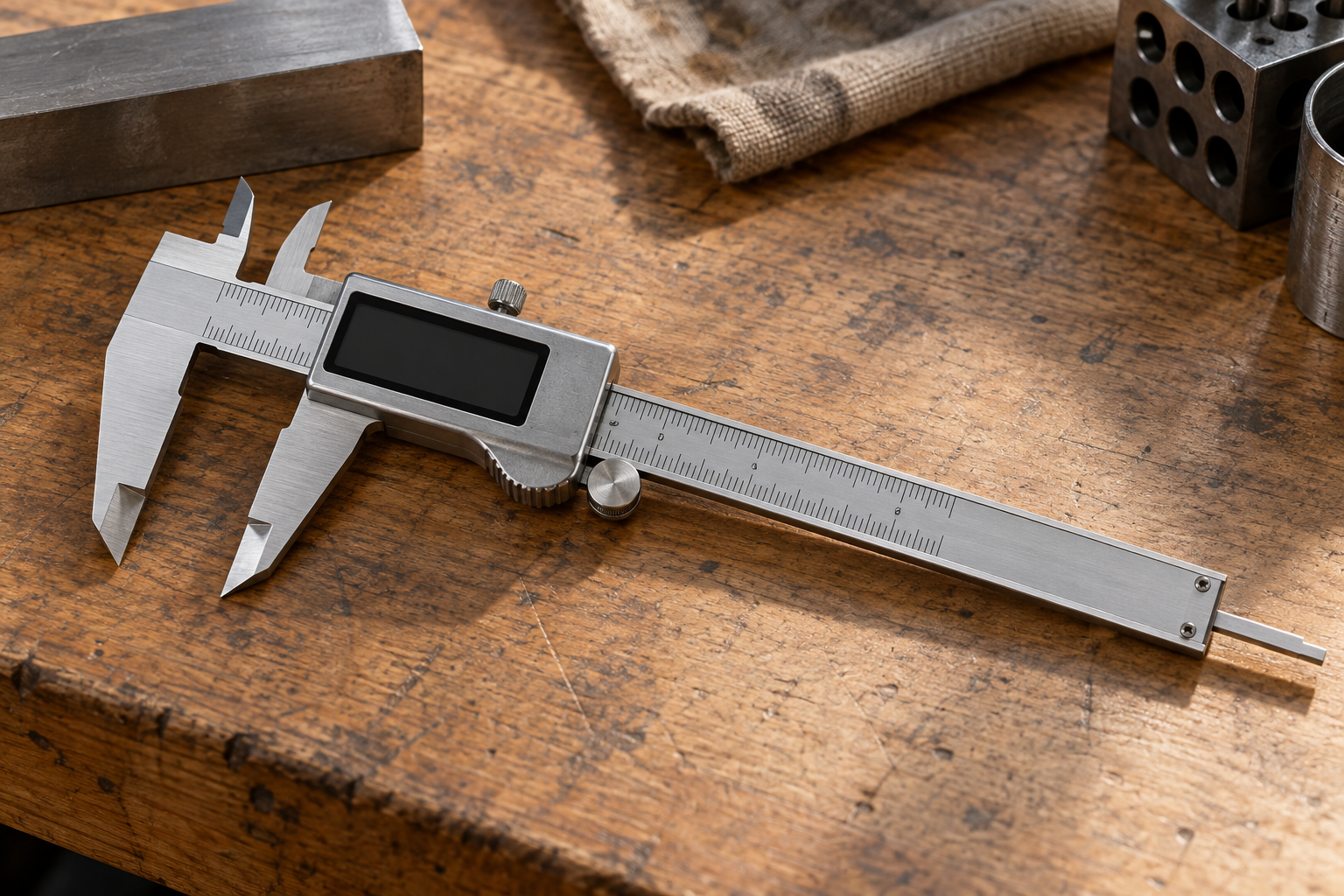
What's inside
As an Amazon Associate I earn from qualifying purchases. This post may contain affiliate links at no extra cost to you.
Starrett 798A and Mitutoyo 500-196-30 digital calipers occupy the same basic space: 6-inch stainless-steel calipers with 0.0005-inch (0.01 mm) display resolution, outside and inside jaws, a depth rod, and a step-measuring function. Both are suitable for general machine-shop, fabrication, maintenance, and DIY measurements.
The important difference is not that one displays finer numbers than the other. Neither should be treated as a measuring instrument accurate to half a thousandth. The real buying decision comes down to protection from coolant and dirt, jaw feel, display behavior, battery features, and the quality of the individual tool.
As an Amazon Associate we earn from qualifying purchases at no extra cost to you.


Our Top Picks


At a glance
| Feature | Starrett 798A | Mitutoyo 500-196-30 |
|---|---|---|
| Typical range | 0 to 6 in / 0 to 150 mm | 0 to 6 in / 0 to 150 mm |
| Resolution | 0.0005 in / 0.01 mm | 0.0005 in / 0.01 mm |
| Typical stated accuracy | About ±0.001 in | About ±0.001 in |
| Display | LCD, inch/metric conversion | LCD, inch/metric conversion |
| Coolant resistance | Depends on the exact 798A version; verify the listing | IP67 protection |
| Best fit | General shop and inspection work | Wet, dirty, or production-shop use |
Specifications can vary slightly by length and regional version, especially within the 798A family. Check the manufacturer’s data for the exact part number before buying. Also watch for counterfeit Mitutoyo calipers sold through marketplace listings.
Measurement performance
Both calipers are aimed at ordinary shop measurements rather than high-precision inspection. Their 0.0005-inch display resolution lets you see changes of half a thousandth, but display resolution is not the same as accuracy. A reading such as 1.2345 inches should not be interpreted as proof that the part is within a few ten-thousandths.
For checking stock thickness, bolt diameters, turned features, tubing, saw-cut parts, and general fit-up, either tool is capable. The outside jaws are the feature most users rely on, and both have narrow enough jaws for many routine measurements. The inside jaws and depth rod are useful for quick checks, but they are more sensitive to technique. Keep the caliper square to the part, use light and repeatable pressure, and avoid squeezing flexible material.
For tolerances tighter than roughly ±0.001 inch, use the appropriate instrument instead. A precision dial caliper is not automatically a better answer, but a micrometer is usually the right next step for outside dimensions. Gauge blocks, bore gauges, or a height gauge may be necessary for more demanding inspection.
Where the Starrett 798A fits
The Starrett 798A is a sensible choice for a general-purpose tool chest. Starrett has a long history making shop measurement equipment, and the 798A’s appeal is its familiar mechanical layout and straightforward operation. It is a good match for a machinist who mainly measures dry parts at a bench and wants a readable digital caliper without paying for features that will not be used.
Check the carriage for smooth travel before putting the tool into service. A good caliper should move without gritty spots, excessive side play, or a sudden change in resistance along the beam. Close the jaws gently and confirm that they meet evenly. With clean jaws, the display should return to zero; if it does not, clean the contact surfaces and inspect for chips before assuming the electronics are faulty.
The main caution is model protection. “798A” identifies a family, not necessarily one identical configuration in every listing. Some versions are marketed for ordinary shop use rather than full coolant-proof service. If the caliper will live beside a CNC machine, be exposed to cutting fluid, or be wiped down while wet, confirm its ingress-protection rating rather than assuming it has one.
Where the Mitutoyo 500-196-30 fits
The Mitutoyo 500-196-30 is the stronger choice for a production environment or any shop where coolant exposure is routine. Its IP67 rating is the practical advantage: the caliper is designed to resist dust and temporary immersion when the battery cover and other seals are in proper condition. That does not make it indestructible. Chips can still damage the beam and jaws, and a dirty or damaged battery seal can compromise protection.
Mitutoyo’s ABSOLUTE encoder also avoids the need to reset the true mechanical position every time the caliper is switched on. In daily use, that makes the tool less fussy than older digital calipers that can lose their reference after a battery change or a rapid slide movement. The display is clear and the thumb roller allows controlled jaw movement, which helps when trying to repeat a measurement.
The drawback is cost. If the tool will be used to measure lumber hardware, 3D-printed parts, automotive components, or dry steel at a workbench, the added sealing may never repay the premium. Buy from a reputable seller, because a low price on a “new” Mitutoyo is often a warning sign rather than a bargain.
Daily use and common failure modes
Digital calipers are often damaged by storage and handling rather than by normal measuring. Do not slide the jaws across abrasive grit, use the caliper as a clamp, or force the jaws over a burr. A burr on the part can produce a convincing but wrong reading and can nick the measuring faces.
Battery problems are another frequent cause of erratic displays. Replace the battery with the specified type, clean corrosion promptly, and remove the battery for long-term storage if the tool will sit unused for months. If the display flickers when the caliper is moved, suspect a battery contact or contamination before blaming calibration.
Wipe the beam and jaws after use, then store the tool closed but not under pressure. A protective case is worthwhile; a 6-inch digital caliper case costs little compared with replacing bent jaws.
Which one should you buy?
Choose the Mitutoyo 500-196-30 if coolant resistance, repeatable production work, or long-term shop use justifies the higher price. It is the safer default for a machine shop, especially where several people use the tool and it will not always be cleaned immediately.
Choose the Starrett 798A if the work is mostly dry, the seller offers a meaningful price advantage, and you want a capable general-purpose caliper from an established measurement-tool maker. For occasional fabrication, maintenance, woodworking hardware, and noncritical fit checks, the cheaper option is entirely adequate.
Whichever you choose, verify zero, check it against a known dimension, and reserve micrometers for decisions where a thousandth of an inch genuinely matters. That habit will improve measurement results more than paying for a higher-resolution display.