What's inside
- Best Home Coffee Roasters for Fresh Beans
- Home coffee roaster comparison
- Best picks by situation
- FreshRoast SR800: best value for learning
- Gene Cafe CBR-101: best for quieter countertop roasting
- Behmor 2000AB Plus: best larger-batch option
- Kaffelogic Nano 7e: best for repeatable small profiles
- Aillio Bullet R2: best for advanced control
- How much capacity do you really need?
- Smoke, cooling, and counter space
- Ownership costs and maintenance
- Final buying recommendation
As an Amazon Associate I earn from qualifying purchases. This post may contain affiliate links at no extra cost to you.
Our Top Picks
 Fresh Roast SR540 Automatic Coffee Bean Roaster1 Count (Pack of 1)8.5 x 8.5 x 13.5 inches5.7 PoundsCheck on Amazon


Best Home Coffee Roasters for Fresh Beans
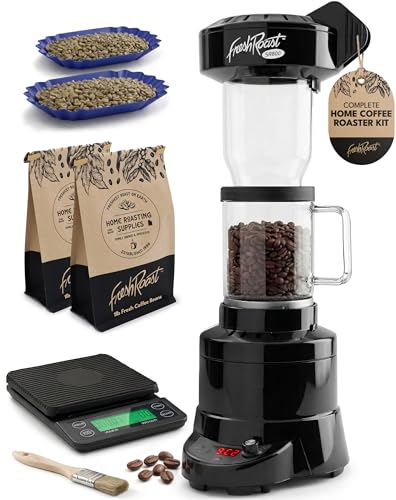
The best home coffee roaster for most beginners is the FreshRoast SR800, while the Behmor 2000AB Plus is better for larger batches, the Gene Cafe CBR-101 is the quieter choice, and the Aillio Bullet R2 is the strongest option for serious roast profiling.
The right choice depends less on the maximum capacity printed on the box than on how much coffee you need each week, how closely you want to control the roast, and whether your kitchen can handle smoke, chaff, and noise. Home roasting is also a process: green coffee expands, sheds its papery skin, and produces smoke as it approaches darker roast levels.
As an Amazon Associate we earn from qualifying purchases at no extra cost to you.



Home coffee roaster comparison
| Roaster | Practical batch size | Roast control | Cooling | Smoke management | Approximate footprint | Typical market range |
|---|---|---|---|---|---|---|
| FreshRoast SR800 | 4–8 oz (113–227 g) | Manual fan and heat adjustment | Built-in cooling cycle | Needs strong ventilation, especially for dark roasts | About 8 x 8 x 15 in | $250–$350 |
| Gene Cafe CBR-101 | Up to 8 oz (250 g) | Adjustable time and temperature | Dedicated cooling cycle | Chaff collector; use near a window or hood | About 19 x 10 x 11 in | $550–$700 |
| Behmor 2000AB Plus | Up to 1 lb (454 g); smaller loads roast more evenly | Preset programs plus manual time and temperature control | Built-in cooling cycle | Smoke suppression system, but not smoke-free | About 17 x 10 x 18 in | $350–$500 |
| Kaffelogic Nano 7e | About 4 oz (120 g) | Profile-based automatic control with app or computer editing | Automatic cooling | Chaff and smoke exhaust require ventilation | About 10 x 8 x 13 in | $1,000–$1,400 |
| Aillio Bullet R2 | Up to 2.2 lb (1 kg); smaller batches offer more headroom | Highly precise heat, fan, and drum-speed control | Fast powered cooling | Requires serious exhaust planning | About 17 x 16 x 20 in | $3,500–$4,500 |
Dimensions and capacities are approximate and can vary by regional version or measuring method. Treat maximum capacity as a ceiling, not the ideal everyday load. A roaster generally gives you better control when the drum or chamber is not completely full.
Best picks by situation
| Your situation | Best fit | Why | Main compromise |
|---|---|---|---|
| First roaster, limited budget, one or two people | FreshRoast SR800 | Low entry cost, visible beans, and direct manual control | Small batches and noticeable noise |
| Want roughly half a pound at a time | Gene Cafe CBR-101 | Large clear roasting chamber and relatively calm operation | Longer footprint and less detailed control than a drum roaster |
| Need several days of coffee from one session | Behmor 2000AB Plus | Large drum and integrated smoke-reduction features | Cooling is slower than on dedicated high-end machines |
| Repeatable profiles and small, precise batches | Kaffelogic Nano 7e | Automatic profile management makes repeatability easier | About 4 oz per batch means more roast cycles |
| Frequent roasting, advanced experimentation, or small business use | Aillio Bullet R2 | Large capacity, strong data logging, and extensive control | High cost, weight, heat output, and ventilation demands |
FreshRoast SR800: best value for learning
The SR800 uses a glass roasting chamber and moving hot air, so you can watch color change, first crack, and chaff release. Fan speed is especially important: more airflow helps move the beans and manage heat, while lower airflow lets the roast build temperature. This makes the SR800 educational and responsive, although it also means the operator must pay attention.
Its practical strength is flexibility at a modest price. A 4-ounce batch is easier to control than the 8-ounce maximum, and it suits someone who drinks one or two cups daily. The drawbacks are a fairly loud air-fryer-like sound, a tall chamber that needs overhead clearance, and a cooling cycle that can leave beans warmer than ideal if the load is too large.
Gene Cafe CBR-101: best for quieter countertop roasting
The Gene Cafe rotates beans in a glass roasting chamber rather than suspending them in a strong column of air. That gives it a distinctive tumbling motion and generally a less piercing sound than air roasters. The clear chamber also makes it easy to judge color, though the roasting path is not as data-rich or aggressively adjustable as the Aillio Bullet.
The CBR-101 can handle up to about 250 grams, making it a sensible middle ground for a couple or small household. Its elongated body takes more counter depth than the SR800, and it still needs ventilation. The separate cooling phase is useful, but freshly roasted beans should be removed promptly when the cycle ends so residual heat does not continue darkening them.
Behmor 2000AB Plus: best larger-batch option
The Behmor is a drum roaster designed around convenience. Its presets simplify the first few batches, while manual controls allow changes to time and heat as your skills improve. The 1-pound rating is attractive, but a full load can be harder to roast evenly than a 12- to 16-ounce load, particularly with dense green coffee.
Its smoke-suppression system reduces visible smoke, but it does not make indoor roasting completely odorless or ventilation-free. Dark roasts can still produce substantial smoke, and the built-in cooling cycle is not as rapid as the cooling system in high-end commercial-style machines. Plan for a heat-resistant location with clearance around the cabinet rather than treating it like an appliance that can remain tightly enclosed after use.
Kaffelogic Nano 7e: best for repeatable small profiles
The Nano 7e is aimed at people who want repeatability without manually adjusting every stage. Its profile-based approach lets you save and refine roast curves, which is valuable when comparing origins or trying to reproduce a successful batch. The approximately 120-gram capacity is enough for a few days of coffee, but not for a large household unless you are willing to run multiple batches.
This is a good choice for a compact coffee station where consistency matters more than volume. It costs substantially more than a basic air roaster, and software-based control adds a learning curve of its own. Its small batch size can also be an advantage: failed experiments waste less coffee and are easier to compare side by side.
Aillio Bullet R2: best for advanced control
The Bullet R2 is the most capable option in this comparison. It provides detailed control over heat, airflow, and drum speed, along with roast data that makes it easier to compare profiles. Its powered cooling system is a major benefit when running consecutive batches because it brings the beans down in temperature quickly and reduces carryover into the next roast.
That capacity comes with practical costs. The machine is heavy, occupies substantial counter space, and produces enough heat and smoke to require a carefully planned exhaust arrangement. It is excessive for someone roasting a few ounces once a week, but its control and workflow make sense for frequent users who want to develop repeatable profiles.
How much capacity do you really need?
A useful calculation is to start with your weekly brewed coffee. Suppose two people each use 30 grams of roasted coffee per day:
- 30 g × 2 people × 7 days = 420 g of roasted coffee per week.
- Roasting typically causes roughly 12% to 18% weight loss, so 420 g roasted coffee requires about 480–510 g of green coffee.
- A Behmor running one 450 g batch may cover nearly a week, although two smaller batches may produce more even results.
- An SR800 at a practical 113 g batch size would require four or five batches per week.
That calculation explains why a small roaster can be affordable but time-consuming. If you roast only once or twice weekly, choose enough capacity to finish the job without filling the chamber beyond the load that gives you good bean movement.
Smoke, cooling, and counter space
Roast smoke increases sharply near second crack, when beans move toward darker styles. A kitchen range hood that recirculates air may not remove enough smoke; a window exhaust fan or externally vented hood is more effective. Never place a hot roaster beneath low cabinets, near curtains, or where its exhaust can discolor a wall.
Cooling performance affects flavor and repeatability. The roast does not stop the instant heat is reduced, so slow cooling can push a light roast darker and make consecutive batches behave differently. Remove the beans when the machine instructs you to do so, keep the cooling outlet clear, and avoid piling hot beans in a deep bowl where heat remains trapped.
Ownership costs and maintenance
Green coffee commonly costs about $7–$16 per pound depending on origin and availability. At a 15% roast loss, 1 pound of green coffee yields roughly 386 grams of roasted beans. If a 1-pound bag costs $12, the beans cost about $0.031 per gram, or approximately $0.93 for a 30-gram brew, before electricity and equipment costs.
Chaff collectors, screens, glass chambers, and cooling paths need regular cleaning. Chaff buildup can restrict airflow, slow cooling, and create a fire risk. The first parts likely to show wear are seals, screens, fan components, bearings, and removable roast chambers. Avoid using water on electrical assemblies, do not vacuum hot chaff, and let the roaster cool fully before cleaning.
The most common beginner mistake is filling the machine to its advertised maximum and then compensating with excessive heat. Start below maximum capacity, record bean weight, ambient conditions, fan or heat settings, and the timing of first crack. Those notes will improve results more reliably than changing several controls at once.
Final buying recommendation
Choose the FreshRoast SR800 if you want the lowest-cost path to learning and do not mind small, noisy batches. Choose the Gene Cafe CBR-101 for a calmer, larger countertop workflow. Pick the Behmor 2000AB Plus when batch size matters and you can provide ventilation. The Kaffelogic Nano 7e is the better specialist tool for repeatable small profiles, while the Aillio Bullet R2 is the right investment for frequent roasting and advanced control.