What's inside
- What makes a snap ring plier set worth buying?
- Best snap ring plier sets by situation
- Best all-around choice: an eight-piece interchangeable-tip set
- Best small snap ring pliers
- Best heavy-duty snap ring pliers
- Head-to-head: fixed tips versus interchangeable tips
- How to choose the right coverage
- Case storage and long-term ownership
- Common mistakes that shorten tool life
As an Amazon Associate I earn from qualifying purchases. This post may contain affiliate links at no extra cost to you.
The best snap ring plier set for most workshops is a four- or eight-piece set with interchangeable straight and angled tips, separate internal and external pliers, roughly 10–60 mm ring coverage, and a case that keeps tips and adapters organized.
As an Amazon Associate we earn from qualifying purchases at no extra cost to you.



Our Top Picks
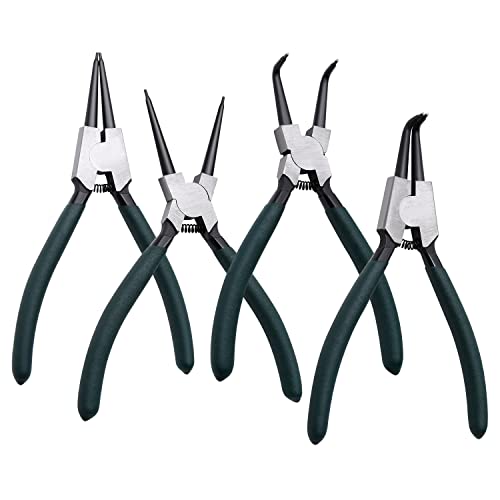
 Doaho 10pcs Snap Ring Pliers Set with Straight/Bent10 PCS12.6 x 10.2 x 0.1 inches3.5 poundsCheck on Amazon


What makes a snap ring plier set worth buying?
Snap rings, also called circlips, are retained by either their eyelets pointing inward or outward. Internal rings sit inside a bore and must be compressed; external rings sit on a shaft and must be expanded. A set that handles only one style may be inexpensive, but it will not be a complete solution for machinery, automotive, bicycle, appliance, and woodworking-equipment repairs.
The most important buying criteria are:
- Tip style: Fixed tips are quick and durable, while interchangeable tips are more versatile. Straight tips suit accessible rings; 45-degree and 90-degree tips reach recessed or obstructed rings.
- Tip diameter: Small tips fit narrow eyelets but can bend or slip if overloaded. Larger tips are stronger and better for heavy rings.
- Ring-size coverage: Check the manufacturer’s stated minimum and maximum ring diameter, not just the number of pliers in the box.
- Jaw control: A positive stop or controlled-opening mechanism helps prevent over-expanding a ring and permanently deforming it.
- Storage: A molded case or labeled pouch prevents adapters from disappearing and makes it easier to identify the correct tip.
Best snap ring plier sets by situation
| Situation | Best configuration | Useful coverage | Typical market range |
|---|---|---|---|
| Occasional household or small-equipment repairs | Four fixed-tip pliers, two internal and two external | 10–32 mm | $20–$45 |
| General workshop use | Eight-piece set with straight, 45-degree, and 90-degree interchangeable tips | 10–60 mm | $45–$110 |
| Frequent automotive or industrial service | Heavy-duty fixed pliers plus replaceable tips or a larger shaft-ring tool | 19–85 mm | $90–$220 |
| Small mechanisms and precision work | Compact internal/external pliers with 1.5–2.0 mm tips | 5–25 mm | $25–$75 |
| Limited storage or mobile tool kits | Four-piece set with a compact hinged case | 8–40 mm | $30–$80 |
These ranges are practical categories rather than guarantees. Ring thickness, eyelet size, access depth, and the force required can matter more than the advertised diameter range.
Best all-around choice: an eight-piece interchangeable-tip set
For a mixed workshop, the most capable format is usually four handles—internal small, internal large, external small, and external large—combined with several tip pairs. A useful set includes straight, 45-degree, and 90-degree tips in at least two diameters.
This layout covers the common failure of basic kits: the pliers reach the ring but approach it at the wrong angle. A 90-degree tip is particularly valuable when a circlip is recessed behind a bearing, pulley, gearbox cover, or furniture mechanism. Interchangeable tips also reduce the number of complete pliers required.
Look for hardened steel handles, a corrosion-resistant finish, smooth-return springs, and tips secured by a screw or locking collar rather than a loose friction fit. The trade-off is that adapters introduce joints that can loosen. For rings requiring substantial force, a fixed-tip heavy-duty plier is often safer than a highly modular tool.
Best small snap ring pliers
Small snap ring pliers are best chosen by tip precision rather than maximum jaw opening. For rings below approximately 25 mm, tips around 1.5–2.0 mm are often more useful than thick universal tips. The ends should enter both eyelets fully without bottoming out or spreading the holes.
Compact tools from established professional brands such as Knipex, Gedore, and USAG are worth considering when the ring is small, recessed, or expensive to replace. Knipex’s circlip-plough range, for example, is known for offering dedicated internal and external formats in different sizes rather than treating one tool as universal. Verify the exact tip diameter and capacity for the particular model before purchase.
Avoid using needle-nose pliers as a substitute. Their jaws can slip out of the eyelets, scratch a shaft, or launch the ring across the workshop. Small rings have less tolerance for a poor fit because their eyelets and spring sections are relatively delicate.
Best heavy-duty snap ring pliers
For large transmission, motor, hydraulic, or industrial rings, choose dedicated heavy-duty pliers with thick forged handles, a strong return spring, and tips designed for the ring’s eyelet diameter. Useful heavy-duty coverage begins around 40 mm and may extend beyond 80 mm, but capacity alone does not indicate safe working force.
A heavy ring should be expanded only enough to clear its groove. If the handles must be forced together until they touch, the tool is undersized or the ring is being approached incorrectly. Some larger circlips require a screw-operated or spreader-style tool instead of hand pliers. These tools provide more control and reduce the chance of the ring twisting.
Among professional options, Knipex, Gedore, and OTC make established circlip tools and sets, while many general-purpose sets are sold under hardware and automotive-tool brands. The best heavy-duty snap ring pliers are the ones whose stated capacity matches the ring’s thickness and eyelet geometry—not merely its outside diameter.
Head-to-head: fixed tips versus interchangeable tips
| Feature | Fixed-tip pliers | Interchangeable-tip set |
|---|---|---|
| Setup time | Immediate | 30–90 seconds to select and install tips |
| Typical access angles | Usually one angle per tool | Often straight, 45°, and 90° |
| Strength under high load | Usually better | Depends on adapter and locking system |
| Replacement cost | Replace the whole plier | Replace an individual tip pair |
| Storage footprint | Larger for equivalent coverage | Smaller, but parts can be lost |
| Best use | Frequent work on known ring sizes | Mixed repairs and awkward access |
If one ring size appears repeatedly in your work, buy a dedicated fixed-tip tool for it. If every repair presents a different ring, the interchangeable set offers better overall value.
How to choose the right coverage
Measure the ring’s installed diameter with calipers if possible. For an external ring, measure the shaft or groove diameter; for an internal ring, measure the bore or groove diameter. Then check three additional dimensions:
- Eyelet-hole diameter: this determines whether the tips actually fit.
- Ring-wire thickness: thicker rings need stronger pliers even when the diameter is modest.
- Groove depth and access: a recessed ring may require angled tips or long-reach jaws.
Allow a sensible margin rather than buying exactly to the stated limit. For example, if your largest regular external ring is 55 mm, a set rated to 60 mm gives little reserve for a thick or stiff ring. A 70 mm-capacity tool is a more comfortable match.
Case storage and long-term ownership
Case design is not cosmetic. A good case labels internal and external tips, identifies the angle and diameter, and holds spare screws or adapters. A loose fabric pouch is acceptable for fixed pliers but frustrating for a modular kit.
The parts that wear first are usually the tip ends, adapter threads, return springs, and pivot joint. Inspect the tips for rounding or bending before each demanding job. Replace a damaged tip rather than grinding it smaller; altered geometry can make the ring slip.
Wipe away grease and abrasive dust after use, then apply a small amount of light oil to the pivot. Do not pack the tip holes with heavy grease, since it can prevent full insertion into the ring eyelets. Keep the case dry, and store interchangeable tips in their assigned slots.
Common mistakes that shorten tool life
- Using internal pliers on an external ring or vice versa.
- Choosing a tip that is too small for the eyelet and allowing it to punch through.
- Over-expanding a ring until it loses its spring tension.
- Pulling sideways while the tips are engaged, which bends the tips and damages the groove.
- Failing to shield the ring during removal, allowing it to eject unexpectedly.
For most buyers, an eight-piece set with internal and external handles, three approach angles, replaceable hardened tips, approximately 10–60 mm coverage, and a molded case is the best balance. Choose a compact precision set for small mechanisms, fixed-tip pliers for repetitive work, and a dedicated heavy-duty tool when ring thickness and removal force exceed the limits of a general-purpose kit.