What's inside
- Quick picks by buyer and workflow
- What a torque wrench tester actually checks
- Best torque wrench tester types compared
- Accuracy, range, and drive compatibility
- Display and mounting features that matter
- Worked sizing example
- Setup procedure for a repeatable check
- Ownership costs and common failure points
- Final buying advice
- Related Guides
As an Amazon Associate I earn from qualifying purchases. This post may contain affiliate links at no extra cost to you.
The best torque wrench tester for most workshops is a digital transducer tester covering your wrench’s full range, using the same drive size or a suitable adapter, with a rigid bench or wall mount; inexpensive mechanical checkers are useful for occasional screening but cannot match the accuracy or reporting of a calibration system.
As an Amazon Associate we earn from qualifying purchases at no extra cost to you.


Our Top Picks



Quick picks by buyer and workflow
| Situation | Best tester type | Useful target specification | Why it fits |
|---|---|---|---|
| Occasional home or woodworking use | Compact digital torque adapter | 10–200 N·m, 1/2-inch drive, ±2% or better | Small, relatively affordable, and adequate for checking common 1/4- and 3/8-inch drive wrenches with adapters |
| Busy repair shop | Bench-mounted digital tester | 10–1,000 N·m, interchangeable drives, peak and track modes | Covers a broad tool range and speeds up repeat checks |
| Low-torque precision work | Dedicated low-range transducer | 0.2–20 N·m, 1/4-inch drive, resolution of 0.01 N·m or finer | Prevents a large-capacity tester from hiding small errors |
| Calibration records or professional service | Calibrated electronic system | Traceable certificate, multiple ranges, data output, ±1% or better | Creates defensible results and allows repeatable pass/fail decisions |
| Large industrial or vehicle tools | High-capacity reaction tester | 1,000–3,000 N·m or more, reaction arm, fixed mounting | Controls the substantial force produced by long-handled and hydraulic tools |
What a torque wrench tester actually checks
A tester measures the torque delivered by a wrench at a controlled drive point. Most electronic units use a strain-gauge transducer and show the measured value on a display. Depending on the model, they may offer peak mode, real-time tracking, clockwise and counterclockwise readings, selectable units, and data storage.
A tester does not automatically recalibrate a torque wrench. It tells you whether the wrench is delivering the expected torque. If the result is outside your chosen tolerance, the wrench needs adjustment, repair, or professional calibration. A tester also cannot compensate for poor technique: pulling too quickly, holding the wrench at the wrong grip point, or using an adapter incorrectly can change the result.
Best torque wrench tester types compared
Digital torque adapters
These sit between the wrench and socket. They are the simplest choice when storage space and price matter. A typical adapter covers approximately 10–200 N·m and uses a 1/2-inch square drive, with 1/4- and 3/8-inch tools supported through reducers.
The limitation is mounting. Because the adapter is held in the tool train rather than secured to a rigid reaction fixture, the operator must control the assembly while applying force. That makes it convenient for a quick check, but less suitable for formal calibration work. Look for a clear peak reading, audible or visual alerts, rechargeable power, and a certificate stating accuracy rather than only display resolution.
Bench-mounted electronic testers
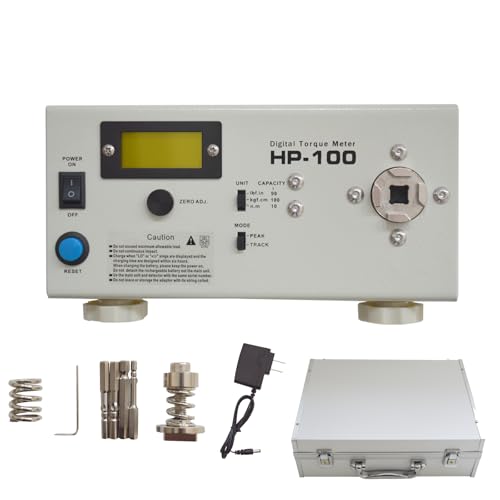
Bench units are the best all-round choice for a repair shop or serious workshop. They normally accept interchangeable square-drive fittings and include a reaction post or plate so the wrench can be loaded consistently. A useful medium-range unit covers roughly 10–1,000 N·m, although high-capacity versions extend beyond 3,000 N·m.
Mounting improves repeatability because the tester stays aligned while the wrench moves through its operating arc. It also reduces the risk of dropping a tool or twisting the display away from view. The trade-off is cost, bench space, and the need to match the tester’s capacity to the wrench. Do not use a 1,000 N·m tester as the main reference for a 2 N·m screwdriver; the low end may have insufficient resolution and accuracy.
Dedicated low-torque testers
Small torque screwdrivers and miniature wrenches require a low-range instrument. A 0.2–20 N·m tester with a 1/4-inch drive is more useful for electronics, cabinet hardware, and precision assemblies than a large automotive tester. These units often have finer resolution and may include a small reaction fixture.
Low-range instruments are sensitive to friction, bearing drag, and operator speed. Keep the setup clean and use the same adapter configuration every time. If your work spans both 2 N·m and 200 N·m, buying two correctly sized transducers is more dependable than expecting one broad-range unit to perform equally well at both extremes.
Accuracy, range, and drive compatibility
Accuracy is the first specification to compare. “Resolution” is only how finely the display changes; a tester can show 0.1 N·m increments and still be inaccurate. For workshop verification, ±1% to ±2% of reading is a sensible target. Check whether the manufacturer states accuracy as a percentage of reading, full scale, or a combination of both. Full-scale accuracy can be less impressive near the bottom of the range.
Use the tester across its practical middle range. For example, if a tester is rated from 20 to 1,000 N·m and your wrench is set to 30 N·m, the measurement is near the lower boundary. A 5–200 N·m tester would generally be a better match, even though its maximum capacity is lower.
Drive size affects mechanical fit, not just convenience. A 1/4-inch drive tester suits small screwdrivers, 3/8-inch fits many general-purpose wrenches, and 1/2-inch is common for automotive tools. Adapters are acceptable when they are square, undamaged, and fully seated, but every additional connection adds length and potential flex. Avoid universal joints and angled adapters during a calibration check.
Display and mounting features that matter
- Peak hold: essential for observing the maximum torque reached when the wrench clicks or releases.
- Track mode: useful for watching a smooth loading process and detecting a jerky technique.
- Selectable units: prevents conversion mistakes when switching between N·m, lbf·ft, lbf·in, and kgf·m.
- Large backlit display: easier to read when the wrench, reaction arm, and operator are not in the same line of sight.
- Reaction fixture: improves repeatability and reduces hand-loading errors.
- Data output: valuable when recording calibration results or comparing several tools.
- Battery indicator and automatic shutoff: prevent failed checks caused by a weak battery.
A wall-mounted or bench-mounted tester should have a rigid fixing surface. A thin portable bench can flex under load, causing the display to read a valid transducer value while the overall setup moves unpredictably. For high torque, use the manufacturer’s reaction arm or fixture rather than improvising with a loose bar.
Worked sizing example
Suppose a workshop owns three wrenches rated at 5–25, 20–100, and 80–400 N·m. A 10–1,000 N·m tester technically covers two of them, but it is poorly matched to the 5–25 N·m wrench. A better arrangement is a low-range 1–30 N·m tester plus a 20–500 N·m tester. The second unit covers the 20–100 and 80–400 N·m tools with useful headroom, while the first measures the small wrench without relying on the bottom few percent of a large transducer.
For a quick purchasing check, list each wrench’s lowest and highest intended test value, then choose a tester whose working range contains those values away from the extreme ends. Leave capacity above the highest target—around 20% is practical—without sacrificing low-end resolution.
Setup procedure for a repeatable check
- Inspect the wrench and tester. Check the square drives, adapters, display, and reaction fixture for damage. Do not test a tool with a bent head or slipping mechanism.
- Allow the equipment to stabilize. Keep it at normal room temperature and let an electronic unit complete its startup or zero routine.
- Mount the tester securely. Align the drive, reaction point, and wrench so force is applied in the intended plane.
- Select the correct unit and mode. Use peak mode for click-type wrench checks and confirm clockwise or counterclockwise direction.
- Exercise the wrench. Apply three gradual loads at approximately the lower, middle, and upper test values before recording readings. This settles contact surfaces and reveals erratic behavior.
- Take repeated readings. Make at least three measurements at each point, using a smooth pull and the marked grip position. Record the average and the spread.
- Compare with the allowed tolerance. Follow the wrench manufacturer’s limit or your workplace standard. If readings are inconsistent, investigate technique and mounting before adjusting the wrench.
Ownership costs and common failure points
The transducer is usually the most important and expensive component, while adapters, square-drive fittings, cables, batteries, and reaction pads are the items most likely to wear or disappear. Keep the tester covered, wipe off oil and metal dust, and never use it as a general-purpose breaker bar. Store adapters without side-loading them, and replace rounded drive fittings before they affect alignment.
Electronic testers should be checked against their calibration interval, commonly annually or after an overload, impact, or unexplained reading. A certificate is only useful if it identifies the instrument, range, uncertainty or accuracy, and calibration date. Keep records of the tester’s certificate and each wrench’s readings.
The most common mistake is testing a click wrench by pulling from the end of an extension or gripping away from the manufacturer’s reference point. Another is exceeding the tester’s capacity during a stuck-fastener job. Torque testers are measuring instruments, not substitutes for a breaker bar or torque multiplier.
Final buying advice
Choose a compact digital adapter when you need occasional confirmation and portability. Choose a rigid bench tester when several people will check tools regularly. Choose a dedicated low-range tester for precision screwdrivers, and a traceable multi-range system when calibration records matter. Above all, match the tester’s accuracy and useful range to the torque values you actually use; a high maximum number is less valuable than reliable readings in the middle of your wrench’s working range.