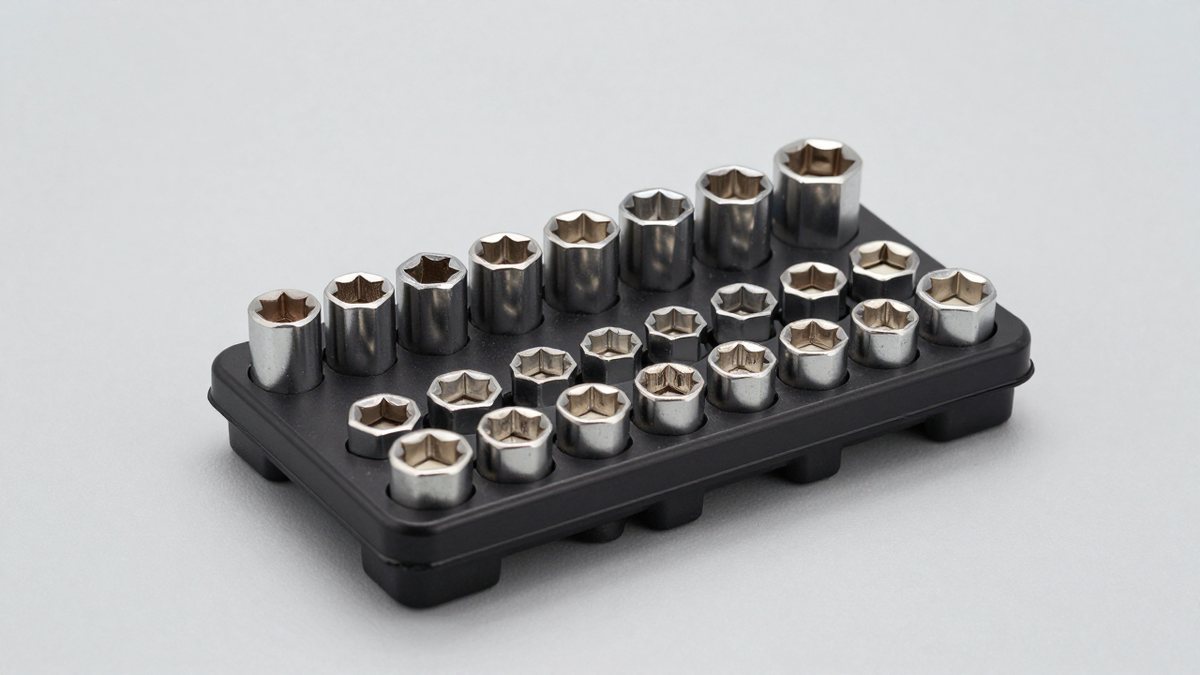
What's inside
- What to prioritize in an automotive socket set
- Best mechanics socket sets by situation
- Recommended types and notable product lines
- Chrome sockets versus impact sockets
- Ratchet, extension, and swivel details that matter
- How much socket coverage do you actually need?
- Durability and storage realities
- Bottom line
- Related Guides
As an Amazon Associate I earn from qualifying purchases. This post may contain affiliate links at no extra cost to you.
The best mechanics socket set for most automotive repairs is a 3/8-inch-drive set with metric and SAE six-point sockets, deep sockets, a durable 72-tooth ratchet, extensions, a universal joint, and room to add a 1/2-inch impact set later.
For occasional maintenance, choose a complete 3/8-inch set from a reputable manufacturer such as TEKTON, GearWrench, or Craftsman. For frequent brake, suspension, and engine work, step up to a set that adds 1/2-inch-drive impact sockets and stronger accessories. Professional technicians may justify premium systems from Snap-on or SK, but the most expensive set is not automatically the best choice for a home garage.
As an Amazon Associate we earn from qualifying purchases at no extra cost to you.



Our Top Picks
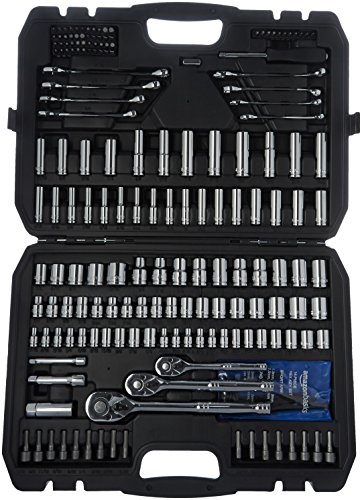 Amazon Basics 201-Piece Mechanic's Socket Tool Set With201 Piece17.7 x 13 x 3.53 inches16.49 poundsCheck on Amazon


What to prioritize in an automotive socket set
- Six-point sockets: They grip the flats of a fastener rather than its corners, reducing rounding on rusted or over-tightened bolts.
- Metric coverage: Modern vehicles are predominantly metric. A useful general-purpose range is 8–19 mm in 3/8-inch drive, with larger sizes in 1/2-inch drive.
- Deep sockets: These reach nuts on long studs, shock absorbers, suspension links, and threaded engine-bay components.
- Impact sockets: Use impact-rated sockets with impact wrenches. Standard chrome sockets are not designed for repeated hammering and can crack or shatter.
- Drive-size versatility: A 1/4-inch drive handles small fasteners, 3/8-inch covers most routine repairs, and 1/2-inch supplies the leverage needed for wheel and suspension work.
- Useful accessories: Extensions, wobble extensions, a universal joint, adapters, and spark-plug sockets often matter more than a large count of rarely used bits.
- Storage: A marked case or drawer-compatible organizer prevents missing sizes and makes it easier to identify a socket left in the engine bay.
Best mechanics socket sets by situation
| Situation | Best configuration | Typical size coverage | Why it fits |
|---|---|---|---|
| Basic home maintenance | 3/8-inch drive, chrome, shallow and deep | 8–19 mm; 5/16–3/4 inch | Compact, affordable, and sufficient for oil-service hardware, clamps, brackets, and many engine repairs |
| Frequent DIY automotive work | 1/4-, 3/8-, and 1/2-inch drives; chrome plus impact | 6–24 mm; 1/4–1 inch | Covers brake, steering, suspension, and general engine work without forcing one ratchet to do everything |
| Wheel and suspension repairs | 1/2-inch-drive impact set with deep sockets | 17–24 mm common wheel sizes; larger sizes available | Handles high torque and works safely with a breaker bar or impact wrench |
| Limited storage | Compact 3/8-inch set with modular trays | 8–19 mm, shallow and deep | Delivers useful coverage without a large blow-molded case or duplicate sizes |
| Professional daily use | Separate complete sets by drive size | 1/4-inch through 1/2-inch, metric and SAE | Reduces tool changes, improves organization, and provides backup ratchets and accessories |
Recommended types and notable product lines
Best value for a home garage: TEKTON or Craftsman chrome sets
TEKTON and Craftsman offer broad chrome socket assortments aimed at general repair rather than one narrow specialty. Look for a package containing both shallow and deep six-point sockets, a 72-tooth ratchet, several extensions, and metric coverage at least through 19 mm. A 72-tooth mechanism needs only about 5 degrees of movement between clicks, which is helpful around exhaust components, firewall brackets, and crowded engine bays.
These sets are normally a better first purchase than a huge assortment dominated by screwdriver bits or duplicate 12-point sockets. General-market chrome sets commonly fall in the approximate $70–$180 range, depending on the number of drive sizes and whether a case or organizer is included.
Best for frequent DIY repairs: GearWrench mixed-drive sets
GearWrench sets often make sense for owners who perform their own brakes, suspension, cooling-system, and drivetrain work. Choose a configuration with 1/4-, 3/8-, and 1/2-inch drives rather than a very large 3/8-inch-only kit. The smaller drive is easier to control on small fasteners, while 1/2-inch tools provide the strength and leverage required for lug nuts and large suspension hardware.
Pay attention to whether the advertised socket count includes bit sockets, adapters, and duplicates. A 200-piece set may have less useful automotive coverage than a 120-piece set with complete shallow and deep ranges. GearWrench sets with mixed drive sizes and impact accessories generally occupy the midrange to upper-midrange market, often about $150–$350 depending on contents.
Best for impact-wrench users: Sunex or Milwaukee impact sets
If an impact wrench is part of your workflow, buy impact sockets separately or choose a set clearly marked for impact use. Sunex is well known for impact socket assortments, while Milwaukee offers impact socket systems designed to pair with its broader cordless tool ecosystem. Black oxide or phosphate finishes are common on impact sockets; the finish is less important than the socket’s impact-rated construction and correct drive size.
A useful starter impact kit includes deep 1/2-inch-drive sockets from roughly 13–24 mm, although the exact range should match your vehicles. Add thin-wall or special wheel sockets only when your wheels require them. Impact socket sets often cost about $80–$250, with larger professional assortments costing more.
Best premium ownership experience: Snap-on or SK
Snap-on and SK target users who value refined ratchet mechanisms, extensive replacement support, and professional tool-truck or distributor service. Their cost is difficult to justify for occasional oil changes, but frequent users may value a ratchet that can be rebuilt or a missing socket that can be replaced individually rather than forcing a complete new set purchase.
Premium sets can cost several hundred dollars and may exceed $1,000 when multiple drive sizes, impact sockets, and specialty tools are included. Buy this tier for daily use, downtime concerns, or a long-term professional toolbox—not simply because the piece count is higher.
Chrome sockets versus impact sockets
Chrome sockets are the right choice for hand tools such as ratchets, torque wrenches, and breaker bars. They are usually slimmer and easier to read. Impact sockets are built with tougher steel and thicker walls to tolerate repeated shock loads. They should be used with impact wrenches and are also suitable for hand use, although their bulk can limit access.
Do not use a chrome adapter to turn a high-torque impact wrench into a different drive size unless the adapter is specifically impact-rated. The adapter, extension, or universal joint can become the weakest part of the assembly. For stubborn fasteners, use the largest suitable drive, penetrating lubricant where appropriate, and controlled leverage rather than repeatedly shocking a damaged socket.
Ratchet, extension, and swivel details that matter
A fine-tooth ratchet is convenient in tight spaces, but tooth count is only one durability factor. A good ratchet should have a positive direction selector, a secure socket release, minimal handle flex, and a mechanism that can be cleaned or serviced. Keep a strong 36-tooth or 72-tooth ratchet for high-load work and reserve ultra-fine mechanisms for confined areas.
Prioritize at least one 3-inch extension and one 6-inch extension in 3/8-inch drive. A 12-inch extension is useful for recessed fasteners but can amplify twisting and make alignment awkward. Wobble extensions provide a small amount of angular movement while retaining better control than a loose universal joint. A universal joint is valuable for offset access, but avoid placing it in an impact setup unless it is impact-rated.
How much socket coverage do you actually need?
Suppose a basic 3/8-inch set covers 8–19 mm, inclusive. That is 12 metric sizes, but automotive sets may omit intermediate sizes or include only shallow versions. If the set has 12 shallow and 12 deep sockets, it supplies 24 useful socket positions before counting accessories. Adding a 1/2-inch impact set from 13–24 mm contributes 12 more positions, including sizes commonly used for wheel and suspension work.
This two-stage approach is often more efficient than buying a 200-piece kit immediately: first purchase the 3/8-inch hand-tool set, then add the impact range when your repairs require it. It also prevents paying for extensive SAE coverage when nearly all of your vehicles use metric fasteners.
Durability and storage realities
Ratchet mechanisms, socket-release buttons, extension detents, and universal-joint pins usually wear before the socket steel does. Clean grease and grit from ratchets with a dry brush and manufacturer-approved cleaner; do not soak a sealed mechanism in solvent unless its service instructions allow it. Wipe chrome sockets after exposure to water, road salt, or brake cleaner, and replace any socket showing cracks, severe distortion, or rounded internal walls.
Store sockets by drive size and type, with shallow and deep versions separated. A drawer tray is faster to use than a deep case when you work at a bench, while a latching case is better for mobile repairs. Keep impact sockets in a clearly labeled section so a chrome socket is not accidentally attached to an impact wrench.
Bottom line
For most people searching for the best socket sets for mechanics, the strongest starting point is a complete 3/8-inch metric-and-SAE chrome set with six-point shallow and deep sockets, a durable fine-tooth ratchet, extensions, and a swivel accessory. Add a 1/2-inch impact set when wheel, suspension, or seized-fastener work becomes routine. Choose by coverage, access, drive size, and replaceability—not by the largest piece count printed on the box.