What's inside
- What “110V” Actually Limits You To
- Miller’s 120V-Compatible Lineup Compared
- Millermatic 141: The Dedicated Home-Garage MIG
- Millermatic 211: MIG With a 240V Head Start
- Multimatic 215: One Machine, Four Processes
- Which One Fits Your Situation
- Understanding Duty Cycle Before You Buy
- Ownership Costs Beyond the Machine
- FAQ
- Bottom Line
- Related Guides
As an Amazon Associate I earn from qualifying purchases. This post may contain affiliate links at no extra cost to you.
If you need a welder that runs on a standard 110–120V household outlet, Miller’s lineup is led by the Millermatic 141 (MIG-only), the Multimatic 215 (multiprocess), and the dual-voltage Millermatic 211 — and the right pick depends on how thick you’ll weld and whether you need TIG and stick capability too.
As an Amazon Associate we earn from qualifying purchases at no extra cost to you.



Our Top Picks


What “110V” Actually Limits You To
A 110 miller welder — more precisely, a 120V-input welder — is bounded by the circuit behind the receptacle, not just the machine. Most U.S. household outlets are 15A or 20A at 120V, which caps input power around 1,800–2,400W. That translates to roughly 90–140A of usable welding output. Practically, that means:
- Solid wire MIG on steel: comfortable up to about 3/16″ (4.8mm) in a single pass; 1/4″ possible with beveling and multiple passes.
- Flux-cored wire: slightly deeper penetration per amp, so 1/4″ mild steel is realistic on a 20A circuit.
- Aluminum MIG: possible only with a spool gun and only on thinner stock (roughly 14–18 gauge) at these output levels.
Before buying, check your breaker rating and wire gauge. A dedicated 20A, 120V circuit with 12-gauge wire is the baseline for getting full output from any machine on this list. Long or undersized extension cords are the most common cause of weak, sputtering arcs — if you must use one, keep it under 25 feet and 12-gauge or heavier.
Miller’s 120V-Compatible Lineup Compared
| Model | Process | Input | Rated Output (120V) | Duty Cycle @ 120V | Max Steel Thickness | Weight |
|---|---|---|---|---|---|---|
| Millermatic 141 | MIG / flux-cored | 120V only | 140A max; 90A rated | 20% @ 90A | 3/16″ single pass | 51 lb |
| Millermatic 211 | MIG / flux-cored | 120V / 240V dual | 110A @ 120V (230A @ 240V) | 20% @ 110A (120V) | 3/16″–1/4″ on 120V; 3/8″ on 240V | 38 lb |
| Multimatic 215 | MIG / TIG / stick / flux-cored | 120V / 240V dual | ~110A MIG @ 120V | 20% @ 105A (120V) | 3/16″–1/4″ on 120V | 38 lb |
Two things stand out. First, the 211 and 215 are dual-voltage machines, meaning they grow with you — plug into 120V today, a 240V circuit later, and roughly double your output. Second, the 141 is the only true single-voltage machine here; it’s also the cheapest entry point, but it has no upgrade path.
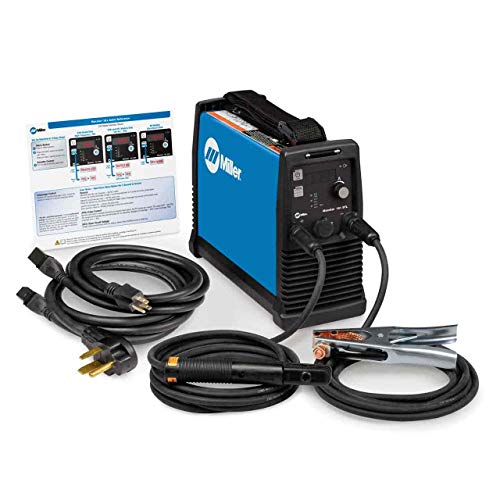
Millermatic 141: The Dedicated Home-Garage MIG
The 141 is Miller’s simplest answer to the 110V question. It uses Auto-Set — you dial in wire diameter and material thickness and the machine sets voltage and wire feed speed for you. Infinite voltage control is available for users who want manual fine-tuning. It welds 24-gauge up to 3/16″ steel in a single pass and accepts 4″ and 8″ wire spools.
Its limits are real: 120V-only input, no TIG or stick, no spool-gun aluminum support out of the box. But for a hobbyist doing auto-body patches, gates, brackets, and mower-deck repairs on a standard circuit, nothing in the line is simpler.
Millermatic 211: MIG With a 240V Head Start
The 211 is the same class of machine with a bigger ceiling. On 120V it behaves like a slightly stronger 141; on 240V it pushes 230A and handles 3/8″ steel. It’s notably lighter (38 lb), uses Miller’s MVP plug so swapping between input voltages takes seconds, and supports the Spoolmate spool gun for aluminum. If there’s any chance you’ll add a 240V circuit in the next few years, the modest price premium over the 141 is usually worth it.
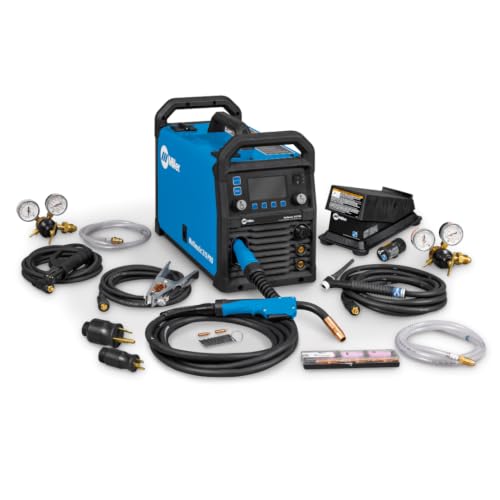
Multimatic 215: One Machine, Four Processes
The 215 adds lift-arc DC TIG and stick welding to the MIG package. For a small shop that occasionally needs to repair a cast-iron table leg (stick) or weld a stainless exhaust flange (TIG), it replaces two machines. The trade-offs: it costs meaningfully more than the 141, DC TIG means no AC aluminum TIG (aluminum still requires the spool gun via MIG), and the TIG torch and gas setup are typically purchased separately.
Which One Fits Your Situation
| Your situation | Best pick | Why |
|---|---|---|
| Only 120V outlets, tightest budget, MIG only | Millermatic 141 | Cheapest Miller entry; Auto-Set removes the learning curve |
| May wire a 240V outlet later | Millermatic 211 | Dual voltage; output nearly doubles on 240V |
| Need TIG or stick occasionally | Multimatic 215 | Four processes, one chassis |
| Portability matters (farm, site work) | 211 or 215 | 38 lb vs. 51 lb; runs on suitable generators |
| Regular aluminum work | 211 or 215 + spool gun | 141 lacks spool-gun support; 215 can’t AC-TIG aluminum |
Understanding Duty Cycle Before You Buy
Duty cycle is stated over a 10-minute window. The 141’s 20% @ 90A rating means 2 minutes of arc-on time followed by 8 minutes of cooling. On thin material (under 1/8″), you rarely arc continuously that long, so the limit is invisible in practice. But if your project is continuous 1/4″ flux-cored welds — a trailer frame, say — you’ll hit thermal shutdown regularly, and a 240V machine is the better answer. A useful rule: if you’ll weld more than about 60 linear feet of 3/16″ bead per hour, step up a class.
Ownership Costs Beyond the Machine
- Consumables: contact tips, nozzles, and liner — budget roughly $30–60/year for hobby use. The liner wears fastest if you swap between steel and flux-cored wire sizes.
- Gas: solid-wire MIG needs a C25 (75/25 argon/CO₂) cylinder; renting an 80 cu ft bottle runs roughly $50–80 per refill. Flux-cored wire eliminates the gas but costs more per pound and produces more spatter and slag cleanup.
- The 15A trap: many garages only have 15A circuits. At max settings the machine may nuisance-trip the breaker — derate output to ~80% or budget for an electrician to add a 20A circuit.
- Common mistake: running the machine through a shared circuit with a compressor or space heater. Voltage sag under load is a leading cause of cold, poorly fused welds that buyers wrongly blame on the welder.
FAQ
Can a Miller 110 welder run off a generator?
Yes — the 211 and 215 handle generator power well thanks to inverter architecture. Plan on a generator rated at least 5,000–6,000 running watts for full output, and expect to reduce settings on smaller units.
Is 120V enough for auto-body work?
More than enough. Sheet metal (18–22 gauge) uses only 30–60A, well inside any of these machines’ comfortable range. Auto-Set on the 141 is particularly forgiving for thin-panel beginners.
What’s the thickest I can realistically weld on 110V?
Single-pass, fully fused: about 3/16″ steel with MIG and 1/4″ with flux-cored on a healthy 20A circuit. Anything thicker is possible with joint prep and multiple passes, but productivity drops sharply.
Bottom Line
For pure 120V MIG on a budget, the Millermatic 141 is the sensible buy. For flexibility, the Millermatic 211’s dual-voltage headroom makes it the best long-term value in the line. If one machine must do everything — MIG, flux-cored, TIG, and stick — the Multimatic 215 is the only Miller that does it, at a price that still undercuts buying dedicated machines separately.