What's inside
As an Amazon Associate I earn from qualifying purchases. This post may contain affiliate links at no extra cost to you.
The best pneumatic hammer for demolition and heavy rust-busting is a long-stroke (.401 shank) model with 2,500-3,200 BPM and higher impact force, while the best for sheet metal, pin driving, and exhaust work is a short-stroke, high-BPM (3,500-4,500 BPM) model with lower vibration and air consumption to match a small compressor.
As an Amazon Associate we earn from qualifying purchases at no extra cost to you.


Our Top Picks
 Ingersoll Rand 119MAXK 3 1/2" Stroke Long-Barrel Air3-1/2" Stroke9.1 x 2 x 7.2 inches4.5 poundsCheck on Amazon

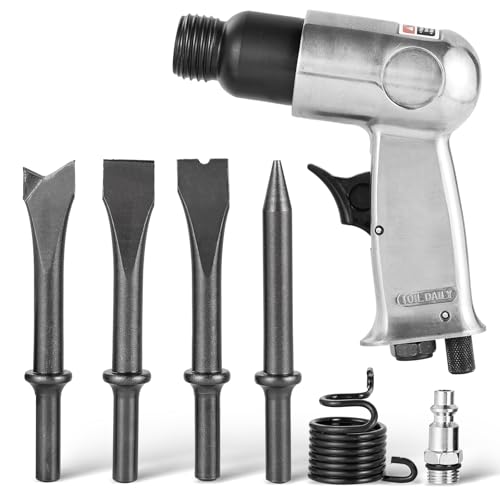
How to Choose a Pneumatic Hammer: 4 Specs That Matter
Most air hammers look identical, but four specifications determine whether the tool will actually run on your compressor and do the job you bought it for. Ignore marketing names like “super duty” and compare these numbers instead.
1. Blows Per Minute (BPM) vs. Stroke Length
BPM and stroke work inversely. A pneumatic hammer does not hit harder because it hits faster.
- Long stroke (2-3/4″ to 4-1/8″): Lower BPM, typically 2,200 to 3,200. Each blow delivers more energy. Ideal for demolition: driving out kingpins, breaking concrete, cutting with a chisel, separating ball joints and tie rods.
- Short / medium stroke (2″ to 2-5/8″): Higher BPM, typically 3,200 to 4,500. Lighter hits but much faster cutting on sheet metal, spot weld breaking, and muffler work. Less likely to distort panels.
- Super-short stroke (3/4″ to 1-1/8″): Very high BPM (4,000+). Used for needle scalers and light riveting, not general demolition.
If you can only own one, a 2-5/8″ stroke at around 3,500 BPM is the most versatile compromise for mixed automotive and metalwork.
2. Air Consumption (CFM) and Compressor Match
Air hammers are rated in CFM at 90 PSI. This is average consumption under load, not idle flow. Two numbers matter: the tool’s average CFM and your compressor’s delivered CFM at 90 PSI, not its displacement or tank size.
Running a 6 CFM hammer on a compressor that delivers 4 CFM at 90 PSI will cause pressure drop, weak blows, and constant waiting for the tank to recover. For continuous use, your compressor should deliver at least 1.3x the tool’s average CFM.
3. Shank Compatibility: .401 vs .498
This is the most common buying mistake.
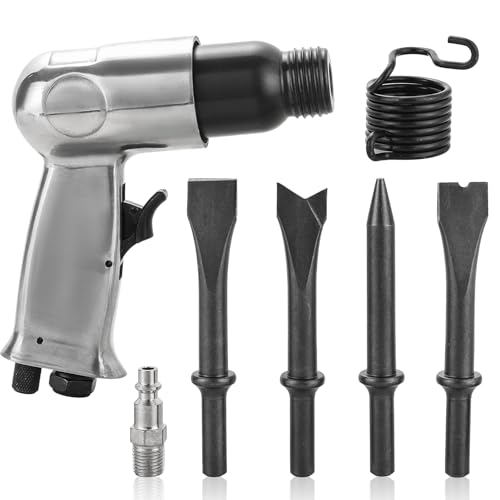
- .401 Parker Taper (standard): The universal standard for automotive and light demolition. Widest choice of chisels, cutters, and punch sets. All general-purpose hammers below use this shank.
- .498 Parabolic / heavy-duty: Found on long-barrel rivet hammers and heavy demolition hammers (like Chicago Pneumatic CP9361 or Ingersoll Rand 122MAX series heavy versions). Chisels are larger, more expensive, and not interchangeable with .401. Do not buy a .498 hammer unless you specifically need rivet-bucking or heavy concrete breaking power.
- Quick-change retainer vs. spring retainer: Quick-change (twist-lock) is faster and holds the chisel more securely under vibration. Spring retainers are cheaper but stretch and need frequent replacement.
4. Vibration and Weight
Pneumatic hammers transmit severe hand-arm vibration. Models with built-in vibration damping, composite housings, and anti-vibration retainers reduce fatigue significantly during overhead or extended use. Weight also matters: a 3.5 lb short-barrel hammer is easier to control on sheet metal than a 5.5 lb long-barrel hammer, but the heavier tool will do demolition work with less operator pressure.
Pneumatic Hammer Comparison: Concrete Specs
These are representative current-production models in 2026 that illustrate the main categories. All are .401 shank unless noted, rated at 90 PSI.
| Model | Stroke | BPM | Avg. Air Consumption | Weight | Shank / Retainer |
|---|---|---|---|---|---|
| Ingersoll Rand 114GQC | 2-5/8″ (67mm) | 3,500 | 4.2 CFM | 3.4 lbs (1.54 kg) | .401 / Quick-change |
| Chicago Pneumatic CP714 | 2-3/4″ (70mm) | 2,100 | 6.5 CFM | 4.6 lbs (2.1 kg) | .401 / Spring + Quick-change options |
| Astro Pneumatic 49803 | 3-1/2″ (89mm) Long Stroke | 2,200 | 6.0 CFM | 5.1 lbs (2.3 kg) | .401 / Spring retainer |
| Snap-on PH3050A | 2-7/8″ (73mm) | 3,000 | 4.0 CFM | 4.1 lbs (1.86 kg) | .401 / Quick-change with anti-vibration |
| Ingersoll Rand 123MAXK | 3-1/2″ (89mm) | 3,600 | 4.8 CFM | 4.0 lbs (1.8 kg) | .401 / Quick-change, composite damping |
Takeaway: BPM alone is misleading. The CP714 and Astro 49803 hit far harder per blow than the 114GQC despite lower BPM because of their long stroke. The 123MAXK is notable for combining a long stroke with high BPM and relatively low air consumption due to its tuned valving.
Will Your Compressor Run It? A Worked Calculation
Use this before you buy. Check your compressor’s plate for “Delivered CFM at 90 PSI” or “SCFM at 90 PSI.” Do not use tank gallons or HP.
Example: You have a 20-gallon portable compressor rated at 5.1 SCFM at 90 PSI with a 50% duty cycle. You want to run a Chicago Pneumatic CP714 (6.5 CFM avg).
- Required CFM with buffer: 6.5 CFM x 1.3 = 8.45 CFM needed for continuous work. Your compressor delivers 5.1 CFM, so it is undersized for continuous demolition.
- Effective CFM with duty cycle: Many direct-drive portable compressors are rated for 50-60% duty cycle, meaning they need to rest 40-50% of the time to avoid overheating. Effective continuous output is roughly 5.1 x 0.50 = 2.55 CFM. The hammer will cycle 15-20 seconds on, then you will wait 30-40 seconds for pressure to rebuild from 90 PSI back to 120-135 PSI cut-out.
- What will work: An Ingersoll Rand 114GQC (4.2 CFM) needs 4.2 x 1.3 = 5.46 CFM. Your 5.1 CFM compressor is borderline but usable for intermittent automotive work (short bursts on exhaust bolts, panel cutting), especially if you add a 3/8″ hose and keep hose length under 25 feet to reduce pressure drop.
Rule of thumb: For a 4-6 CFM hammer doing real demolition, you want at least a 30-gallon, 2-stage or high-output single-stage compressor delivering 7+ CFM at 90 PSI. For light sheet metal work with a 3.5-4.5 CFM hammer, a 20-gallon unit delivering 5+ CFM at 90 PSI is adequate.
Which Pneumatic Hammer to Buy: Decision Matrix
Match your situation to the right category, not just a brand.
| Your Situation | Best Category | Why | Example Type |
|---|---|---|---|
| Home garage, 20-gal compressor, exhaust / brake / light rust work | Short-stroke, low-CFM composite | Runs on small compressor, less vibration, good control | Ingersoll Rand 114GQC class (3,500 BPM, ~4.2 CFM) |
| Mixed auto restoration, panel cutting, occasional front-end work | Medium-stroke, anti-vibration, quick-change | Versatile; handles chisel and panel cutter without panel warping | Snap-on PH3050A or Ingersoll Rand 123MAXK class |
| Professional demolition, kingpins, concrete, heavy chiseling daily | Long-stroke, heavy-duty | Maximum energy per blow; does not stall on loaded chisels | Chicago Pneumatic CP714 / Astro 49803 class (6+ CFM) |
| Aircraft / rivet work, or you already own .498 tooling | Rivet hammer .498 shank | Designed for controlled bucking, not demolition | Chicago Pneumatic CP9361 / Ingersoll Rand 122MAX .498 class |
| Limited budget, infrequent use | Standard .401 spring-retainer hammer | Lowest cost, widest chisel availability; accept higher vibration | General .401 short-barrel economy type |
Durability and Ownership Realities
Pneumatic hammers are simple but wear in predictable places. A product listing will not tell you this.
- What wears first: The retainer spring, the chisel bushing, and the valve. A stretched spring lets the chisel wobble and kills energy transfer. A worn bushing causes side-play and air bypass. If the hammer loses power but still cycles, the valve or O-rings are likely dry or scored.
- Consumables to stock: Pack of .401 retainer springs, extra chisel bushing, and a set of chisels in the correct shank. Cheap chisels mushroom quickly and jam in the retainer. Look for heat-treated, black-oxide chisels with proper taper.
- Daily maintenance that actually extends life: Add 4-6 drops of air tool oil into the air inlet before each use and again after 2 hours of continuous use. Run the tool for 3 seconds to distribute oil. Drain your compressor tank and install an in-line water separator. Water is the main killer of the internal cylinder and valve.
- Common mistakes: Running without oil, using a 1/4″ hose on a 6 CFM hammer (starves the tool; use 3/8″ ID hose), firing the hammer without a chisel loaded or without load against a surface (this hammers the retainer and internal piston), and using .498 chisels in a .401 hammer with an adapter which reduces impact energy.
- Noise and safety: All air hammers exceed 100 dB. Use hearing protection and impact-rated eye protection. Chisel fragments and scale are the most common injury. Secure the workpiece; a long-stroke hammer can launch a seized chisel if the retainer is worn.
Setup Checklist Before First Use
- Verify shank size of your existing chisels matches the hammer you order.
- Install a 3/8″ ID air hose, 25 feet or shorter if possible, with a high-flow coupler. Avoid restrictive 1/4″ Milton M-style couplers on high-CFM models.
- Set regulator to 90 PSI at the tool with the trigger pulled, not just at the compressor gauge.
- Oil the inlet, insert chisel fully, secure retainer, and test on scrap before working on the vehicle or workpiece.
Frequently Asked Questions
Can I use a pneumatic hammer as an air chisel and vice versa?
Yes. “Air hammer” and “air chisel” describe the same tool category. The difference is the accessory: a flat chisel, cape chisel, punch, or hammer head. All .401 hammers accept the same accessories within that shank size.
What size air hose do I need?
For hammers drawing under 4.5 CFM, a 1/4″ ID hose can work for short runs. For 4.5 CFM and above or hose runs over 25 feet, use a 3/8″ ID hose to prevent pressure drop of 10-20 PSI that robs power.
Are quick-change retainers worth it?
For anyone changing chisels frequently, yes. They lock faster, reduce chisel wobble, and lower vibration transfer to the housing compared to wire spring retainers. Springs are inexpensive but should be replaced as soon as they stretch or deform.