
What's inside
As an Amazon Associate I earn from qualifying purchases. This post may contain affiliate links at no extra cost to you.
The best classical guitar strings depend on the instrument’s scale length and your preferred response: choose normal tension for most guitars, hard tension for a long-scale or overly soft instrument, and high tension only when you need a firmer attack; select nylon trebles for warmth or fluorocarbon trebles for extra clarity and projection.
As an Amazon Associate we earn from qualifying purchases at no extra cost to you.




Our Top Picks
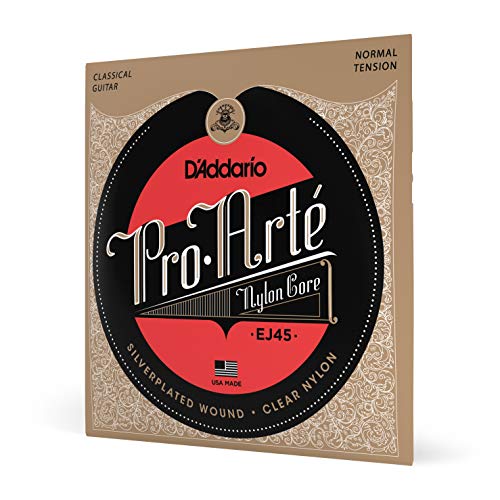 D'Addario Pro-Arte Nylon Classical Guitar StringsNormal Tension6 x 14 x 10 inches0 poundsCheck on Amazon

Quick picks by playing situation
| Situation | Best starting choice | Why it fits | Typical full-set tension |
|---|---|---|---|
| Most classical guitars, mixed repertoire | Normal-tension nylon set | Balanced resistance, comfortable left hand, broad tone | Approximately 35–42 lb (16–19 kg) |
| Short scale, low action, or a soft-sounding guitar | Hard-tension nylon set | Restores definition and reduces an excessively loose feel | Approximately 40–48 lb (18–22 kg) |
| Long scale or a very responsive, bright guitar | Normal or light-tension set | Avoids an overly stiff attack and excessive brightness | Approximately 35–42 lb (16–19 kg) |
| Strong attack, rasgueado, or amplified performance | Hard or high-tension set | More resistance under the right hand and stronger fundamental | Approximately 42–52 lb (19–24 kg) |
| Need treble clarity and projection | Fluorocarbon-treble set | Brighter articulation and quick response | Depends on the manufacturer and bass set |
These are useful comparison ranges rather than universal standards. Manufacturers measure tension differently, and a set labelled “high” by one company may overlap a “hard” set from another. Compare the manufacturer’s individual-string tension charts when available.
Normal, hard, and high tension compared
Normal tension: the safest default
Normal-tension strings are the best classical guitar strings for most players starting with an unfamiliar instrument. They bend slightly under the fingers, speak easily at a quiet volume, and usually provide a balanced compromise between warmth and projection. They are also a sensible choice for vintage or lightly built guitars because they place less continuous load on the bridge and top than stiffer sets.
On a typical 650 mm (25.6-inch) scale, a normal set may feel neither loose nor forceful. It is often the most forgiving option for beginners, fingerstyle players, and musicians who use frequent vibrato. If the notes sound unfocused, do not assume higher tension is automatically the answer: worn strings, excessive relief, poor right-hand contact, or an unsuitable saddle height can produce similar symptoms.
Hard tension: more resistance and definition
Hard-tension strings give the left hand a firmer surface and can make fast passages feel more controlled. The tone often has a stronger initial attack and a slightly denser fundamental, while the guitar may produce more headroom before the sound becomes harsh. They can suit a guitar with a loose-feeling top, a low-tension short-scale design, or a player with a powerful right hand.
The trade-off is physical effort. Chords may require more pressure, bends become less yielding, and a setup with high action can become tiring quickly. Hard tension is not a repair for fret buzz caused by poor setup. It may reduce buzz in some cases, but it can also increase stress on an older instrument.
High tension: a specialist choice
High-tension sets are intended for players who specifically want maximum resistance, a forceful attack, or a particular concert sound. They can work well on a structurally sound guitar with a long scale and appropriate setup. They are less suitable as a blind upgrade, especially on a lightly built, older, or unknown instrument.
Before fitting high tension, check the bridge, top, neck angle, and action. A lifting bridge, a bulging top, or a neck that already needs correction is a reason to consult a qualified guitar repairer rather than experimenting with stiffer strings.
Nylon versus fluorocarbon trebles
Traditional nylon trebles usually sound rounder and less incisive. They are often comfortable under the fingers and can complement a bright guitar by adding warmth. Their diameter is relatively large for a given pitch, which some players find makes the string feel stable during vibrato.
Fluorocarbon trebles are denser than nylon, so they can achieve the same pitch with a smaller diameter. The result is commonly a quicker, clearer response with strong upper partials. Players who need separation in fast polyphonic passages or projection in an ensemble often prefer them. On an already bright guitar, however, fluorocarbon may emphasize edge or make the tone less forgiving.
Fluorocarbon does not automatically mean higher tension. Tension is determined by density, diameter, pitch, and scale length. A fluorocarbon set can be labelled normal, hard, or extra hard, so read the full specification rather than judging by the material alone.
| Treble material | Typical feel | Tone tendency | Best match | Common compromise |
|---|---|---|---|---|
| Nylon | Softer, broader contact area | Warm, rounded, singing | Bright guitars, traditional repertoire, comfort | Less immediate definition |
| Fluorocarbon | Firm, slim, quick response | Clear, focused, projecting | Dense arrangements, ensemble playing, dull guitars | Can sound sharp on a bright instrument |
Match tension to scale length
Scale length is the vibrating distance from the nut to the saddle. A longer scale raises tension at the same pitch and string diameter; a shorter scale lowers it. For a practical comparison, tension varies approximately with the square of scale length when the other variables remain constant.
Suppose a string set produces 40 lb of total tension on a 650 mm scale. On a 630 mm scale, an approximate calculation is:
40 × (630 ÷ 650)2 = about 37.6 lb.
That 2 cm difference reduces the calculated tension by roughly 6 percent. The shorter guitar may therefore benefit from hard tension if the normal set feels floppy, while the same hard set on a 650 mm instrument may feel unnecessarily stiff. This is an approximation because gauges, materials, and actual scale measurements vary, but it explains why the same packet can feel different on two guitars.
Measure from the nut to the centre of the saddle, not merely from the published body description. Common full-size classical scales are around 650 mm, while compact instruments may be 630 mm or shorter. A 660 mm long-scale guitar will add resistance compared with a 650 mm model, making normal tension a sensible first trial.
Recommended string types and established product families
For a conventional nylon starting point, D’Addario Pro-Arté EJ45 is a widely available normal-tension example, while EJ46 represents a hard-tension option. Augustine Classic sets offer another traditional nylon reference, with different tension grades for players who want to compare feel within one product family.
Savarez 540R sets are useful when you want traditional nylon trebles paired with wound basses, while Savarez Alliance sets are known for fluorocarbon trebles. Hannabach 815 sets provide another established nylon-string range with multiple tension choices. These families are not interchangeable by label alone: compare the exact set, treble material, bass construction, and tension designation.
Prices commonly range from roughly $8 to $20 per set, with premium carbon or specialist combinations sometimes costing more. A more expensive set is not necessarily longer-lasting; it may simply use a different treble material, bass winding, or manufacturing tolerance.
How to choose and install a set without guessing
- Record the guitar’s scale length and current setup. Note action, fret buzz, and whether the existing set feels loose or stiff.
- Keep one variable consistent. If changing from normal to hard tension, stay with a similar material first. This makes the tonal difference easier to identify.
- Change all six strings together. Mixing old basses with new trebles can make a set seem unbalanced and makes comparison unreliable.
- Stretch and retune gradually. Nylon settles over several days. Tune gently to pitch, stretch each string lightly along its length, and repeat rather than pulling aggressively.
- Recheck after settling. Inspect the bridge and top, listen for new buzzing, and reassess action. Give the strings several playing sessions before deciding.
Never judge longevity only by whether a string breaks. Nylon trebles may lose brightness and tuning stability first, while wound basses can develop rough winding, discoloration, or a dull response. Replace the set when intonation becomes unreliable, notes lose separation, or tuning requires constant correction. Wipe strings with a dry, soft cloth after playing, wash and dry your hands first, and keep the guitar away from severe heat or humidity swings.
Final buying decision
Choose normal nylon tension for the broadest compatibility and the lowest-risk first purchase. Choose hard tension when a short-scale or soft-feeling guitar lacks definition, or when your playing requires more resistance. Reserve high tension for a suitable, well-maintained instrument and a deliberate tonal goal. Within any tension category, choose nylon trebles for warmth and fluorocarbon trebles for speed, clarity, and projection. The best classical guitar strings are therefore the set that balances material, tension, and scale length rather than the one with the most extreme label.