What's inside
As an Amazon Associate I earn from qualifying purchases. This post may contain affiliate links at no extra cost to you.
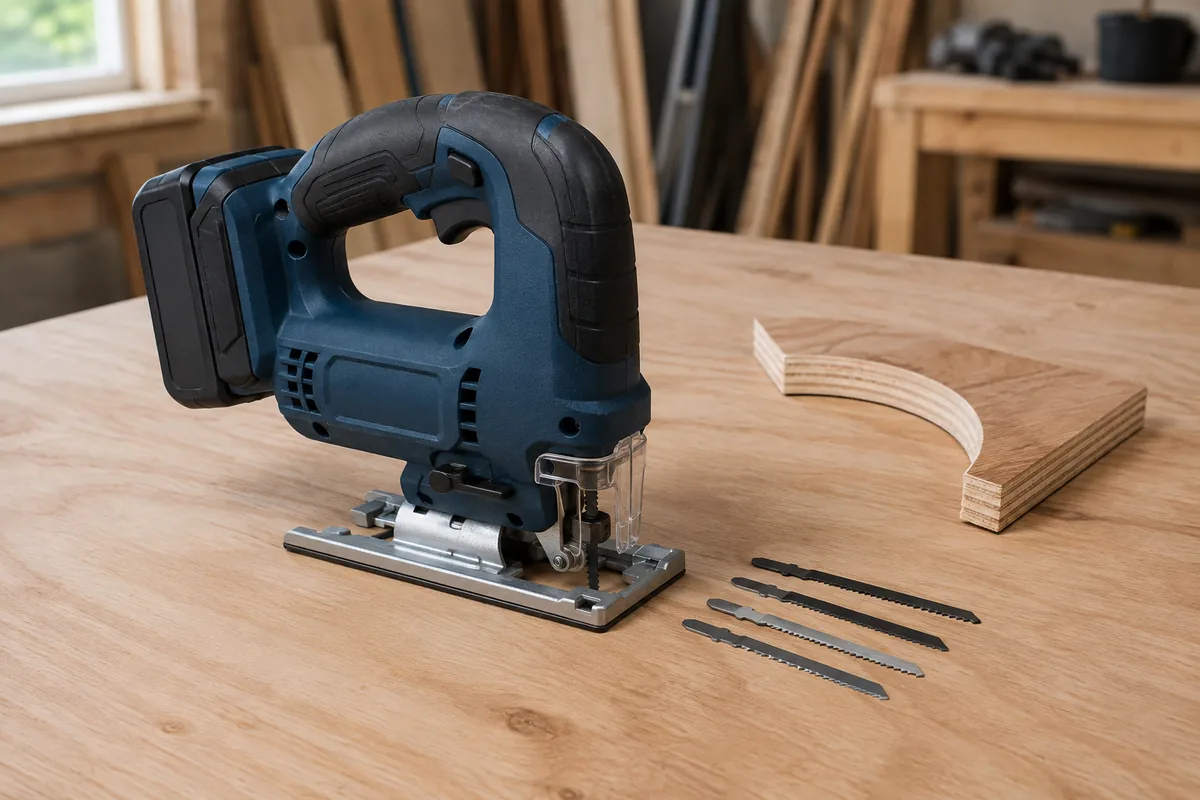
For tight curves in hardwood, a jigsaw is usually the easier tool to buy and use, while a bandsaw produces cleaner, more controlled work when the curve is large enough to fit its blade path. Neither tool is automatically better. The deciding factors are the curve’s radius, the stock thickness, the required finish, and whether you need to follow a line accurately or remove waste quickly.
As an Amazon Associate we earn from qualifying purchases at no extra cost to you.


Our Top Picks
 BOSCH T503 3-Piece Hardwood/Laminate Flooring T-Shank Jig Saw1 Units0.3 x 2.1 x 6.65 inches0.04 poundsCheck on Amazon
 Jig Saw Corded: DEKOPRO Electric Jigsaw Tool Power9.25 x 3.54 x 11.2 inches4.9 PoundsCheck on Amazon


The quick answer
Choose a jigsaw for tight inside curves, occasional projects, thin hardwood, and work that must start from a drilled hole. Choose a bandsaw for repeated curved parts, thicker boards, smoother cuts, and curves that can enter from the edge of the workpiece.
For a one-off chair brace, guitar-shaped panel, sign, or template, a good corded jigsaw with hardwood blades is often the sensible purchase. If you regularly make furniture parts or cut curves in stock 1 inch thick or more, a woodworking bandsaw offers better control and less finishing work.
Jigsaw vs. bandsaw at a glance
| Factor | Jigsaw | Bandsaw |
|---|---|---|
| Tightest curves | Excellent, especially with a narrow blade | Good, but limited by blade width and entry direction |
| Thick hardwood | Practical up to roughly 1-1/2 inches, depending on the saw and blade | Better for 2-inch-plus stock and repeated cuts |
| Cut quality | More wandering, splintering, and blade deflection | Usually straighter and smoother |
| Inside cutouts | Easy after drilling an entry hole | Requires blade removal and re-welding, or a different cutting method |
| Learning curve | Low, though accurate cutting takes practice | Higher; setup, tracking, tension, and drift matter |
| Typical cost | Lower | Higher, plus space and dust collection needs |
Where the jigsaw wins
A jigsaw’s narrow reciprocating blade can turn within a small radius, making it the better choice for genuinely tight curves. A 1/4-inch blade may handle curves around a radius of roughly 1/2 inch, while a wider 3/8-inch blade needs more room. These figures are working estimates, not guarantees: hardwood species, blade tooth pattern, cutting speed, and the thickness of the board all change the result.
The jigsaw also handles enclosed shapes. Drill a starter hole larger than the blade at each inside corner, insert the blade, and cut outward to the line. That is much more convenient than a bandsaw, whose continuous blade cannot simply be inserted into the middle of a panel.
For hardwood, use a sharp blade with relatively fine teeth. A 10- to 14-teeth-per-inch blade is a useful general range for stock around 3/4 inch thick. Finer blades reduce chipped edges but cut more slowly and can clog in dense wood. Coarse blades clear sawdust better but make rougher cuts and are more likely to grab on a tight turn.
Jigsaws have two important failure modes. First, the blade can deflect away from the line, particularly in thick stock or when the operator pushes too hard. Second, orbital action improves speed but makes the cut more aggressive and rougher. Turn orbital action down or off for tight curves and visible edges. Keep the shoe flat on the work, feed slowly, and let the teeth cut rather than forcing the tool around the bend.
Where the bandsaw wins
A bandsaw cuts with a continuous blade supported above and below the work. That support makes it substantially more stable in thick hardwood. It also creates less up-and-down vibration at the cut, so the edge is commonly cleaner and easier to sand.
Blade width determines how tightly a bandsaw can turn. As a practical guide, a 1/4-inch blade can follow curves around a 3/8- to 1/2-inch radius, a 3/8-inch blade suits moderate curves, and a 1/2-inch blade is better for straight cuts or broad arcs. The manufacturer’s stated minimum radius is the safer reference, because tooth set and blade thickness vary.
The bandsaw’s advantage becomes clearer with thick material. Cutting a curved leg from 2-inch maple is possible with a jigsaw, but blade deflection can leave a tapered or wavy edge. A correctly tensioned bandsaw with a sharp blade tracks more predictably. It also wastes less material than making a series of relief cuts with a jigsaw.
However, a bandsaw is not automatically precise. A dull blade, poor tension, dirty tires, or incorrect guide adjustment can cause drift. Drift makes the blade pull away from the marked line as the board moves through. Make a test cut in scrap, adjust the fence or use a pivoting technique, and do not assume the fence is parallel to the blade’s natural tracking direction.
How to get cleaner hardwood curves
Use a full-size template or a clearly marked line, and leave about 1/16 inch of waste when the edge will be routed or sanded afterward. Cutting directly on the final line gives you no room to correct a wandering blade.
On a jigsaw, support the board close to the cut without allowing the support to interfere with the shoe. Clamp the work firmly, but avoid clamping so close that the tool cannot turn. For a tight inside corner, drill a hole slightly larger than the blade’s width rather than trying to rotate the tool in place.
On a bandsaw, use relief cuts when approaching a concave section. These short cuts remove waste and prevent the offcut from binding the blade. Stop the relief cuts short of the layout line. If the waste twists and pinches the blade, the cut can burn, stall the saw, or pull the workpiece off the intended path.
Hardwoods such as maple, beech, and walnut reward sharp blades and moderate feed pressure. Burning is usually a sign of a dull blade, excessive rubbing, a blade that is too fine for the stock, or feeding too slowly. If the cut is rough on only one face, check blade deflection and support rather than simply switching to a finer blade.
Which tool should you buy?
Buy the jigsaw if you need one versatile curve-cutting tool, have limited space, or expect to cut plywood, cabinet panels, and occasional hardwood parts. A quality saw and a selection of hardwood jigsaw blades cost far less than a bandsaw, and the cheaper option is completely adequate when the edge will be hidden, routed, or painted.
Buy the bandsaw if you cut curves every week, work with thick hardwood, need multiple matching parts, or want to remove less material during shaping. Budget for blades in different widths, a stable stand, and dust collection. A bandsaw is the better production tool, but it takes more setup and occupies permanent shop space.
For the tightest decorative curves, neither tool may leave a finished edge. Plan to cut slightly outside the line, then use a spindle sander, oscillating spindle attachment, or contour sanding tools to remove the final marks. That workflow is often faster—and more accurate—than demanding a perfect finished curve directly from the saw.