What's inside
As an Amazon Associate I earn from qualifying purchases. This post may contain affiliate links at no extra cost to you.
Rounded fasteners are where locking pliers earn their keep—and where the wrong jaw shape can make the job worse. A curved-jaw pair usually gives the strongest grip on a damaged hex head, while straight-jaw pliers are more useful when you need to grab a flat-sided part, a thin edge, or a fastener in a tight recess. The choice is not simply about which tool clamps harder. It is about how much usable contact the jaws can maintain without slipping or crushing the fastener.
As an Amazon Associate we earn from qualifying purchases at no extra cost to you.



Our Top Picks
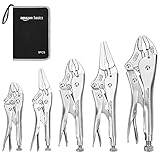
 Amazon Basics 5-Piece CR-V Locking Pliers Set with5-Piece9 x 2.5 x 0.75 inches3.8 PoundsCheck on Amazon


The basic difference
Curved-jaw locking pliers have rounded inner jaws designed to wrap around bolts, nuts, pipe, and other irregular shapes. The contact is concentrated on two or more points around the fastener. That lets the jaws bite as you turn the adjustment screw tighter.
Straight-jaw locking pliers have flatter, more parallel gripping faces. They behave more like a compact clamp or adjustable wrench. They work well on square stock, sheet metal, flat nuts, and fasteners that still have reasonably defined sides. They are also easier to position against a flat surface.
For a badly rounded bolt head, start with curved-jaw locking pliers. For a fastener with only light damage, straight jaws may be adequate and can be less aggressive.
Which jaw grips rounded fasteners better?
Curved jaws normally win because they can contact the fastener below the damaged corners. A rounded bolt head often has no reliable flat faces left, but its lower shoulder or remaining curved sections can still give a curved jaw something to hold. As clamp pressure increases, the jaws tend to seat instead of simply sliding over the top.
Straight jaws depend more heavily on parallel faces. If the bolt has lost its corners, the flat jaw faces may touch only at small areas. Turning force then creates a cam-out effect: the pliers climb upward and release, or they rotate around the fastener while removing more material.
There is a limit to both designs. If the fastener is completely circular, deeply rusted, or too small for the pliers, neither jaw style is a reliable replacement for a bolt extractor socket. Locking pliers are most useful when they can clamp around a substantial portion of the head.
| Feature | Curved jaws | Straight jaws |
|---|---|---|
| Rounded or damaged bolt heads | Best general choice | Works only with usable flat areas |
| Flat nuts and sheet metal | Acceptable, but less precise | Usually better |
| Grip in a recessed area | Often needs more clearance | Usually easier to position |
| Risk of crushing thin parts | Higher if overtightened | Higher on edges and thin sheet |
| General workshop usefulness | Excellent for fasteners and pipe | Better for mixed clamping and flat work |
Size and jaw capacity matter more than many buyers expect
A 10-inch pair is the practical all-rounder for many automotive and household fasteners. It gives more leverage than a 7-inch pair while remaining easier to place than a locking pipe wrench or oversized pliers. A 7-inch tool is useful in cramped spaces, but its shorter handles provide less turning force. A locking plier with a 9- to 10-inch handle can produce enough torque to damage a soft bolt head if you force it.
Check the stated jaw capacity before buying. A tool that opens to 1 3/4 inches may be excellent for large nuts but awkward on a 1/4-inch bolt. Oversized jaws can bottom out against nearby parts before they clamp the fastener. For common automotive work, a pair opening around 1 1/2 to 2 inches covers many jobs, but smaller 5- to 7-inch pliers are easier to control on small hardware.
When buying, look for 10-inch curved-jaw locking pliers with a hardened gripping surface and an adjustment screw that turns smoothly. Avoid choosing solely by the maximum opening. Jaw alignment, handle strength, and the release lever are just as important.
How to grip a rounded fastener without making it worse
First, remove dirt, loose rust, and paint from the fastener. A wire brush or pick can expose the largest usable section. Spray penetrating oil and give it time to work; 10 to 30 minutes is a reasonable starting point, while heavily corroded hardware may need repeated applications.
Set the pliers so the jaws close around the widest part of the head, not on the pointed top. Adjust the screw until the handles require firm hand pressure to lock. You should not need to strike the handles closed. If the tool locks with almost no resistance, it is too loose. If you cannot fully engage the release lever, it is too tight.
Pull in the direction that keeps the jaws seated. A short, controlled pull is safer than jerking the tool. If possible, use a wrench on the locking plier’s body or a length of pipe only after confirming that the jaws are not climbing off the fastener. Excess leverage can shear the fastener or break the plier’s teeth.
For a bolt that will not move, apply moderate heat to the surrounding metal—not directly to a fuel line, bearing seal, painted panel, or flammable residue. A few light taps on the fastener can help break corrosion. If the jaws slip twice, stop and change strategy rather than repeatedly squeezing harder.
When straight jaws are the better buy
Straight-jaw pliers are the better choice when the damaged fastener still has two flat sides. They can sit squarely against those faces and are often easier to use in narrow gaps. They are also more versatile for holding brackets, bending tabs, clamping small workpieces, and gripping flat bar.
They cost no more than curved-jaw versions in many tool lines, so a straight-jaw pair is a sensible first purchase for general repairs. If rounded fasteners are a regular problem, add a curved pair rather than expecting straight jaws to handle every extraction.
A 10-inch straight-jaw locking plier is often enough for light automotive work, furniture repairs, and household clamping. For a small repair kit, pairing it with a curved-jaw tool covers more situations than buying two similar straight-jaw sizes.
When locking pliers are the wrong tool
Do not use locking pliers as a routine substitute for a correctly sized wrench. Their teeth mark the fastener, and excessive pressure can distort nuts, damage plated surfaces, or crush tubing. On a fastener that is still serviceable, a six-point socket is less destructive and usually applies more even torque.
If the head is rounded smooth, recessed, or nearly flush with the surrounding surface, use a bolt extractor socket, a dedicated nut splitter, or a drill-and-extract method. If the fastener is seized and failure would be costly, replacing a cheap pair of pliers with bolt extractor sockets is often the cheaper decision than damaging the surrounding component.
Buying verdict
Choose curved jaws when your main job is removing rounded bolts, nuts, pipe fittings, or irregular metal parts. Choose straight jaws when you need a more controlled grip on flat surfaces and general-purpose clamping. If the budget allows only one pair and damaged fasteners are the priority, buy a 10-inch curved-jaw model. If most fasteners are merely tight rather than damaged, buy straight jaws and preserve them for clamping and light repairs.