Key takeaways
- We compare corded and cordless angle grinders on power, runtime and convenience for cutting, grinding and polishing.
What's inside
As an Amazon Associate I earn from qualifying purchases. This post may contain affiliate links at no extra cost to you.
An angle grinder is one of the most useful — and most abused — tools in any shop. The core choice is corded versus cordless, and each suits a different kind of work. Here’s the side-by-side.
The honest starting point is that this is no longer a power argument. Brushless motors and high-output packs closed most of that gap, and a good cordless grinder will cut angle iron about as fast as a corded one turning the same size wheel. What has not changed is duty cycle: how long the tool can stay under load before something stops it. A corded grinder is limited by your patience and the wheel. A cordless one is limited by watt-hours and heat. Almost every other difference in this angle grinder comparison is downstream of that.
As an Amazon Associate we earn from qualifying purchases at no extra cost to you. Product prices and availability are accurate as of the date shown and are subject to change.




So this stays on things you can verify before you buy — wheel size, switch type, guard design, safety electronics, spindle standard and platform cost — rather than model names, which get replaced constantly while the buying rules stay the same.
Corded: relentless power
For heavy grinding, cutting thick steel, or long sessions, a corded grinder never fades and never needs a battery swap. It’s the choice when the job is big and an outlet is nearby.
The advantage is unlimited watt-hours. When you are grinding welds flat for an hour, cutting a stack of rebar, or wire-wheeling rust off a trailer frame, a corded tool holds a steady speed at a steady cost. Amp rating is the useful shorthand: small 4.5-inch units sit at the bottom of the range, while large-wheel 7- and 9-inch machines pull most of a domestic circuit. More amps means more sustained torque and faster recovery when the wheel starts to bog, which is what you actually feel in the cut.
Corded is also cheap where it counts. There is no battery in the price, so the same money buys a heavier gearcase, better bearings and more motor. It remains the only sensible way to buy a large-wheel grinder, and it is the natural choice for the tool that lives on the bench with a wire wheel fitted.
Cordless: go anywhere
Cordless grinders have caught up impressively. For quick cuts, field work, and anywhere without power, the freedom is worth the slightly shorter runtime.
Think of runtime in cuts, not minutes. A grinder is one of the two or three hungriest tools on any battery platform, so pack capacity matters far more here than it does on a drill. The compact packs that feel pleasant on a driver will feel permanently empty on a grinder; the larger high-output packs are what make the tool credible. Two batteries and a fast charger is the realistic minimum kit, not an upgrade.
Cordless also tends to arrive with better safety electronics, because the platform already has the circuitry for it. Brakes, kickback detection and anti-restart are common on mid and upper cordless grinders and rare on budget corded ones. And the platform matters more than the tool: buy into batteries you already own, or ones you are willing to keep buying for a decade.
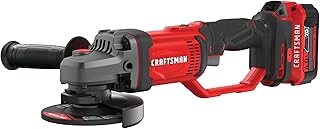
Cordless Angle Grinder
Grab-and-go grinding and cutting with no cord to snag. Modern brushless power handles most cutoff and grinding tasks, and swapping a battery beats hunting for an extension cord in the field.
- ✔ Cordless = total freedom
- ✔ Corded = endless power
- ✔ Both cut, grind & polish
- ✘ Cordless runtime limited
- ✘ Corded tethered to outlet
The Specs That Actually Matter
Most of a grinder spec sheet is noise. These are the parts that change how the tool behaves in your hand.
- Wheel size. 4.5 and 5 inch is the all-rounder. Six inch buys depth of cut; 7 and 9 inch is fabrication territory with much more stored energy and much less forgiveness.
- Switch type. A held paddle switch releases the moment you let go. A slide switch with lock-on suits long grinding runs and stand work. Know which one you are buying before it surprises you.
- Electric brake. Stops the wheel in a second or two instead of letting it coast. Once you have used one, a coasting grinder feels careless.
- Kickback and anti-restart protection. Cuts power when the wheel binds, and stops the tool restarting on its own after a battery swap or power cut.
- Tool-free guard adjustment. A guard you can rotate without hunting for a wrench is a guard that stays fitted.
- Spindle thread. Most consumer grinders use a common thread standard, but confirm it before you buy quick-change nuts, backing pads or flap discs.
- Body diameter and vibration. Grip circumference decides whether you can hold it all day. The side handle should thread into at least two positions for left- and right-hand work.
- Housing quality. Metal gearcase, sealed switch, and cooling air routed away from the electronics — the same durability signals that separate tools in every other category.
What Changes At Each Price Band
Entry tier
At the bottom, corded is honest and cordless usually is not. A basic corded 4.5-inch grinder is crude, loud and brakeless, but it spins the right wheel at the right speed and will free a seized bolt or trim a bracket. The bad entry pick is a cheap cordless kit on a battery family you do not otherwise own — you are paying for a platform you will abandon.
Mid tier
This is where most buyers should shop. Expect a brushless cordless grinder on a mainstream platform, or a corded unit with a heavier gearcase, a proper paddle switch and a tool-free guard. Good picks here spend money on the brake, the guard and the bearings. Weak ones spend it on a bundled case and a stack of thin cutoff wheels.
Professional tier
The top band buys endurance and electronics: better cooling, sealed switchgear, kickback cutoff, vibration-damped handles and larger wheel capacity on corded machines. Worth it if the tool runs daily. If you grind twice a month, that money is better spent on quality abrasives, a face shield and a second battery.
Who Should Skip Each One
Skip cordless if you own none of the platform’s batteries and your work is always within reach of an outlet — you would be paying a real premium for freedom you never use. Skip corded if your grinding happens on ladders, roofs, fence lines and vehicles, where dragging a cord is itself the hazard. And skip large-wheel grinders altogether unless you cut heavy stock; a 4.5-inch tool with the correct wheel covers nearly all home and hobby work.
Common Mistakes And How To Avoid Them
- Wrong wheel for the job. Thin cutoff wheels are for cutting only — grinding on the face of one can shatter it. Check that the wheel’s rated speed meets or exceeds the grinder’s.
- Removing the guard. Rotate it to clear the work instead. The guard is what stands between a failed wheel and your hand.
- Bargain abrasives. The wheel is the only part spinning at full speed next to your face. Buy reputable bonded and flap discs and store them dry and flat.
- Forcing the cut. Leaning on the tool glazes the abrasive, burns the workpiece and overheats the motor. Cordless tools simply shut down instead of warning you.
- Thin PPE. Full face shield rather than glasses, hearing protection, no loose sleeves, and a respirator for masonry dust.
- Undersized extension cord. A long, light-gauge cord starves a corded grinder and cooks it. Use heavy gauge, as short as practical.
Which to choose
Big shop jobs near power: corded. Field work and quick cuts: cordless. Serious fabricators own both. Whatever you pick, respect it — grinders demand full safety gear.
If you can own only one and you are already on a battery platform, buy cordless and pay attention to pack capacity. If you have no platform and the bench is the center of your work, buy corded and put the difference into wheels and protection.
FAQ
Is a cordless angle grinder powerful enough to cut steel?
For the sizes most people cut, yes. On a high-output pack, a brushless cordless grinder handles bar, angle, bolts, mesh and thin plate at a rate close to a corded tool of the same wheel size. The limit is volume — a long run of cuts drains packs fast, so sustained heavy work still favors corded.
Does a bigger battery make the grinder more powerful?
Mostly it makes it last longer, but on many platforms a higher-output pack also delivers more current, so the tool holds speed better under load. That is why the same grinder can feel gutless on a compact battery and strong on a large one.
What size should a first-time buyer get?
A 4.5- or 5-inch model. It cuts, grinds, wire-brushes and, with the right backing pad, sands and polishes. Larger machines are heavier, harder to control and far less useful for general work.
When should a wheel be retired?
Once it is worn past the point where the guard covers it properly, or immediately if it is chipped, cracked, dropped hard or stored damp. Bonded abrasive wheels also carry a date stamp and are not intended to be used indefinitely.