What's inside
As an Amazon Associate I earn from qualifying purchases. This post may contain affiliate links at no extra cost to you.
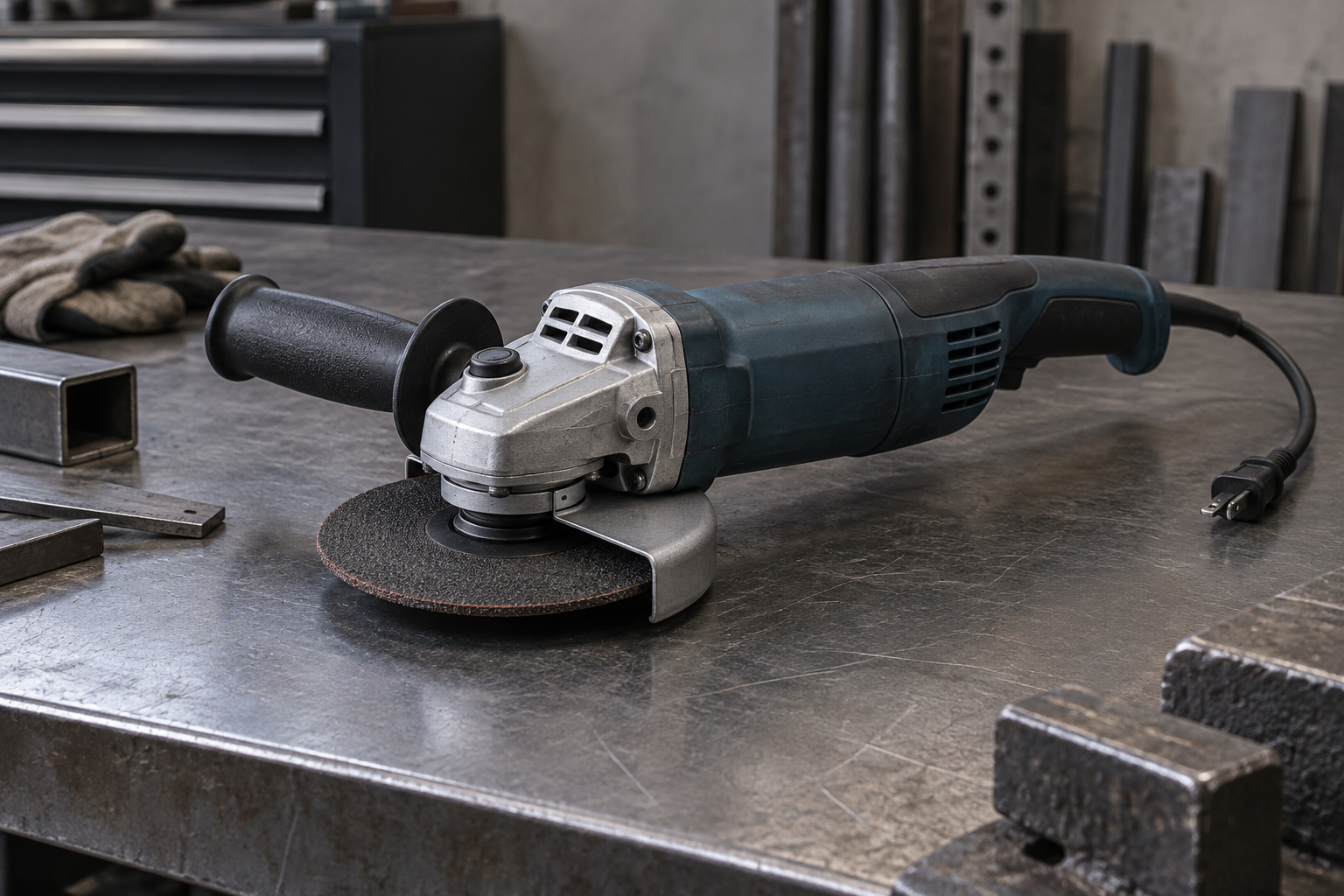
For fabrication work, the Metabo WEV15-125 and DeWalt DWE402 represent two different approaches to a corded angle grinder. The Metabo is a powerful, variable-speed 5-inch grinder built for controlled stock removal and finishing. The DeWalt is a simpler 4-1/2-inch grinder focused on compact size, high speed, and a lower purchase price.
Neither is automatically the better buy. The right choice depends on whether your work is mostly cutting and grinding mild steel, or whether it includes stainless steel, aluminum, surface finishing, flap-disc work, and long sessions where speed control and vibration matter.
As an Amazon Associate we earn from qualifying purchases at no extra cost to you.


Our Top Picks


Specifications at a Glance
| Feature | Metabo WEV15-125 | DeWalt DWE402 |
|---|---|---|
| Wheel size | 5 inches / 125 mm | 4-1/2 inches / 115 mm |
| Motor input | 13.5 amps | 11 amps |
| No-load speed | 2,800–11,000 rpm, variable | 14,000 rpm |
| Electronic controls | Soft start, overload protection, restart protection, speed control, safety clutch | Soft start and overload protection |
| Spindle thread | 5/8-11 | 5/8-11 |
| Primary advantage | Control, capacity, and sustained power | Simple, fast, and generally less expensive |
Specifications can vary slightly by market and package, so check the label and included accessories before ordering. Both grinders use common 5/8-11 accessories, but the Metabo’s 125 mm guard and the DeWalt’s 115 mm guard are not interchangeable.
Power and Cutting Performance
The Metabo has a clear electrical advantage. Its 13.5-amp motor gives it more reserve when you lean into a grinding wheel or use a large flap disc to remove weld metal. That does not mean it cuts steel 23 percent faster in every situation. Wheel type, operator pressure, material thickness, and extension-cord voltage drop often matter more than the amp rating.
Its 5-inch wheel also provides roughly 9 percent more diameter than a 4-1/2-inch wheel. That extra reach is useful when cutting angle iron, plate, tubing, or heavy weldments. It will not turn the grinder into a metal-cutting saw, however. A cutoff wheel is still limited by its depth of cut, and forcing it through thick stock can cause binding or wheel breakage.
The DWE402 uses an 11-amp motor and spins at 14,000 rpm. It is quick with thin-wall tubing, sheet metal, tack welds, and general deburring. For a fabrication shop that mostly trims small parts and cleans weld spatter, its performance is entirely adequate. The motor can bog sooner than the Metabo under heavy grinding pressure, but that is often a technique problem: use the correct wheel and let the abrasive do the work rather than leaning hard on the tool.
Speed Control and Material Compatibility
The Metabo’s variable-speed dial is the most important difference in actual fabrication use. Its lower settings are better for flap-disc finishing, blending welds, working near thin edges, and reducing heat buildup. Lower speed also helps when polishing stainless steel or using wire wheels that can become aggressive at full rpm.
That control does not make it safe to use any accessory at any speed. Every wheel, brush, sanding disc, and polishing attachment has a maximum rpm. The accessory’s rating must meet or exceed the grinder setting. A disc rated for 12,000 rpm should not be run on a tool at 14,000 rpm, which is one reason the DeWalt is less flexible for accessory work.
For ordinary carbon-steel grinding with standard depressed-center wheels, the DeWalt’s fixed high speed is often fine. It removes material quickly and has fewer controls to adjust. It is less suitable for controlled finishing, heat-sensitive material, and operations where a high-speed wheel can gouge the work.
Handling, Safety, and Failure Modes
Both grinders have soft-start behavior, so they do not jerk as violently when switched on as older basic grinders. The Metabo adds a safety clutch that helps limit kickback when the wheel catches. It also has electronic restart protection, which prevents the motor from starting unexpectedly after a power interruption if the switch was left on.
Those features reduce risk but do not compensate for poor technique. A cutoff wheel can bind when the kerf closes, especially in tubing or plate supported on the wrong side. Keep both hands on the grinder, stand out of the wheel’s plane, support the work securely, and use a guard designed for the accessory. Never use a side-grinding technique on a thin cutoff wheel.
The DWE402 is comparatively straightforward. Its low number of electronic features can be an advantage in dirty shop conditions, but it offers less protection when an accessory grabs. Its 4-1/2-inch format is also easier to control in tight corners and overhead work. If you spend hours cutting in awkward positions, the smaller wheel and familiar compact layout may outweigh the Metabo’s extra power.
For either tool, a quality metal cutoff wheel is a better investment than simply buying the cheapest abrasive pack. Cheap wheels can cut slowly, shed abrasive unevenly, or break after being side-loaded. Use eye protection, hearing protection, gloves appropriate to the job, and local dust control when grinding coatings or stainless steel.
Which One Fits Your Shop?
Choose the Metabo WEV15-125 if you regularly grind large welds, work with stainless steel or aluminum, use flap discs for blending, or want one grinder that can cover cutting, grinding, and finishing. It costs more and is generally more complex, but the extra motor capacity, 5-inch wheel, speed control, and electronic protection are useful rather than decorative.
Choose the DeWalt DWE402 if your work is mainly carbon-steel cutting, weld cleanup, rust removal, and occasional fabrication. It is a sensible tool for a home shop, maintenance department, or backup grinder. The fixed 14,000 rpm is limiting for polishing and delicate finishing, but it keeps the tool simple and usually makes it the better value when your accessories are standard high-speed grinding and cutoff wheels.
Before buying, also budget for a set of metal flap discs, spare guards, and a proper extension cord. A long, undersized cord can reduce voltage and make either motor run hot. For a 15-amp-class grinder, use a short 12-gauge cord when possible, especially in a shop where the tool will be loaded continuously.
Verdict for Fabrication
The Metabo WEV15-125 is the stronger fabrication choice because it offers more usable range: more motor reserve, a larger wheel, adjustable speed, and better electronic protection. It earns its higher price when one grinder must handle rough removal and controlled finishing.
The DeWalt DWE402 is the better economical choice for straightforward steel work. If you are cutting tubing and cleaning welds rather than polishing stainless or blending visible surfaces, its limitations are unlikely to slow you down. Buy the Metabo for versatility; buy the DeWalt when simple high-speed grinding is all the job requires.