Key takeaways
- Four honest routes to replace a dead power tool battery, compared on design philosophy, warranty, availability and price behavior, with a verdict for each type of buyer.
What's inside
As an Amazon Associate I earn from qualifying purchases. This post may contain affiliate links at no extra cost to you.
A worn out battery does not kill a good drill, it just parks it. That is why hunting for the best replacement power tool battery is one of the most annoying purchases in the tool world. The tool is fine, the charger is fine, and yet the honest replacement can cost a serious slice of what the original kit cost. Then the marketplace fills with lookalike packs at a third of the price and the decision turns murky.
There are four realistic routes, and each suits a different buyer: a first-party pack from your tool’s own brand, a reputable third-party pack, a rebuild with fresh cells, or the sideways play of buying a bundle and treating the tool as a bonus. The table compares them on what actually varies.
As an Amazon Associate we earn from qualifying purchases at no extra cost to you. Product prices and availability are accurate as of the date shown and are subject to change.


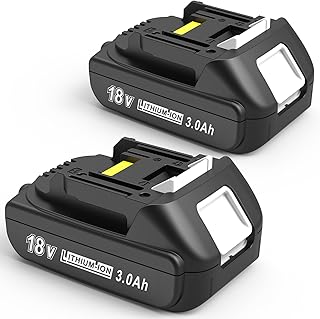


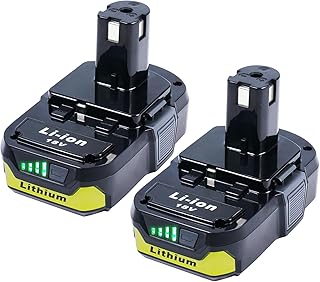


| Route | Design philosophy | Warranty and support | Price behavior |
|---|---|---|---|
| First-party OEM (DeWalt XR, Milwaukee M18, Makita LXT) | Matched cells, brand electronics, full tool communication | Platform warranty and a real returns path | Highest sticker, moves in promo windows |
| Kit or starter pack with charger | Same OEM pack, bundled to sell tools | Same as OEM, tied to the bundle | Usually the lowest cost per amp-hour |
| Reputable third party | Reverse-engineered housing, mid-grade cells, generic board | Seller warranty only, nothing for your tool | Cheaper year round, stock comes and goes |
| Bargain no-name | Cost first, cell grade unknown, gauge approximated | None once the listing vanishes | Cheapest and most volatile |
| Rebuild or cell swap | Your original housing and board, fresh cells | Only as good as the shop doing the work | Mid-range, set by labor and cell count |
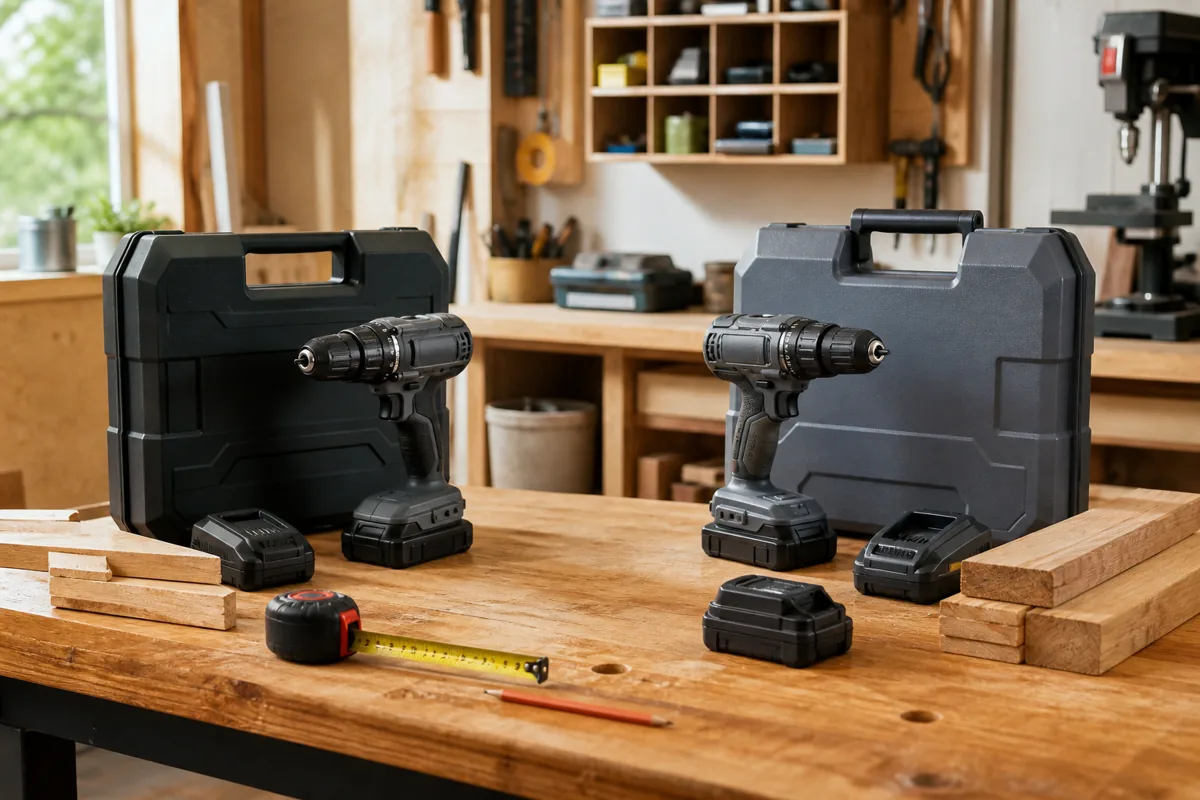
How to choose the best replacement power tool battery for your platform
Start with the platform, not the capacity. Voltage on the label is not compatibility: Makita 18V LXT and 40V XGT are separate systems, DeWalt 20V MAX and FlexVolt share a foot but not a purpose, and Milwaukee M12 and M18 only look like neighbors on the shelf. Check the rail and latch on your dead pack, then confirm your existing charger accepts the new one. A pack you cannot charge is a paperweight.
Amp-hours buy runtime, not power
Capacity is a fuel tank, not an engine. A bigger pack runs longer and sags less under load, but it adds weight and height, which you feel overhead or inside a cabinet. The sane setup is mixed: compact packs on the drill and impact driver, high capacity packs on the circular saw, grinder and vacuum.
High draw changes the answer
Saws, rotary hammers, blowers and mowers pull hard, and that is where cell quality shows itself. Brand high-output lines exist for that reason, and the gap between premium and budget widens the harder you push. If the dead pack lived on a drill you have latitude. If it lived on a 7-1/4 inch saw, spend.
First-party OEM packs for your existing platform
If the tool is still under warranty or earns its keep, this is the low-drama choice. Swap the brand term in the search for your own platform and buy from Amazon-shipped or authorized listings.
What an OEM pack actually buys you
You are paying for three things no listing photo shows: cell selection, the protection and communication electronics in the housing, and recourse when something fails. Modern platforms have the tool, pack and charger negotiating temperature and current limits. Aftermarket boards approximate that conversation, which is fine on a flashlight and less fine on a tool that briefly demands enormous current.
One warning specific to the US marketplace: counterfeit packs in brand livery are common. Buy from listings shipped and sold by Amazon or the brand’s authorized storefront, treat any OEM-branded high-capacity pack priced far under the going rate as suspect, and keep the packaging until you have charged and used it.
Third-party packs: where they hold up and where they bite
Third-party is not a scam category, it is a value category with a wide spread of outcomes. The good ones use recognizable cells, seat without shimming, and report state of charge closely enough to trust. The bad ones fit loose, overstate capacity, run hot and trip cutoffs early. Listings rotate constantly and the factory behind a name can change between production runs, which is why naming specific sellers ages badly.
- ✔ Half or less the cost of OEM, so spares fit the budget
- ✔ Keeps discontinued platforms working
- ✔ Fine for lights, radios, inflators and light drilling
- ✔ Often in stock when OEM packs are not
- ✘ Cell grade can change between production runs
- ✘ Fuel gauges and low-voltage cutoffs are often approximate
- ✘ No recourse if a failure damages the tool
- ✘ Heat and sag under high load, worse in cold
Best fit: keeping a discontinued platform alive, or adding spares for a light, radio or inflator. Worst fit: the daily pack on a high-draw tool that is still under warranty.
High-output packs for saws, grinders and rotary hammers
High-output packs cost more and weigh more, and they are the honest answer for saws, grinders and rotary hammers. On a compact drill they are overkill.
The kit math: sometimes a new tool is the cheapest battery
Brands subsidize batteries to sell platforms, so starter packs and combo kits are often cheaper per amp-hour than a bare battery. A two-pack with a charger, or a kit built around a drill you do not strictly need, can land under the price of two loose packs during a sale. The US promo calendar is predictable: spring, Father’s Day, Labor Day, Black Friday and the holiday run-up, with free-battery bundles common at Amazon, Home Depot, Lowe’s and Acme Tools.
Two side routes are worth pricing first. Factory reconditioned OEM packs from authorized outlets are genuine hardware at a lower price with a shorter warranty. Cell replacement services reuse your original housing and board, which keeps the OEM electronics alive on a platform with no fresh stock. Both are inconsistent in availability, so check them rather than count on them.
Two-pack and charger starter kits
Price the starter pack before the bare battery. Two packs plus a charger frequently costs less than two loose packs, and the spare charger is worth having.[/afk_card>
Frequently asked questions
Will a third-party battery void my tool warranty? Not automatically, but it removes your easy path to a claim. If a pack fails in a way that damages the tool, the tool brand can decline the repair and the pack seller will rarely cover it. Keep OEM packs on anything still in warranty.
Is a high capacity pack bad for a small drill? No. The tool draws only what it needs, so a bigger pack simply runs longer. The real costs are weight, balance on a compact driver, bulk in tight spaces and price.
Can I revive a dead pack instead of replacing it? Sometimes. A pack that reads dead may only have a tripped protection circuit, and a full cool down plus a fresh charge cycle on a known-good charger is worth trying. If cells are swollen, the case is cracked, or it warms up sitting idle, stop using it and recycle it at a hardware store drop-off.
Match the platform first, spend where the current draw is highest, and let the promo calendar decide between a bare pack and a bundle. If the tool earns money, stay first party. If you need three packs for weekend jobs, reputable third party stretches the budget further than pride does. If the platform is old and stock is thin, price a rebuild.
Check prices on Amazon →