Key takeaways
- Two premium brands, one buying decision. We compare power, ergonomics, runtime and value to help you pick.
What's inside
As an Amazon Associate I earn from qualifying purchases. This post may contain affiliate links at no extra cost to you.
Makita and Milwaukee are two of the most respected names in cordless tools, and choosing between their drills is a genuine dilemma. We put them side by side on the factors that actually affect your work.
The honest starting point is that you are not really choosing a drill. You are choosing a battery platform you will still be buying into in five years, and the drill is just the first tool through the door. Both companies make brushless drills that will outlast most of the people arguing about them online, so the decision comes down to grip shape, the rest of the range, and what your local service situation looks like. Get those right and the drill takes care of itself.
As an Amazon Associate we earn from qualifying purchases at no extra cost to you. Product prices and availability are accurate as of the date shown and are subject to change.


We are not going to quote torque figures or bench numbers, because the published ones are measured differently by each brand and tell you almost nothing about how a tool behaves with a dull bit in wet framing lumber. This is a comparison desk view: what each company optimizes for, which user gets rewarded by that choice, and which user quietly gets punished by it.
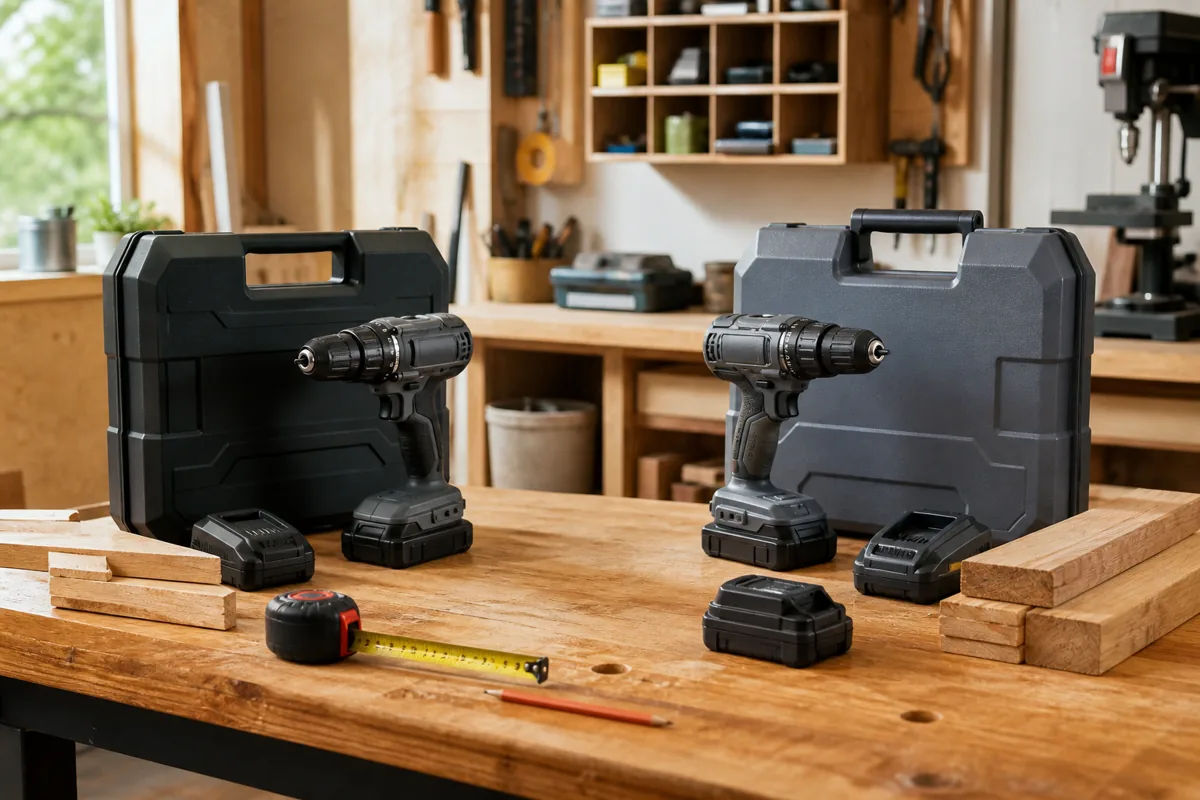
Power and runtime
Milwaukee’s Fuel line tends to edge out on raw torque, while Makita counters with excellent runtime and heat management. In practice both have more than enough power for any drilling task — the gap is smaller than forum arguments suggest.
The reason the gap feels small is that on most jobs the drill is not the limiting factor. A sharp bit, a correctly sized pilot hole and your own wrist give out long before either motor does. Torque only becomes the deciding variable in a narrow band of work: large hole saws, self-feed bits through joists, mixing paddles in thinset or mortar, and long structural screws driven without a pilot. If that is your week, buy a high-torque unit with a two-speed or three-speed gearbox and a real auxiliary handle, and treat the badge on it as the second question.
Runtime is a battery and thermal story more than a motor story. Both brands throttle output to protect cells and electronics when things get hot, and the tool that throttles less on the fifth hole saw in a row is the one that feels faster all afternoon. That is where Makita’s reputation for heat management earns its keep, and where Milwaukee’s heavier housings and larger high-output packs do the same job by a different route. The practical lesson: the pack decides your runtime far more than the tool does. Pairing a high-torque drill with the smallest compact battery in the range is the most common way to be disappointed by a genuinely good tool.
| Factor | Makita | Milwaukee |
|---|---|---|
| Torque | Very high | Highest |
| Runtime | Excellent | Very good |
| Ergonomics | Lighter | Grippier |
| Ecosystem | Huge | Huge |
How to weigh the criteria that actually decide this
The first and heaviest factor is what batteries you already own, or whose you can borrow. If there are four working packs of one brand in your garage or on your crew’s van, that is most of the decision made, and no torque difference justifies starting a second platform from scratch. Both brands are large enough that neither is a dead end.
The second is the range beyond drills. Write down the three cordless tools you expect to buy next, then check that both platforms cover all three well. Milwaukee has pushed hardest into trade-specific tools — plumbing, electrical, mechanical, site lighting. Makita’s strength runs through fine woodworking, sanding, track saws and a deep outdoor equipment line on the same 18V packs. Whichever list matches your next three tools should outweigh a spec sheet.
The third is service and parts. Find out where your nearest authorized service centre is and which of the two it actually handles, and search the brand plus “parts diagram” for a drill that is a few years old. A brand that publishes exploded views and still sells you a chuck, a trigger or a set of brushes is a brand you can keep running. The fourth is hand fit, which we cover below and which decides it for more people than they expect. Everything else — LED placement, belt hook side, bit holder, whether the chuck is all-metal — belongs in a fifth tier. It matters daily, but only after the first four agree.
What separates a good pick from a bad one at each price band
Entry kits
At the bottom of each brand’s range you will find brushed motors, simpler clutches and the smallest compact packs. A good buy here is a brushless drill with a two-speed gearbox and two batteries; a bad buy is a brushed drill bundled with accessories you will throw away, or a big combo kit bought for one tool you wanted and three you will never charge. If the money has to go somewhere, put it in the motor and the second battery, not the case.
The middle band
This is where both brands are at their best and where most readers should be shopping. Expect a brushless hammer drill or a drill/driver plus impact driver pair, an all-metal chuck, a usable clutch and mid-capacity packs. The good pick is simply the kit whose batteries you would want anyway. The bad pick is stretching past this band into a flagship high-torque tool when ninety percent of your work is driving screws and boring holes under half an inch — you pay for mass you then carry all day.
High-torque flagships
Worth every cent if you run self-feed bits, big hole saws or mixing paddles, especially with electronic anti-kickback and a side handle you actually use. Skip this band if you build cabinets, hang trim or work overhead, because the weight and grip circumference that make these tools feel planted in a stud bay make them tiring on a bench. Bare tool plus your existing packs is nearly always the better value once you are inside a platform.
Ergonomics decide it for most
Makita drills tend to feel lighter and more balanced; Milwaukee’s grip is chunkier but reassuring under load. This is personal — if you can, hold both.
Hold them the way you will use them, not the way you pick them off a shelf. Fit a battery, point the drill at the ceiling and hold it there for thirty seconds, then try a low, awkward angle with your wrist turned. Note whether your fingertips wrap comfortably around the grip, whether the trigger has enough travel for slow, controlled starts, and whether the LED lights the bit or your own knuckles. If you wear gloves, test in gloves. Smaller hands frequently prefer the slimmer Makita grip; people who choke up on a tool under heavy load often prefer Milwaukee’s fuller one. Neither preference is wrong, and no review can have it for you.
Milwaukee M18 Fuel Drill
If outright torque and a rugged feel are your priorities, Milwaukee’s Fuel drill is a workhorse with an enormous tool ecosystem behind it. Our pick for heavy, daily use.
Mistakes that cost people money
- Starting a second platform to save on one tool. The discount evaporates the moment you buy the second charger and third battery.
- Shopping on peak torque. It is a brochure number measured at stall. Gearbox range, clutch quality and control at low speed affect your work far more.
- Overbuying the tool and underbuying the batteries. Two mid-capacity packs on a mid-range drill beat one small pack on a flagship, every time.
- Ignoring grip size because the specs matched. Hand fit is the factor people most regret and the easiest one to test for free.
- Leaving the auxiliary handle in the box. Big bits grab, and a drill that grabs with one hand on it sprains wrists. Use the handle and set the clutch.
- Expecting a hammer drill to behave like a rotary hammer. Hammer drills handle occasional holes in masonry and tile; sustained work in concrete wants an SDS tool in either brand.
Who each one suits, and who should skip it
Choose Milwaukee if you use a drill hard and daily, work in the mechanical trades, want the widest catalogue of trade-specific cordless tools to grow into, and like a tool that feels overbuilt in the hand. Skip it if you spend your days overhead or on fine work where every extra ounce and every millimetre of grip circumference is felt by the end of the shift.
Choose Makita if you do finish carpentry, cabinetry or all-day handheld work, value balance and lower fatigue over headline torque, or want woodworking and outdoor equipment sharing one battery family. Skip it if your next three purchases are specialty trade tools that one brand covers and the other does not.
And if you build two bookshelves a year, be honest about it: a mid-band kit from either brand is already more tool than you need, and the money is better spent on good bits, a decent driver set and a second battery than on the flagship of either line.
The verdict
Both are excellent — pick based on which ecosystem you’re building and which feels better in your hand. You won’t regret either. For a cheaper matchup, see our corded vs cordless breakdown.
FAQ
Can I use Makita batteries in a Milwaukee drill, or the other way round?
No. The packs are physically and electronically incompatible, and the third-party adapters that claim to bridge them bypass the communication between pack and tool that manages heat and cell protection. They also tend to void your warranty on both ends. Assume one platform per set of batteries and plan purchases accordingly.
Do I need a hammer drill, or will a plain drill/driver do?
If you only occasionally anchor into brick, block or tile, the hammer function is worth having and costs little extra weight. If you never touch masonry, a drill/driver is lighter and quieter. For repeated holes in poured concrete, neither is the right tool — step up to a dedicated rotary hammer.
Is Milwaukee’s torque advantage worth it for woodworking?
Rarely. Wood does not resist the way masonry or steel does, and in fine work the qualities that matter are low-speed control, a clutch you trust and a tool that stays comfortable for hours. Save the high-torque flagship for hole saws and self-feed bits.
Is a kit or a bare tool the better buy?
Buy a kit when you are entering a platform, because the batteries and charger are most of the value. Buy bare tools once you own two or more healthy packs — that is when a platform starts paying you back, and it is the single strongest argument for not splitting your batteries across both brands.