What's inside
As an Amazon Associate I earn from qualifying purchases. This post may contain affiliate links at no extra cost to you.
A thickness planer and a jointer solve different problems, even though both remove wood and can leave a smooth surface. A jointer makes one face flat and one edge straight; a thickness planer makes the opposite face parallel to the face you already flattened. For rough lumber, that distinction determines the right order: flatten a reference face first, then plane to thickness.
The names can confuse buyers. A “portable planer” usually means a benchtop thickness planer, not a machine that can flatten a twisted board by itself. Feed a cupped or twisted board through one and the cutters tend to reproduce its shape on the other face. The board may become smoother and thinner without becoming flat.
As an Amazon Associate we earn from qualifying purchases at no extra cost to you.


Our Top Picks


What each tool does
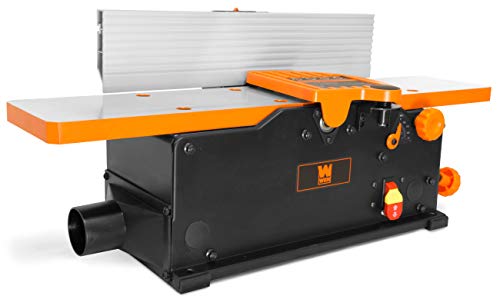
A jointer has a flat infeed table, cutterhead and outfeed table. You press one face against the tables and feed the board over the cutterhead. With a correctly adjusted machine and sound technique, the result is a flat face. Turn the board on its edge and the jointer can also make a straight edge square to that face.
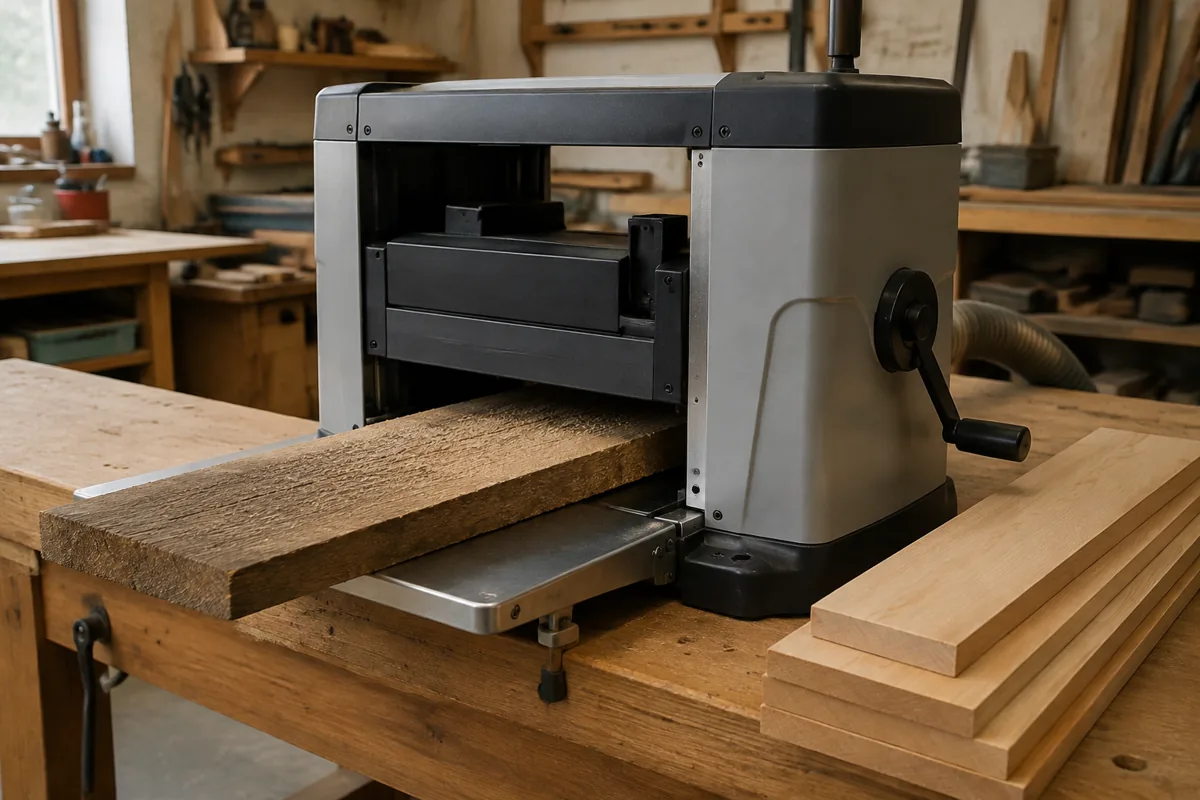
A thickness planer has a bed beneath a cutterhead. It holds the board down as it cuts the upper face, setting that face parallel to the bed. It controls thickness, not flatness. If a board rocks on the bed, the planer can cut away high spots while leaving a bowed or twisted shape intact.
For a typical rough board, the reliable sequence is: joint one face, plane the opposite face parallel, then joint or rip one edge straight and cut the other edge parallel. A planer sled can substitute for a jointer on wide boards: shim the work so it cannot rock, run it through until one face is flat, then remove the sled and plane the other face.
Side-by-side comparison
| Factor | Benchtop thickness planer | Jointer |
|---|---|---|
| Main job | Set thickness; make faces parallel | Flatten one face; straighten an edge |
| Typical portable width | 12–13 inches | 6 inches; 8-inch models are larger and costlier |
| What it cannot do alone | Correct twist or bow reliably | Make opposite faces parallel or hit a final thickness |
| Common limitation | Snipe at board ends; limited width | Short tables struggle with long boards; limited width |
| Best fit | Thicknessing already-flat stock and batch work | Preparing rough stock and straightening edges |
Which should you buy first?
If you mostly buy surfaced lumber that is already reasonably flat, a thickness planer is usually the more useful first machine. It can bring boards to a consistent thickness, remove mill marks and help match parts for a project. A common 12- or 13-inch benchtop model handles many cabinet parts and furniture boards, though its capacity does not mean every 13-inch board can be safely or cleanly processed at full width.
If you regularly buy rough-sawn lumber, a jointer earns its place because a flat reference face makes the rest of the milling predictable. A 6-inch jointer is a practical shop size, but its width limits how broad a face it can flatten in one pass. An 8-inch machine handles wider boards, but costs more and takes more floor space. Check the table length too: a short machine is harder to use on long stock.
When budget or space allows only one machine, choose based on the lumber you actually use. A planer plus a sturdy sled is a workable route for rough boards, including stock wider than a small jointer, but it adds setup and handling. A jointer alone can flatten a face, but you still need a thickness planer, hand plane, or other method to make the opposite face parallel. For many small shops, a planer and sled are the less expensive starting point.
Compare current benchtop thickness planers by capacity, cutter type, table support and dust collection—not just motor power. If rough stock is a regular part of your work, also price 6-inch jointers and account for the room needed to support long boards in and out.
How to flatten without a jointer
For a planer sled, use a flat, rigid base longer than the board and wide enough to support it. Place the board on the sled with its stable side down, then shim gaps with thin wedges or hot-melt glue so the board cannot rock. Keep the work secured and clear of the cutterhead path. Take light cuts until the upper face is fully cut; then remove the shims and sled and plane the opposite face.
This method is slower than jointing and can be awkward with heavy or very long boards. It also does not straighten an edge. A track saw, table saw with a straight-line jig, or hand plane can handle that separate task. If the board is too twisted to sit safely on the sled, remove high spots with a hand plane first or get help from a shop with a larger jointer.
Avoid common problems
Planer snipe—deeper cuts near the leading or trailing end—is a frequent complaint. Support long boards level with the bed, feed them consistently, and avoid pushing down on the ends as they enter or leave. Make test cuts on scrap and leave a little extra length if the ends will be trimmed. Snipe varies by machine and setup; it is not always eliminated by adjusting the rollers.
Both machines can tear out figured grain, and a jointer can launch a short or unstable piece if it is poorly supported. Use sharp knives or inserts, take modest cuts, and follow the manual’s minimum workpiece dimensions and guarding instructions. Never joint end grain, and do not run warped stock through a planer unsecured just to see if it will come out flat. A few careful setup steps save material—and are cheaper than trying to correct a board that has been planed thinner but is still twisted.