What's inside
As an Amazon Associate I earn from qualifying purchases. This post may contain affiliate links at no extra cost to you.
Is a Reciprocating Saw the Right Tool for Cast Iron?
For cutting cast-iron soil pipe or old radiator pipe in place, a reciprocating saw is usually the most practical choice. It will not cut as fast or as cleanly as a snap cutter (chain cutter) or an angle grinder with a diamond wheel, but it fits in joist bays, crawlspaces, and tight wall cavities where those tools cannot. If you have more than 4-5 cuts to make on 3-inch or 4-inch soil pipe in the open, renting a soil pipe snap cutter will save you an hour and a lot of blades. For one or two replacement cuts, demolition, or cutting out a cracked section, a recip saw is faster to set up and more forgiving.
Do not use a standard wood-demolition or thin-metal bi-metal blade and expect it to work. Cast iron is hard, abrasive, and brittle. A standard 14 TPI bi-metal blade will dull in under a minute, overheat, and start bouncing instead of cutting. You need a blade designed specifically for cast iron.
What Blade You Actually Need
For cast iron, there are three blade options that work. Only two are worth buying for most DIY jobs.
| Blade Type | Teeth / Grit | Typical Cost | Life on 4″ Cast Iron | Best For |
|---|---|---|---|---|
| Bi-Metal (14-18 TPI) | Hardened steel teeth | $2 – $4 per blade | Less than 1 cut, frequent stalling | Not recommended – will fail |
| Carbide-Tipped | 8 TPI, carbide teeth | $9 – $15 per blade | 2 – 4 cuts per blade | Most DIY and pro plumbing cuts |
| Diamond Grit | Coarse diamond edge, no teeth | $15 – $25 per blade | 4 – 8+ cuts per blade | Thick-wall, old, or extra-hard pipe |
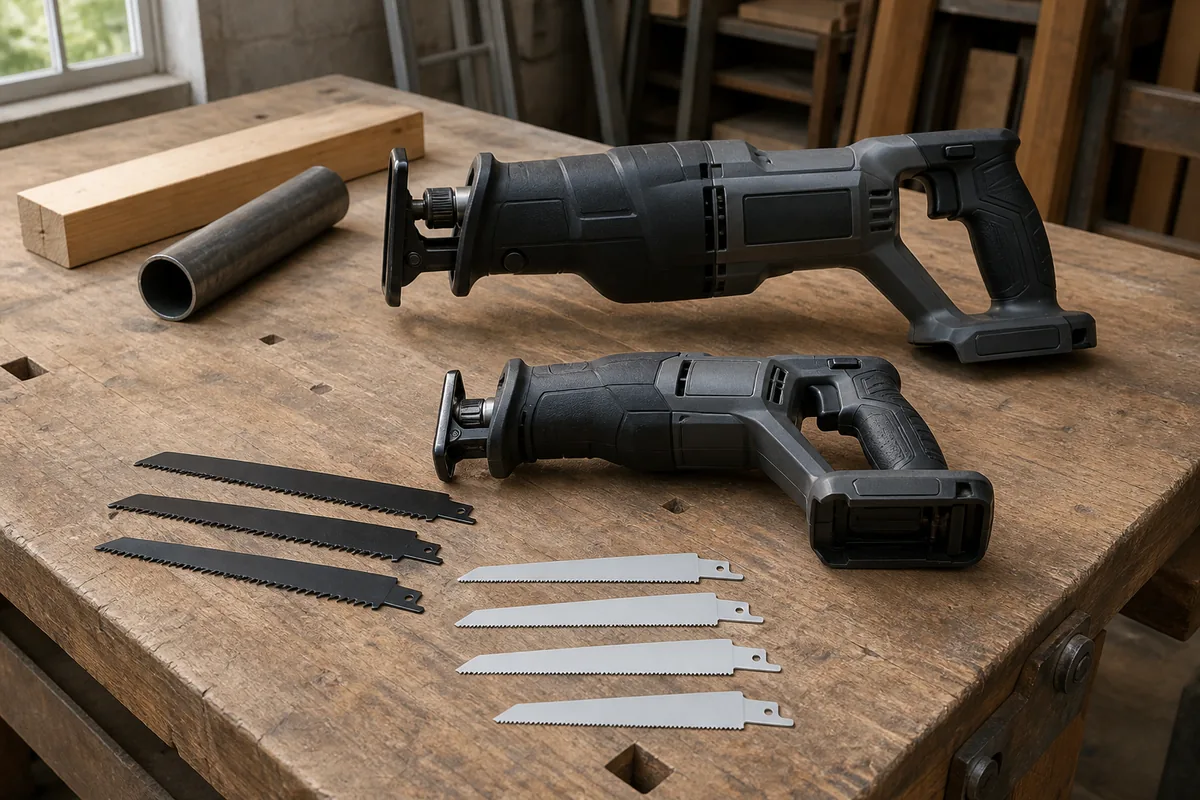
For 90% of homeowners, a carbide-tipped reciprocating saw blade for cast iron at 8 TPI is the right buy. Look for markings like “Carbide,” “CT,” or “Cast Iron / Ductile Iron” on the blade. The large, carbide-brazed teeth grind rather than sheer the iron and they tolerate heat far better than bi-metal.
Diamond grit blades cost more but they do not have teeth to chip or strip. They handle rust scale, sand inclusions, and the very hard outer skin of old cast iron better than carbide. If your pipe is 60+ years old, heavily corroded, or you felt a bi-metal blade skate without biting, step up to a diamond grit reciprocating saw blade. It cuts slower but it will not quit mid-cut.
Blade length matters. For 2-inch or 3-inch pipe, use a 6-inch blade. For 4-inch soil pipe, use a 9-inch blade. A blade that is too long flexes and wanders, which kills blade life and leaves a slanted cut that will not seal with a shielded coupling.
What You Need Besides the Saw and Blade
You do not need a high-end saw. Any 12-amp corded recip saw or 18V/20V brushless cordless saw with orbital action turned OFF will do it. Corded is better for sustained grinding. On cordless, have two fully charged 5.0Ah batteries ready. A single 4-inch cut can take 4 to 8 minutes of trigger time and will drain a small 2.0Ah battery.
Secure the pipe. Cast iron is heavy and brittle. A 4-foot section of 4-inch cast iron weighs about 35 pounds. If it drops or twists while you cut, it will crack the hub you intended to keep and can pinch the blade. Use a riser clamp, pipe hangers, or at least two screw-type hose clamps with wire or chain to joists within 12 inches on both sides of the cut. For vertical stacks, always support the section above the cut before you start.
Safety is not optional here. Cast iron dust is extremely abrasive, hot, and the chips are sharp slivers. You need safety glasses with side shields, not just regular glasses, plus work gloves and hearing protection. A P100 or N95 dust mask is critical in a crawlspace. The saw will also produce sparks and very hot chips that melt plastic sheeting. Keep a fire watch for 10 minutes after cutting near wood.
How to Make the Cut, Step by Step
1. Mark all the way around. Do not just mark the top. Wrap a piece of cardboard or a large hose clamp around the pipe and trace a full line with a marker. A straight mark is your only guide for a square cut, and a no-hub coupling needs a square end to seal.
2. Set the saw correctly. Install the carbide or diamond blade, lock orbital action OFF, and set speed to medium-low (around 1,500-2,000 SPM if your saw has variable speed). High speed just creates heat and polishes the iron instead of cutting it.
3. Start at the top. Hold the saw shoe firmly against the pipe and start the blade before it touches. Let the weight of the saw do the work. Do not force the blade into the pipe. Apply steady, light pressure and let the grit or carbide grind. If you push hard, the blade heats, flexes, and dulls.
4. Work around, do not cut straight through. Cast iron will bind a blade if you try to plunge straight through from one side. Cut the top quarter, then rotate the saw to the side and continue. Work your way around the circumference in 90-degree sections. Keep the shoe pressed tight to the pipe at all times. This dampens vibration and keeps the blade from shuddering.
5. Manage heat and dust. Stop every 60 to 90 seconds to let the blade cool for 20 seconds. Do not quench a carbide blade with water, the thermal shock can crack the carbide tips. Brush off dust. If the blade starts to glaze and slide without cutting, you are pushing too hard or the blade is spent.
6. Control the final break. Leave about 1/4 inch of uncut pipe at the bottom. Support the free end, then finish the cut slowly. If you let the pipe sag, the final sliver will snap and leave a jagged lip that prevents the coupling from sealing. File or grind any burr flat with a half-round file.
Expect real numbers: On 3-inch cast iron with a new 8 TPI carbide blade, a top-side cut takes 3 to 5 minutes. On old 4-inch extra-heavy pipe, expect 6 to 10 minutes. If you are past 12 minutes and barely making progress, change the blade. A dull blade will not recover.
Common Failures and How to Avoid Them
Blade dull in seconds: You used a bi-metal blade or you have orbital action on. Turn orbit off, switch to carbide or diamond, and reduce pressure.
Saw bouncing and chattering: Shoe not in contact with pipe or blade too long. Shorten the blade, brace your forward hand on the shoe, and keep feed pressure light.
Cut wandering off the line: Blade flex from side pressure. Do not twist the saw to steer. Back out, re-enter from a different angle, and let the blade track around the pipe.
Pipe cracked past the cut line: Pipe was not supported or was stressed. Always support both sides within a foot of the cut and never use the recip saw to pry. If you need to separate a hub, make a second cut 4 inches away and remove the section.
After the cut, clean the pipe end thoroughly. Wipe off grit and scale with a rag. Inspect for hairline cracks extending from the cut, especially on old horizontal pipe that was sagging. If you see a crack, you need to cut back another 2 to 3 inches to solid metal. For joining to PVC or ABS, use a shielded transition coupling rated for cast iron to plastic, not a plain rubber Fernco. Torque the bands to spec, usually 60 inch-pounds.
When Not to Use a Reciprocating Saw
If the pipe is in good condition and you have clear access all the way around, a manual snap cutter makes a cleaner, dust-free cut in 30 seconds with no power. If you are cutting dozens of feet for scrap, an angle grinder with a diamond blade for cast iron is faster but throws far more sparks and dust and binds badly in tight spots. The recip saw wins on control and on cuts in place where you cannot get a full wrap around the pipe.
You do not need to buy the contractor 10-pack of diamond blades for a single repair. One or two quality carbide blades will handle a one-off soil stack replacement for less than half the cost and leave a clean enough end for a modern coupling to seal.