What's inside
As an Amazon Associate I earn from qualifying purchases. This post may contain affiliate links at no extra cost to you.
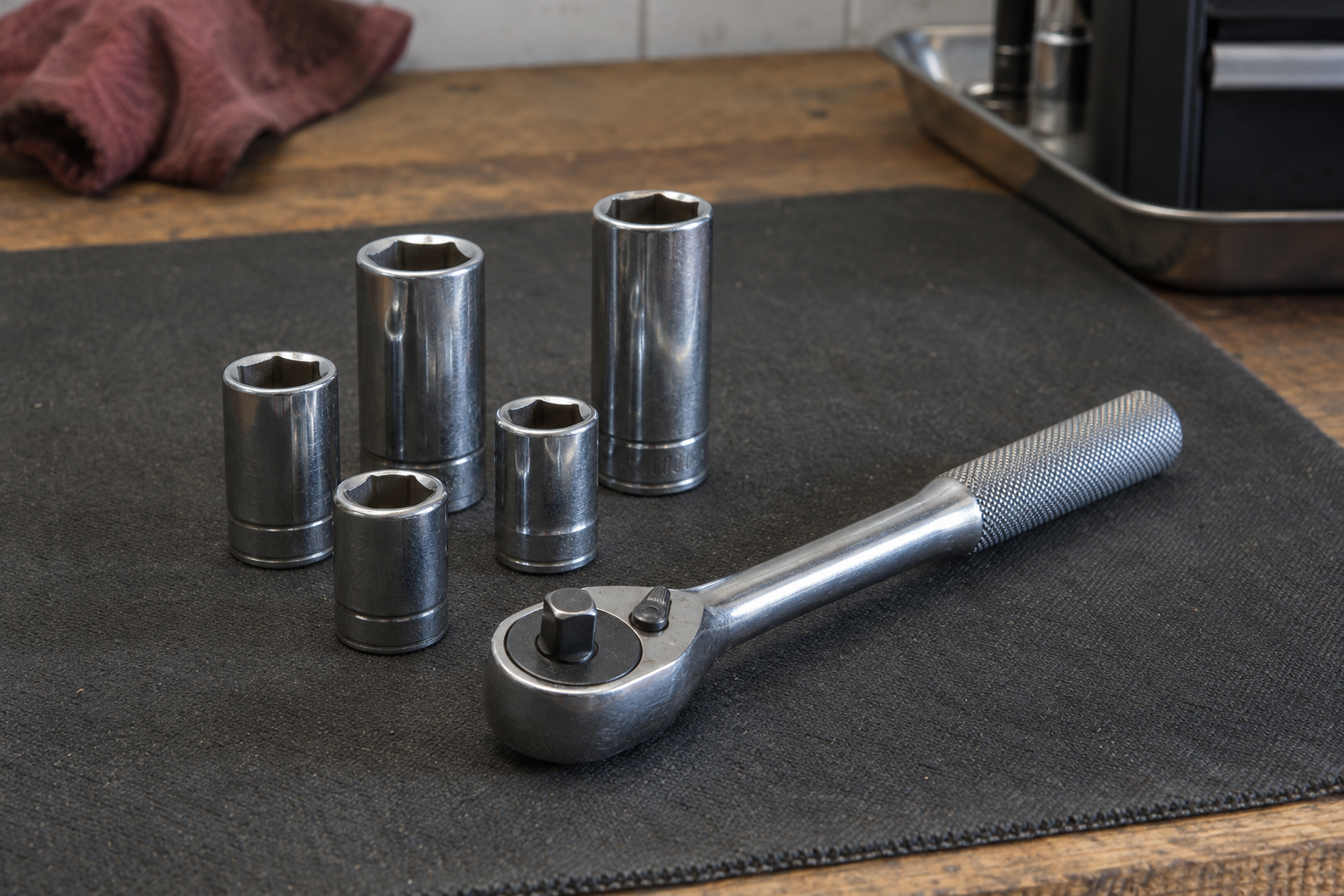
In restricted clearance, a fine-tooth ratchet usually works better—but only when the fastener is accessible enough for the ratchet head to sit squarely on it. A fine-tooth mechanism needs less handle movement to engage the next tooth, so you can work in tighter arcs. That advantage comes with smaller, more delicate teeth and a higher price.
A coarse-tooth ratchet is the better choice when durability, dirt resistance, or high torque matters more than the smallest possible swing. The right decision depends on how much space you actually have, the fastener size, and whether you are breaking loose a stuck bolt or simply spinning an already-loose nut.
As an Amazon Associate we earn from qualifying purchases at no extra cost to you.


Our Top Picks
How Tooth Count Affects Clearance
Tooth count determines the ratchet’s minimum engagement angle. A 36-tooth ratchet engages every 10 degrees, while a 72-tooth ratchet engages every 5 degrees. A 90-tooth tool engages every 4 degrees, and a 120-tooth mechanism engages every 3 degrees.
Those numbers describe the movement needed before the mechanism catches the next tooth. They do not mean the ratchet becomes physically thinner or shorter. A bulky ratchet head can still be difficult to fit between a bolt and an obstruction, regardless of its tooth count.
For example, if you have only 6 degrees of handle swing, a 72-tooth ratchet can advance on every stroke. A 36-tooth model may force you to remove and reposition it after each attempt. That difference is substantial when working between an engine, frame rail, exhaust pipe, or sheet-metal bracket.
Fine teeth are especially useful for tightening or loosening small fasteners in places where a full hand movement is impossible. They reduce wasted repositioning and make it easier to keep the socket engaged.
Fine-Tooth vs. Coarse-Tooth Ratchets
| Feature | Fine-tooth ratchet | Coarse-tooth ratchet |
|---|---|---|
| Typical tooth count | 72, 90, or 120 teeth | 24, 36, or 48 teeth |
| Minimum engagement angle | 3 to 5 degrees | 7.5 to 15 degrees |
| Restricted-clearance performance | Better for short swing arcs | May require frequent repositioning |
| Tooth strength | Usually lower at the same head size | Usually higher and more tolerant of abuse |
| Dirt and neglect tolerance | More sensitive to contamination | Generally more forgiving |
| Typical price | Moderate to high | Low to moderate |
Tooth count is not a direct torque rating. A well-made fine-tooth ratchet can handle considerable torque, but its mechanism has less tooth engagement and smaller internal parts than a coarse-tooth design. Poor technique—such as using a cheater pipe or jerking hard on a stuck fastener—can damage either type, especially a fine-tooth mechanism.
When a Fine-Tooth Ratchet Is the Better Buy
Choose a fine-tooth ratchet when the handle can move only a few degrees at a time. Common examples include automotive trim and accessories, under-dash work, small engine brackets, bicycle components, and fasteners recessed beside wiring or tubing.
A 90-tooth ratchet is a practical middle ground for general work. It provides a 4-degree engagement angle without pushing the mechanism to the smallest available tooth size. A 120-tooth ratchet can be useful in extremely tight spaces, but it is not automatically stronger, smoother, or better built.
Look for a compact head as well as a high tooth count. A low-profile head can save more space than moving from 72 to 120 teeth. A slim direction lever, a secure socket retention button, and a short back drag are also valuable when your fingers cannot get around the handle.
For frequent work in narrow spaces, compare 90-tooth low-profile ratchet sets rather than focusing only on the advertised tooth count. A compact 72-tooth ratchet may outperform a larger 120-tooth tool in a crowded engine bay.
When a Coarse-Tooth Ratchet Is Fine
A coarse-tooth ratchet is sufficient for open workbenches, suspension components with clear access, household repairs, and fasteners that allow at least 10 to 15 degrees of handle movement. If the bolt is already loose, you can also spin it quickly by hand or use a pass-through handle, making tooth count less important.
Coarse mechanisms often cost less and have larger, more robust engagement parts. They are a sensible choice for a first ratchet, a tool kept in a dirty garage, or jobs involving moderate force. A 36-tooth model is not obsolete; it is simply less convenient when space is tight.
If you already own a coarse ratchet, do not replace it just because a newer tool advertises 120 teeth. Add a fine-tooth model in the same drive size when a specific job demands it. For occasional restricted-clearance work, a compact 3/8-inch compact ratchet is often a cheaper and more useful addition than replacing a complete set.
Failure Modes and Safe Use
The most common mistake is using a fine-tooth ratchet as a breaker bar. If a fastener will not move with firm hand pressure, switch to a breaker bar, penetrating oil, heat where appropriate, or an impact tool rated for the job. Do not slide a long pipe over a small ratchet handle.
Another failure mode is partial socket engagement. In a cramped position, it is easy to cock the ratchet so the socket contacts only part of the fastener. That can round the fastener and load the ratchet unevenly. Keep the socket fully seated and use a wobble extension or universal joint only when the angle is controlled.
Fine-tooth ratchets also need cleaner maintenance. Grit or dried grease can prevent the pawl from seating completely. Clean the mechanism according to the manufacturer���s instructions and replace a ratchet that slips under load. A slipping ratchet can damage the fastener or injure your hand.
What to Buy
For one general-purpose ratchet, choose a quality 72- or 90-tooth model in the drive size that matches your work. The 3/8-inch drive is the most versatile for automotive and household repairs; 1/4-inch is useful for small fasteners and very tight spaces, while 1/2-inch is better suited to larger fasteners and higher torque.
Choose coarse tooth when the price matters, the work is open, or the tool will face heavy abuse. Choose fine tooth when restricted clearance is a regular problem. If you need maximum access, prioritize a compact head and short handle first, then tooth count. A compact fine-tooth ratchet set makes sense for repeated tight-access work, while a basic coarse-tooth set remains perfectly adequate for ordinary repairs.