What's inside
As an Amazon Associate I earn from qualifying purchases. This post may contain affiliate links at no extra cost to you.
Our Top Picks


Plunge control at a glance
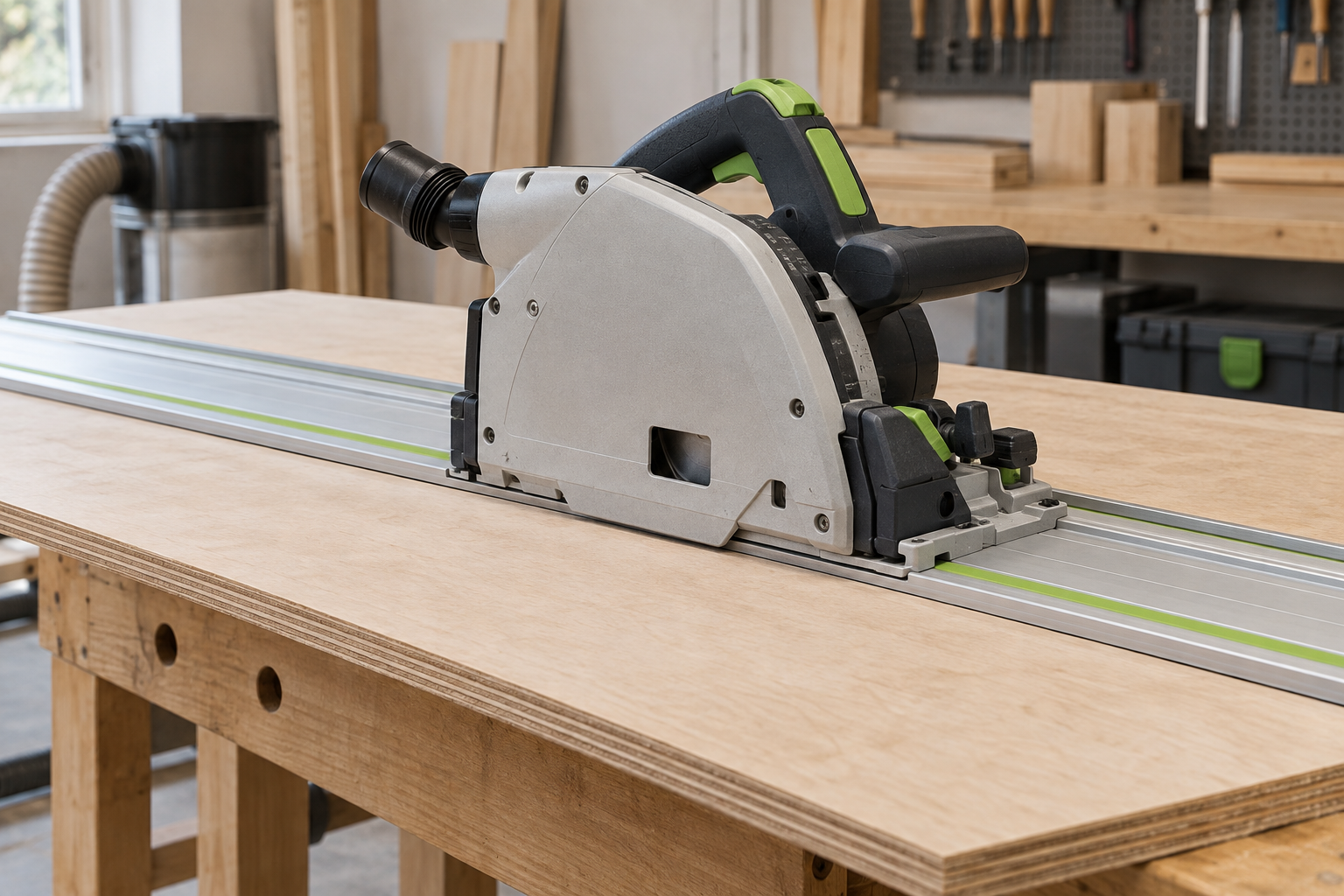
The Festool TS 60 and Makita SP6000 are both capable track saws, but they feel different when the blade enters the work. The TS 60 has the more controlled, engineered plunge action: its spring tension is smooth, the blade guard retracts cleanly, and the saw stays composed when starting in the middle of a panel. The Makita is also predictable, but its plunge movement feels more mechanical and requires a little more attention from the operator.
That difference matters most when making stopped cuts, trimming an installed countertop, or starting a cut far from an edge. For ordinary sheet-goods work against a track, the Makita can produce equally straight cuts for considerably less money.
As an Amazon Associate we earn from qualifying purchases at no extra cost to you.



| Feature | Festool TS 60 | Makita SP6000 |
|---|---|---|
| Maximum cut depth at 90° | About 62 mm (2-7/16 in.) | About 55 mm (2-3/16 in.) |
| Maximum cut depth at 45° | About 45 mm (1-3/4 in.) | About 39 mm (1-9/16 in.) |
| Bevel range | Approximately -1° to 47° | Approximately -1° to 48° |
| Blade diameter | Approx. 6-1/2 in. (165 mm) | Approx. 6-1/2 in. (165 mm) |
| Power source | Corded | Corded |
| Notable control feature | Electronic kickback protection and refined plunge mechanism | Variable speed, soft start, and depth stop |
How the Festool TS 60 controls a plunge
The TS 60’s handle and plunge linkage give it a notably smooth descent. There is enough spring resistance to keep the saw from dropping abruptly, but not so much that you have to force it through the first few millimeters of travel. That makes it easier to start a cut precisely on a pencil mark without the blade skating or the housing twisting.
Its electronic KickbackStop is an additional safety feature rather than a substitute for good technique. The saw monitors conditions associated with a kickback and can stop the blade quickly. This is useful during an interrupted cut or when the blade binds, although electronic protection can react to unusual contact and should not be treated as permission to plunge carelessly.
The TS 60 also gives you more cutting capacity. The roughly 62 mm depth at 90 degrees is enough for thicker countertops, solid timber, and some laminated worktops where the Makita’s approximately 55 mm limit may require a second operation. Remember that a track reduces usable depth slightly, and a worn or thinner replacement blade can change the effective cut position.
For repeat work, the Festool’s depth scale and stop are easy to read. The important failure mode is setting depth too shallow: if the blade barely clears the material, a bowed panel or a track sitting on a dirty surface can leave an uncut web at the bottom.
How the Makita SP6000 behaves
The SP6000 has a firm, direct plunge. Its soft-start motor helps prevent a violent initial jerk, and the variable-speed control is useful when cutting delicate laminates or materials that benefit from a slower blade speed. Once the blade is engaged, the saw tracks steadily and the depth stop makes repeated cuts straightforward.
Compared with the TS 60, the Makita’s handle movement transmits more of the operator’s hand pressure to the saw. If you push down aggressively at the start, the nose can dip slightly before the track has fully stabilized. The fix is simple: place the track securely, hold the front handle first, start the motor, and lower the blade gradually rather than stabbing into the sheet.
The Makita’s depth scale is serviceable, but it deserves verification with a scrap piece. On a track saw, the printed depth is not the same as the visible blade projection above the track. Measure the actual cut when the job is sensitive, particularly for shallow dados, door undercuts, and cuts through finished panels.
A reliable 165 mm track-saw blade can make more difference to plunge behavior than a small adjustment in technique. A dull blade increases feed pressure, which makes both saws harder to control and increases the chance of scorching or wandering.
Stopped cuts, bevels, and real-world control
For a stopped cut, the TS 60 has the advantage. Its smoother plunge and electronic protection make it easier to lower the blade at an exact point, then lift it without dragging the teeth across the work. The Makita can do the same job, but you need to keep the saw square to the track and use a controlled two-handed motion.
Bevel cuts expose another trade-off. Both saws tilt slightly past 45 degrees, which helps with fitting work, but the effective depth falls sharply at an angle. Expect roughly 45 mm from the TS 60 and 39 mm from the SP6000 at 45 degrees. A thick panel may therefore need to be flipped or cut from both sides. Check the bevel lock before starting; even a small amount of play can produce a visible gap in a cabinet joint.
Neither tool should be plunged with the blade already touching the material at full speed. That can pull the saw forward, chip the surface, or twist the track. For cleaner work, use a sharp fine-tooth track-saw blade for veneered plywood and melamine, and support the offcut so it cannot pinch the blade as the cut finishes.
Which saw offers better plunge control?
The Festool TS 60 offers better plunge control, especially for precision starts, stopped cuts, thick material, and users who regularly work with expensive panels. Its smoother mechanism, extra depth, and electronic kickback protection justify the premium when those features save rework.
The Makita SP6000 is the better value when most cuts run from one edge of plywood or sheet goods, the work is supported properly, and you are comfortable lowering the saw deliberately. Its plunge action is not crude; it is simply less insulated from the operator’s technique. For a homeowner, remodeler, or small shop that does occasional cabinet breakdown, the cheaper Makita is entirely adequate.
Choose the TS 60 if plunge starts are a major part of the job or you already use the Festool track and dust-extraction system. Choose the SP6000 if the priority is accurate straight cuts at a lower entry price. In either case, buy a compatible guide rail that is long enough for the panel, clamp or hold it against movement, and test the depth on scrap before cutting the finished piece.