What's inside
As an Amazon Associate I earn from qualifying purchases. This post may contain affiliate links at no extra cost to you.
Preparing 12-gauge solid copper wire is simple only when the stripper matches the job. The wrong tool can nick the conductor, pull strands from the insulation, or leave a ragged jacket that makes a terminal connection harder. For occasional household wiring, a basic manual stripper is usually enough. For repeated work, a self-adjusting stripper saves time but is not automatically gentler or more accurate.
As an Amazon Associate we earn from qualifying purchases at no extra cost to you.


Our Top Picks
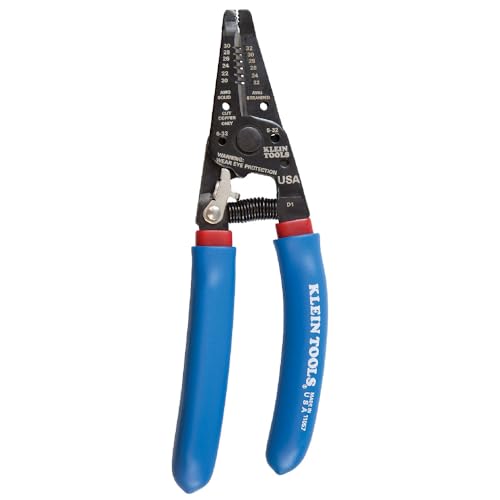
 Klein Tools K11095 Klein-Kurve Wire Stripper and CutterOne Size7.35 x 2.33 x 0.61 inches0.35 poundsCheck on Amazon
 Klein Tools 11061 8-Inch Self-Adjusting Wire Stripper/Cutterone size8.25 x 4 x 1.3 inches0.8 PoundsCheck on Amazon
 Klein Tools K1412 Wire Cutter / StripperNM-B Cable7.75 x 2.56 x 2.9 inches0.41 PoundsCheck on Amazon

What makes 12-gauge solid wire difficult to strip
12-gauge solid copper is relatively stiff, and its insulation is often tougher than the jacket on small electronics wire. Typical building wire has a conductor diameter of about 2.05 mm, or roughly 0.081 inch, but the overall outside diameter varies with insulation type. The stripper must cut the insulation without cutting into that copper core.
A nick matters. A shallow mark may not cause an immediate failure, but it reduces the conductor’s cross-section and creates a stress point when the wire is bent around a screw terminal. Deep cuts are especially undesirable in a receptacle box, where the wire may be repositioned several times. The cleanest result is a smooth, bright conductor with no visible gouges and insulation ending in an even ring.
The best stripper types for this job
For most DIY electrical work, choose a manual wire stripper for 12-gauge wire with a clearly marked 12 AWG notch. A quality manual stripper gives you direct control over cutting depth. It is the best choice when clean ends matter more than speed, particularly with solid copper.
Self-adjusting strippers are convenient when you are processing many wires with different insulation sizes. They grip the insulation and pull it away in one motion, but their jaws can leave a longer split or slightly deform the jacket. Cheap self-adjusting tools are also more likely to fail on stiff building wire or thick insulation. Buy one only if you regularly strip mixed gauges.
Automatic strippers with a dedicated 12 AWG setting can be fast and consistent, but they are usually larger and more expensive. They make sense for repetitive panel, lighting, or fixture work. For a few receptacles, the extra mechanism adds cost without improving the finished connection.
| Stripper type | Best use | Strengths | Weaknesses |
|---|---|---|---|
| Manual gauged stripper | General household wiring | Accurate, inexpensive, good control | Slower for large batches |
| Self-adjusting stripper | Mixed wire sizes and repeated work | Fast, little gauge selection | Can mark insulation or struggle with stiff jackets |
| Automatic stripper | High-volume electrical work | Quick and repeatable | Bulkier, more expensive, more parts to wear |
| Utility knife | Removing outer cable sheathing | Useful for jackets and nonstandard insulation | Easy to nick copper; poor choice for individual conductors |
Features worth paying for
The most important feature is a properly formed 12 AWG cutting notch. The edges should meet cleanly rather than overlap unevenly. Look for markings that are molded, stamped, or deeply etched; shallow paint markings disappear quickly in a toolbox. A spring return is useful, but it should not be so strong that the handles snap open between cuts.
Comfort matters when stripping dozens of conductors. Handles with a modest rubber grip reduce fatigue, but bulky padding can make it harder to reach a wire in a crowded electrical box. A locking catch is helpful for storage. Built-in cutters are convenient for trimming copper, although they should not be used to cut energized wire.
For repeated work, consider a professional manual wire stripper with hardened, precisely aligned jaws. You do not need premium construction for five or ten wire ends, but poor alignment becomes obvious after repeated use. If the 12 AWG notch leaves crescent-shaped marks on insulation, return the tool rather than trying to compensate with extra force.
How to strip 12-gauge solid copper cleanly
First, disconnect power and verify the circuit with a properly rated tester. Cut the wire squarely with a cable cutter or the cutter section of the stripper. An angled cut makes it harder for the jaws to grip evenly.
Set the wire into the 12 AWG notch, not the nearby 10 or 14 AWG position. Close the handles until the insulation is cut, then rotate the tool slightly only if the insulation does not release. Pull the stripper straight toward the wire end. Do not twist aggressively; twisting is a common way to score the copper.
For a typical screw-terminal connection, remove only the length specified by the device, commonly about 5/8 inch, but follow the terminal’s instructions. Too much bare copper can extend outside the terminal or contact an adjacent conductor. Too little leaves insulation under the clamp, which can create a loose connection.
After stripping, inspect the copper under good light. Reject the end if you see a deep scratch, flattened section, or crushed conductor. Cut it back and strip again. If the insulation tears several inches away from the cut, the stripper may be pulling too hard, the wire may be cold and stiff, or the tool may be the wrong size.
When a cheaper stripper is fine
A basic 12 and 14 AWG wire stripper is perfectly adequate for occasional receptacle, switch, and light-fixture work if its jaws are aligned and its markings are accurate. Spend more for smoother pivots, better grip, and durability��not because an expensive tool makes a fundamentally different cut.
A self-adjusting stripper is the better buy when you frequently move between 12, 14, 16, and smaller conductors. For a homeowner preparing a handful of 12-gauge solid copper ends, a well-made manual stripper is easier to control, costs less, and produces the cleanest result with the fewest surprises.