Key takeaways
- Two budget platforms aimed at the same buyer. One has a far deeper range; the other has better hand tools.
What's inside
As an Amazon Associate I earn from qualifying purchases. This post may contain affiliate links at no extra cost to you.
For a homeowner choosing a first cordless platform on a budget, these two come up constantly. They are closer than brand loyalists admit, but they are not equal in every respect.
The argument never resolves because most people compare the wrong object: two similarly priced drills that both sink deck screws into pine without complaint. At the level of one drill, the brands nearly are interchangeable. The decision you are actually making is about the eighth and ninth tool you will own, the batteries that feed them, and the store you drive to when a pack stops holding charge. Platforms diverge much further than drills do.
As an Amazon Associate we earn from qualifying purchases at no extra cost to you. Product prices and availability are accurate as of the date shown and are subject to change.


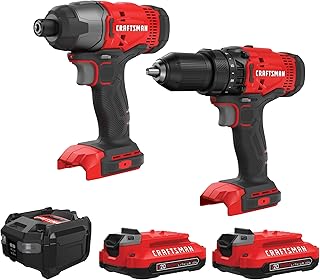


Neither brand publishes anything useful about duty cycle, and honest failure numbers do not exist at this price level. So this is a comparison desk view: what each company optimizes for, who that choice rewards, and who it quietly punishes.
| Aspect | Ryobi ONE+ | Craftsman V20 | |
|---|---|---|---|
| Tool count | 300+ | 100+ | |
| Outdoor equipment | Extensive | Moderate | |
| Battery cost | Lowest | Low | |
| Hand tools | Limited | Excellent, lifetime warranty | |
| Availability | Home Depot | Lowe’ | s, Ace |
| Compatibility history | Since 1996 | Newer platform |
The four criteria that actually decide this
Write down the jobs you already know you have before you compare anything — hanging blinds, cutting down a sticking door, replacing a mower blade, breaking loose lug nuts, taming a hedge. That list should pick your brand, not a spec sheet.
- Tool breadth against your real list. Both brands cover the first three tools everyone buys. Platforms separate at tools four through ten — oscillating tool, inflator, string trimmer, compact router, ratchet. Confirm each item on your list exists on the platform before you commit to a battery.
- Battery cost across the whole platform. The first kit is not the expense; packs five and six are, along with replacements once the originals age out. Compare a bare tool plus a standalone battery, because that is the transaction you repeat for years.
- Where you physically shop. Warranty exchanges, returns and the unplanned Saturday purchase all happen faster at the store you already drive past. Online stock is not the same as walking out with the tool.
- Your ratio of cordless work to hand tool work. Maintaining a house rewards cordless breadth. Working on cars, mowers and appliances rewards sockets, wrenches and ratchets more than a twelfth cordless tool.
When those criteria disagree, the battery decision is the one you cannot cheaply reverse, so breadth outranks the hand tool question. Hand tools carry no lock-in at all — running one brand’s cordless platform alongside the other’s socket set is a normal, sensible setup.
Ryobi’s advantage: range
ONE+ covers a genuinely enormous list of tools, including a strong outdoor power equipment line. For a homeowner with a lawn as well as a garage, that single-battery coverage across both is the strongest value proposition in the entire market.
The underrated line in the table is the compatibility history. A battery family that has stayed usable since 1996 means a tool bought years from now still works with today’s packs, and the used market becomes a cheap way to add something you will only need twice a year. Breadth compounds: each extra tool makes the packs you already own worth more.
Two cautions. A large tool count is not the same as a large count of tools you need, and the tail of the catalogue fills up with novelties. And the higher-voltage outdoor line is a separate battery family that ONE+ packs do not run, so a big property may still mean a second platform.
Ryobi ONE+ tools
Drills, saws, sanders, trimmers, blowers, inflators, fans — all on one battery. Very hard to beat for a house.
Craftsman’s advantage: hand tools and heritage
Craftsman’s hand tool sets — sockets, wrenches, screwdrivers — remain excellent value with a lifetime warranty on many items. The cordless V20 line is competent but does not have Ryobi’s depth.
That gap matters more than it sounds. If your weekends involve a car, a mower, a bicycle or an appliance, the tools you reach for most are not cordless: sockets in both common drive sizes, combination wrenches, a ratchet that does not slip, screwdrivers that do not round out heads. Lifetime coverage turns a snapped wrench into an errand rather than a purchase — check the terms printed on the specific set, since they vary by product family.
On the cordless side, read the naming honestly. Ryobi’s 18V and Craftsman’s 20V describe the same class of pack measured two different ways, so voltage is not an argument between them. V20 offers brushless options in the popular categories and does ordinary jobs well. The real difference is catalogue depth, and it is wide.
Craftsman hand tool sets
Socket and wrench sets with a lifetime warranty. This is where the brand still leads clearly.
Craftsman V20 cordless kits
Perfectly good for homeowner tasks. Just check that the specific tools you want exist on the platform before committing.
Good buys and bad buys at each price band
Both brands sell across the same three bands, and the failure mode is different in each.
The cheapest band: one tool, one small battery
These exist to get you onto the platform. A good buy is a drill/driver you will use this month, bought knowing the included compact pack is really a spare. A bad buy is an underpowered version of a tool that needs power — a bargain circular saw on the smallest battery will sag and overheat, and you will blame the brand for a battery decision.
The middle band: two and three-tool combo kits
Most homeowners should shop here, and the brands are closest here. Judge the kit by its batteries and charger rather than its tool count: two packs of usable capacity and a charger that is not the slowest in the range beat a fourth tool you did not ask for. A drill and impact driver pairing covers more real work than any other combination.
The top of the homeowner range: big kits and brushless
Large kits are often genuine value, provided you would have bought at least three of the tools anyway. Count the ones you actually want; if it is two, buy those two. Brushless earns its premium on tools that run under sustained load — saws, impact wrenches, outdoor equipment — and is a nice-to-have on a drill used a minute at a time.
Common mistakes
- Choosing on the drill. The drills are close. Decide on tools four through ten, where the catalogues stop overlapping.
- Assuming corporate ownership means compatibility. Same parent company, same voltage class and same shelf tell you nothing about whether a pack fits.
- Buying kits for the batteries. Kit packs are usually the smallest available. If you need capacity, buy capacity on purpose.
- Ignoring the retailer. A platform you cannot restock locally turns every battery failure into a shipping wait.
- Drifting into two platforms. One good deal on the other brand and you are maintaining two chargers and two battery families for no benefit.
How to decide
Ryobi suits the person whose property is the project: house, garage and yard, a long and slowly growing tool list, and a habit of adding one cheap tool at a time. Skip it if your list is short and mechanical, or if Home Depot is inconvenient.
Craftsman suits the person who needs a complete hand tool kit as much as a cordless one and wants a modest set of cordless tools rather than a catalogue. Skip it if your wish list runs long into specialist or outdoor tools, because you will reach the end of the range and be tempted into a second platform.
- ✔ Choose Ryobi if you want the widest range and own a yard
- ✔ Choose Ryobi if you shop primarily at Home Depot
- ✔ Choose Craftsman if hand tools matter more than cordless breadth
- ✔ Choose Craftsman if you shop at Lowe’s and want the lifetime hand tool warranty
What neither is for
Both are built to a homeowner duty cycle, and that is a design decision rather than a defect. Run either one the way a trade runs tools — hours a day, under load, in dust — and the lighter internals and consumer-grade sealing show up as failures well before the warranty term suggests.
- ✘ Daily professional use — both are built to a homeowner duty cycle
- ✘ Heavy sustained cutting or drilling
- ✘ Trade-specific tools
- ✘ Anyone who will run tools for hours at a time
FAQ
Are they made by the same company? No. Ryobi’s cordless line is made under licence by TTI; Craftsman is owned by Stanley Black & Decker. They share neither batteries nor service channels.
Do V20 and DeWalt 20V batteries cross? No, despite both being from Stanley Black & Decker. Check the platform name on the pack, never the parent company.
Which for a first tool kit? Ryobi for cordless breadth; Craftsman if you need a mechanic’s hand tool set at the same time. If both apply, buy Ryobi cordless and a Craftsman socket set.
Can I mix the two? On hand tools, freely — nothing locks a wrench to a battery. On cordless, no: packs, chargers and tool interfaces are unrelated, so owning both means duplicating everything for no gain.
Compare budget kits →