What's inside
As an Amazon Associate I earn from qualifying purchases. This post may contain affiliate links at no extra cost to you.
The best softbox lighting kits in 2026 are matched to your subject and room: choose a 60–90 cm softbox with a 60–100 W LED for product photography, a 90–120 cm softbox with a 100–200 W LED for talking-head video, and compact 40–60 cm kits when floor space or portability matters most.
A kit is more than a lamp and a fabric modifier. Its usefulness depends on five interacting specifications: light power, softbox size, stand height, color temperature, and how easily the whole setup can be stored or transported. The right combination produces consistent exposure without forcing you to work at the limits of the equipment.
As an Amazon Associate we earn from qualifying purchases at no extra cost to you.


Our Top Picks


Quick picks by shooting situation
| Situation | Recommended kit specification | Why it fits |
|---|---|---|
| Small product photography | 60–100 W LED, 60–90 cm softbox, 180–220 cm stand | Enough output for tabletop subjects while remaining easy to position around a desk |
| Talking-head video | 100–200 W LED, 90–120 cm softbox, 200–260 cm stand | A larger apparent light source gives softer facial shadows and more even coverage |
| Small room or home office | 40–100 W LED, 60–90 cm softbox, compact air-cushioned stand | Reduces the risk of hitting walls, ceilings, and furniture |
| Portable location work | Battery-compatible LED or 40–60 W LED, 40–80 cm softbox, folding stand | Lower weight and simpler packing matter more than maximum brightness |
| Large room or group shot | 200 W or more, 120–150 cm softbox, 260–300 cm stand | Provides greater reach and a larger, more flattering source |
How much power do you need?
LED wattage is a useful starting point, but it does not equal brightness at the subject. Output is also affected by the reflector, diffusion fabric, softbox depth, beam angle, and distance. A 60 W LED close to a product can be more effective than a 200 W lamp placed several metres away.
For tabletop work, a 60–100 W continuous LED is usually practical. It gives enough brightness for still photography and short-form video when the softbox is positioned within roughly 60–120 cm of the subject. A 100–200 W fixture is a better choice for a presenter, especially if the light must sit farther away or compete with daylight from a window.
For video, continuous LED output is preferable to a flash-only kit because you can see shadows and reflections before recording. Bowens-mount fixtures from brands such as Godox and Neewer are useful when you want to replace the supplied softbox later. Fixed-mount kits can cost less and set up faster, but their accessory options are narrower.
A practical exposure calculation
Suppose a 100 W LED gives a usable exposure at 1 metre from a small product. Moving it to 2 metres does not merely make the light “a little weaker.” Under the inverse-square relationship, illumination falls to approximately one quarter. To recover a similar exposure, you would need about four times the output, a wider aperture, a slower shutter speed, or a higher camera ISO.
That is why a moderate-power kit is often the sensible choice for a small room: keep the light close, rather than buying a very powerful fixture that must be placed far away.
Softbox dimensions: small, medium, or large?
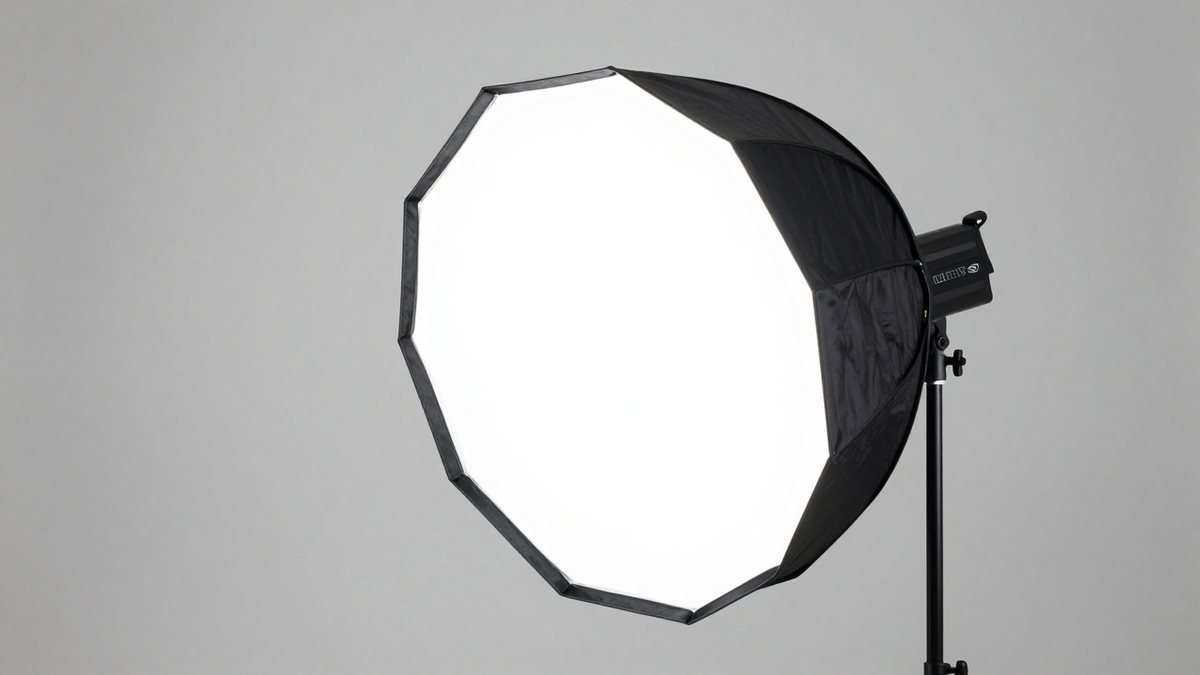
- 40–60 cm: Best for jewellery, small objects, overhead detail, and cramped desks. It is easy to control but creates harder-edged shadows when placed far from the subject.
- 60–90 cm: The most versatile range for tabletop product photos, crafts, tools, and a single presenter in a compact room.
- 90–120 cm: A strong choice for head-and-shoulders video. The larger surface wraps light around the face and reduces abrupt shadow transitions.
- 120–150 cm: Useful for full-body portraits or groups, but it needs more output, more floor space, and a stronger stand.
Softness depends on the apparent size of the source from the subject’s viewpoint. A 120 cm softbox placed close can look soft; the same box placed across a large room may look relatively small. Larger boxes also catch more air, so they need a weighted stand base or sandbag.
Color temperature and color accuracy
A daylight-balanced kit around 5,600 K is the simplest choice when matching a window or other daylight source. A bi-color LED, commonly adjustable from approximately 2,700 K to 6,500 K, gives more flexibility for warm interiors, mixed lighting, and changing conditions. The trade-off is that bi-color fixtures may produce less maximum output at some settings than a daylight-only fixture of similar rated wattage.
Look for a published CRI of at least 95 for product photography, especially when photographing wood, fabric, paint, food, or tools with subtle finishes. TLCI is also useful for video. High color accuracy will not fix incorrect white balance, but it reduces unwanted shifts between materials and makes color correction less demanding.
For consistent product listings, turn off competing room lights when possible. A desk lamp at 3,000 K mixed with a 5,600 K softbox can create different colors across the same object, particularly on reflective surfaces.
Stand height, stability, and room fit
A stand that reaches 200–260 cm is appropriate for most seated or standing presenters. For tabletop work, a 180–220 cm stand is usually enough, and a shorter minimum height makes low-angle placement easier. The important measurement is not maximum height alone: check the stand’s folded length, footprint, and load rating.
Thin three-section stands are light and inexpensive but can flex when fully extended. A stand with wider leg sections, metal locking collars, and an air-cushion feature is safer for frequent indoor use. Add a sandbag whenever the softbox is extended high or placed close to a walkway. Never rely on the lamp’s weight to keep a large softbox stable.
| Kit class | Typical light output | Softbox | Approx. packed weight | Best room size | General market range |
|---|---|---|---|---|---|
| Compact single-light | 40–60 W LED | 40–60 cm | 2–4 kg | Desk or small office | $70–$160 |
| Standard single-light | 60–100 W LED | 60–90 cm | 3–6 kg | Small to medium room | $120–$280 |
| Video key-light kit | 100–200 W LED | 90–120 cm | 5–9 kg | Medium room | $220–$550 |
| Large or two-light kit | 2 × 100–200 W LED | 2 × 90–120 cm | 9–16 kg | Medium to large room | $400–$900 |
These are broad market ranges rather than fixed prices. Cases, stands, wireless control, batteries, and high-output COB fixtures can move a kit into a higher price category.
Brand and kit-type considerations
Godox offers a broad ecosystem of COB LEDs, Bowens-mount modifiers, and portable lighting accessories. Neewer covers many budget-oriented continuous-light and softbox combinations, making it useful when the priority is a complete starter setup at a lower cost. Westcott is known for softbox and lighting accessories with an emphasis on convenient setup. Impact products are another option to consider when stand and modifier construction are more important than the lowest initial price.
Rather than choosing a brand by itself, compare the parts that are expensive or difficult to replace: the light’s output and control system, the stand’s stability, the softbox’s diffusion layers, and the availability of replacement rods and fabric. A kit with a common Bowens mount may have a longer useful life because compatible modifiers are widely available.
What wears out first?
- Diffusion fabric: It collects dust, absorbs odours, and can yellow or tear at the edges. Store it dry and avoid folding it while damp.
- Softbox rods and speed rings: Repeated forced assembly can bend rods or crack plastic mounts. Insert rods evenly and do not twist a loaded softbox.
- Stand locks: Loose collars and stripped knobs make a stand unsafe. Tighten only enough to secure the section and replace damaged parts.
- Power cables: Sharp bends near the lamp or plug cause failures. Coil cables in broad loops rather than wrapping them tightly around the stand.
- LED cooling systems: Dust blocking vents can cause overheating or automatic output reduction. Clean vents with the fixture unplugged and cooled.
Reflective products often reveal more about a kit than matte subjects do. Use the softbox’s front diffusion panel, rotate the product instead of moving the light repeatedly, and flag unwanted reflections with black card. Avoid placing the box so close that its frame appears as a distracting bright shape on polished metal or glass.
How to choose in five steps
- Measure the room. Mark the subject position, camera position, and the space needed behind the stand. A large kit is not useful if it blocks the doorway.
- Choose the softbox first. Select 60–90 cm for products and 90–120 cm for a single presenter, then make sure the light can drive it at the intended distance.
- Set the power target. Start around 60–100 W for close tabletop work and 100–200 W for video or larger spaces.
- Decide whether color adjustment matters. Select daylight-only for a controlled studio or bi-color when the room and schedule change frequently.
- Check ownership details. Confirm replacement diffusion, mount compatibility, stand load rating, folded dimensions, warranty terms, and whether a carry case is included.
Bottom line
For most beginners photographing products or recording in a small room, a 60–100 W daylight or bi-color LED with a 60–90 cm softbox and a stable 200 cm stand is the best balance. Choose a 90–120 cm softbox and 100–200 W fixture when flattering video light is the priority. Go smaller only when portability or desk space dominates, and choose a larger two-light setup when you need background separation, full-body coverage, or consistent lighting across a wider scene.