What's inside
As an Amazon Associate I earn from qualifying purchases. This post may contain affiliate links at no extra cost to you.
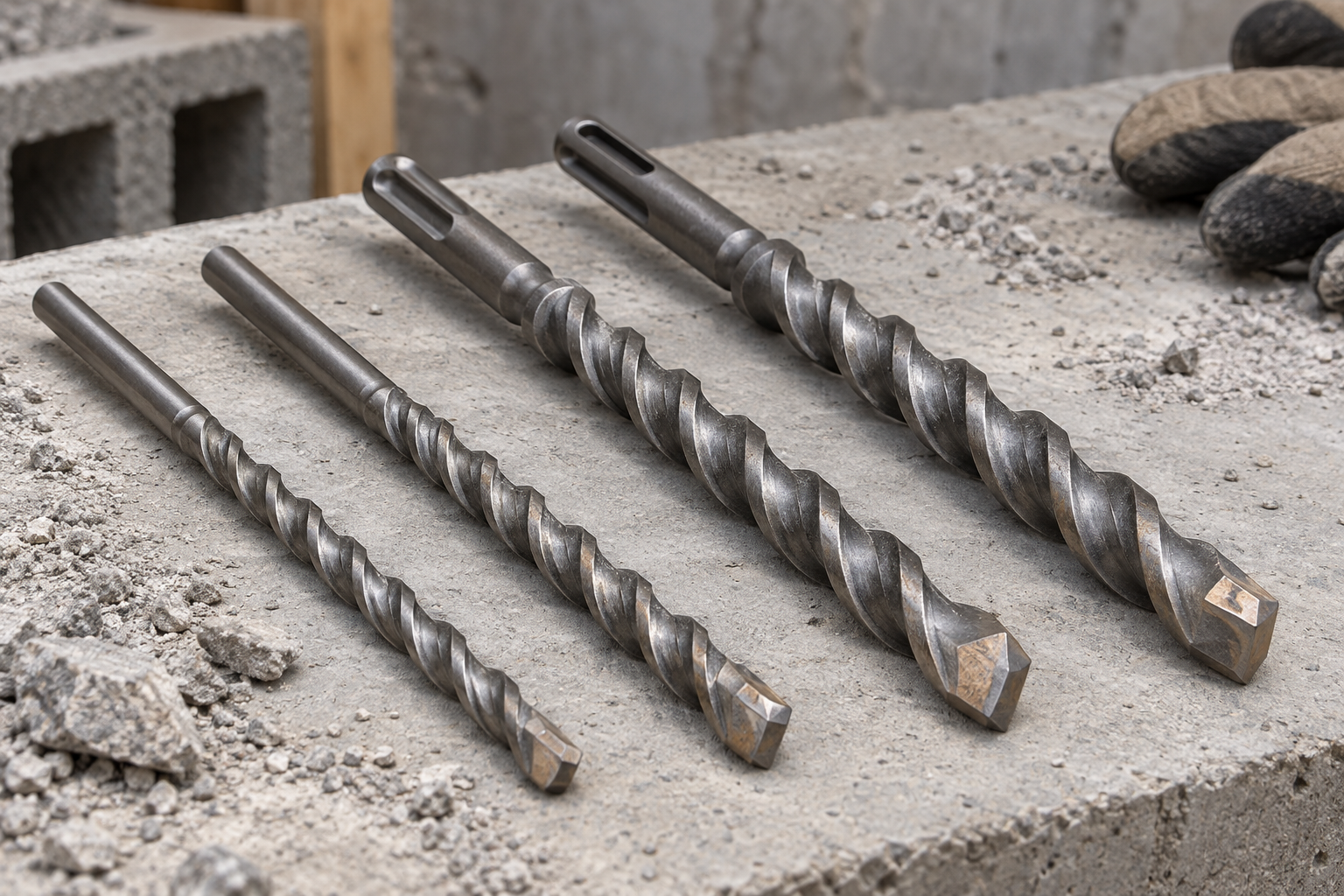
For boring anchor holes in reinforced concrete, the best SDS-Plus bit is usually a four-cutter, full-carbide-head bit—not the cheapest two-cutter bit in the rack. A four-cutter design is less likely to snag when it meets rebar, and it produces a more predictable hole for concrete anchors. It still is not a license to drill through structural steel. If the bit hits serious reinforcement, stop and change the hole location when possible.
As an Amazon Associate we earn from qualifying purchases at no extra cost to you.


Our Top Picks


The best bit type for reinforced concrete
Choose an SDS-Plus four-cutter concrete drill bit with a solid carbide cutting head. The four cutting edges distribute impact more evenly than the common two-cutter tip. That matters when the hole crosses a steel bar: the bit is less prone to locking, chattering, or deflecting sideways.
A two-cutter bit is fine for ordinary brick, block, mortar, and unreinforced concrete. It is also the cheaper choice for occasional holes. But its tip can catch on rebar and lose its edge quickly. For a few small holes in light concrete, the savings may be worthwhile. For repeated anchor work, especially with holes 12 mm (1/2 inch) or larger, the four-cutter upgrade is easier to justify.
Full-carbide-head bits cost more than bits with a small brazed carbide insert, but they handle interrupted cutting better. Reinforced concrete is an interrupted cut by nature: hard aggregate, cement, voids, and steel arrive in sequence. A solid head generally stays accurate longer and is less likely to lose a cutting segment.
What to look for before buying
| Feature | Why it matters | Best use |
|---|---|---|
| Two-cutter carbide tip | Low cost and fast in normal masonry, but more likely to grab rebar | Occasional holes in brick, block, or plain concrete |
| Four-cutter carbide head | Better control and less snagging around reinforcement | Regular anchor holes in reinforced concrete |
| Full-carbide head | Handles interrupted cutting and keeps the hole more consistent | Heavy use or critical anchor installation |
| Length with dust channels | Removes drilling debris and reduces heat buildup | Deep holes, especially 75 mm (3 inches) and longer |
| SDS-Plus shank | Fits rotary hammers with the smaller quick-change chuck | Light- and medium-duty rotary hammers |
Match the bit diameter to the anchor manufacturer’s specification, not just to the fastener diameter. A typical 3/8-inch concrete screw may call for a 5/16-inch hole, while a sleeve or wedge anchor may require a hole the same nominal diameter as the anchor. Check the required depth too. Many anchors need the hole to be at least 1/4 inch deeper than the embedment so dust and drilling debris do not prevent full seating.
Diameter, length, and anchor fit
For common brackets, handrails, ledger supports, and equipment mounts, useful SDS-Plus sizes include 1/4, 5/16, 3/8, 1/2, and 5/8 inch. Metric sizes such as 6, 8, 10, 12, and 16 mm cover much of the same work. Buy the exact size required; an oversized hole can reduce anchor holding power, while an undersized hole can prevent the anchor from seating or overload the fastener during installation.
Use the shortest bit that reaches the required depth. Long bits flex more, especially when the hammer is held at an angle. A bit with 160 mm (6-1/4 inches) of overall length may be adequate for a 3-inch hole, while a 260 mm (10-inch) bit gives useful reach but is less rigid. Do not confuse overall length with working length. The useful drilling depth is the fluted length minus the portion held in the chuck.
For holes deeper than roughly 4 inches, a longer bit with efficient flutes becomes more important. If the bit cannot clear dust, it can bind and overheat even when the cutting head is still sharp. A dust extractor or periodic withdrawal helps considerably.
How to drill without ruining the hole
Use rotary-hammer mode, not hammer-drill mode, when the material is solid concrete. Mark the location and start with the tool square to the surface. Run the hammer at moderate pressure until the tip forms a stable track. Excessive force does not make the carbide cut faster; it can slow rotation, pack dust in the flutes, and overheat the bit.
Withdraw the bit every 2 to 4 inches of drilling to clear dust. For a deep hole, pull it out more often. Keep the hammer running briefly while withdrawing, then clear the hole with a vacuum or the method specified by the anchor manufacturer. Do not rely on blowing dust into the hole with your mouth or compressed air when working overhead.
If the bit strikes rebar, the sound usually changes from a steady grind to a sharp metallic chatter. The bit may stop advancing, twist in your hands, or begin walking sideways. Stop immediately. Do not lean harder on the tool. A four-cutter bit may pass through light wire or a small bar, but drilling reinforcement can weaken the structure, damage the bit, and create a hole that is no longer where you intended.
When SDS-Plus is the wrong size
SDS-Plus is well suited to anchor holes up to about 3/4 inch in ordinary work, though the hammer’s specifications matter. Larger diameters and deep holes can exceed the useful capacity of a compact SDS-Plus tool. If drilling becomes slow, the bit overheats, or the hammer cannot maintain impact, step up to an SDS-Max rotary hammer and the matching bits rather than forcing the smaller system.
For critical structural anchors, engineered post-installed rebar, or holes where reinforcement cannot be avoided, use the project engineer’s instructions. A standard masonry bit is not a substitute for a rebar-cutting system, and an anchor hole that intersects steel may need approval before its location is changed.
The practical buying choice
For occasional DIY work, a reputable two-cutter SDS-Plus masonry bit set is adequate if you are drilling plain concrete and can move the hole when you meet steel. For repeated work in reinforced slabs, foundations, and poured walls, buy a four-cutter full-carbide bit in the exact anchor size. A four-cutter full-carbide SDS-Plus bit costs more, but the improved control and lower chance of edge damage are worth it when every hole needs to be accurate.