What's inside
As an Amazon Associate I earn from qualifying purchases. This post may contain affiliate links at no extra cost to you.
For smoothing mild steel edges, the best general-purpose choice is a single-cut mill bastard file. Its straight, parallel teeth remove metal in a controlled way and leave a cleaner surface than a coarse double-cut file. A 10- or 12-inch file is the most useful size for brackets, plate, flat bar, tubing, and cut edges left by a saw or grinder.
Choose a double-cut bastard file when speed matters more than finish. Choose a second-cut or smooth-cut mill file when the edge is already close to shape and you want fewer visible file marks. The right cut depends on how much metal remains to remove, not simply on the steel’s thickness.
As an Amazon Associate we earn from qualifying purchases at no extra cost to you.


Our Top Picks
 Nicholson "Crescent Nicholson 10" Mill Single Cut SmoothOne Size1 x 1 x 1 Inches0.33 poundsCheck on Amazon
 Crescent Nicholson 14" Mill Single Cut Smooth FilePack of 10.81 x 10.12 x 1.69 inches1 poundsCheck on Amazon


The best cut for smoothing mild steel
A single-cut mill bastard file has one set of parallel teeth running diagonally across the face. The teeth act more like a series of small scrapers than a set of crossing chisels. That makes the file easier to control on a flat edge and less likely to leave deep, torn grooves.
“Bastard” describes the tooth spacing, not poor quality. It is a medium-coarse cut. On ordinary mild steel, it removes enough material to be practical while still producing an edge that can be refined with a finer file or abrasive paper.
For most general repairs, pair the file with a 10-inch single-cut mill bastard file. A 12-inch version gives a longer stroke and tends to leave a flatter result on wide edges, while a 6- or 8-inch file is easier to control on small parts but removes metal more slowly.
Mill file cuts compared
| File cut | Material removal | Surface left on mild steel | Best use |
|---|---|---|---|
| Double-cut bastard | Fast | Coarse, pronounced grooves | Reducing weld spatter, heavy burrs, or excess metal |
| Single-cut bastard | Moderate | Controlled, medium-fine file marks | General edge smoothing and shaping |
| Single-cut second cut | Moderate to slow | Finer and more even | Refining an edge after a bastard file |
| Single-cut smooth | Slow | Fine finish | Final fitting and removing light file marks |
For an edge left by a hacksaw, angle grinder, or abrasive cutoff wheel, a double-cut bastard file can save time during the first pass. It is a poor finishing choice, however. Its crossing teeth can dig into corners, clog more quickly with soft steel, and create deep scratches that require extra work to remove.
When a different cut makes sense
Use a double-cut bastard file if you need to remove roughly 1/32 inch or more from a high spot, flatten a rough saw cut, or knock down a substantial weld bead. Keep the strokes controlled and check the work often. It is easy to remove more steel than intended, especially near a corner.
Use a single-cut second-cut file when the edge is already straight and you are mainly removing burrs and rough marks. It is often the best choice for visible work such as a steel bracket, tool repair, or a fabricated panel where the final surface will be painted.
A smooth-cut file is appropriate for light blending, close fitting, or preparing an edge before fine abrasive finishing. It will not efficiently correct a crooked edge. If you start with a smooth file on a rough cut, the teeth load with steel and the job becomes frustrating rather than precise.
For a two-stage setup, buy a mill file set with bastard, second, and smooth cuts. That costs more than one file, but it avoids forcing one file to perform every job.
Size and shape matter
A 10-inch file, measured by the toothed length, is a strong default for mild steel. Files in this size range have enough cutting surface to bridge small irregularities instead of following every dip. Use a 12-inch file for long edges or when you want a smoother result from each stroke. Use a 6-inch or 8-inch file for small tabs, narrow slots, and work that requires more fingertip control.
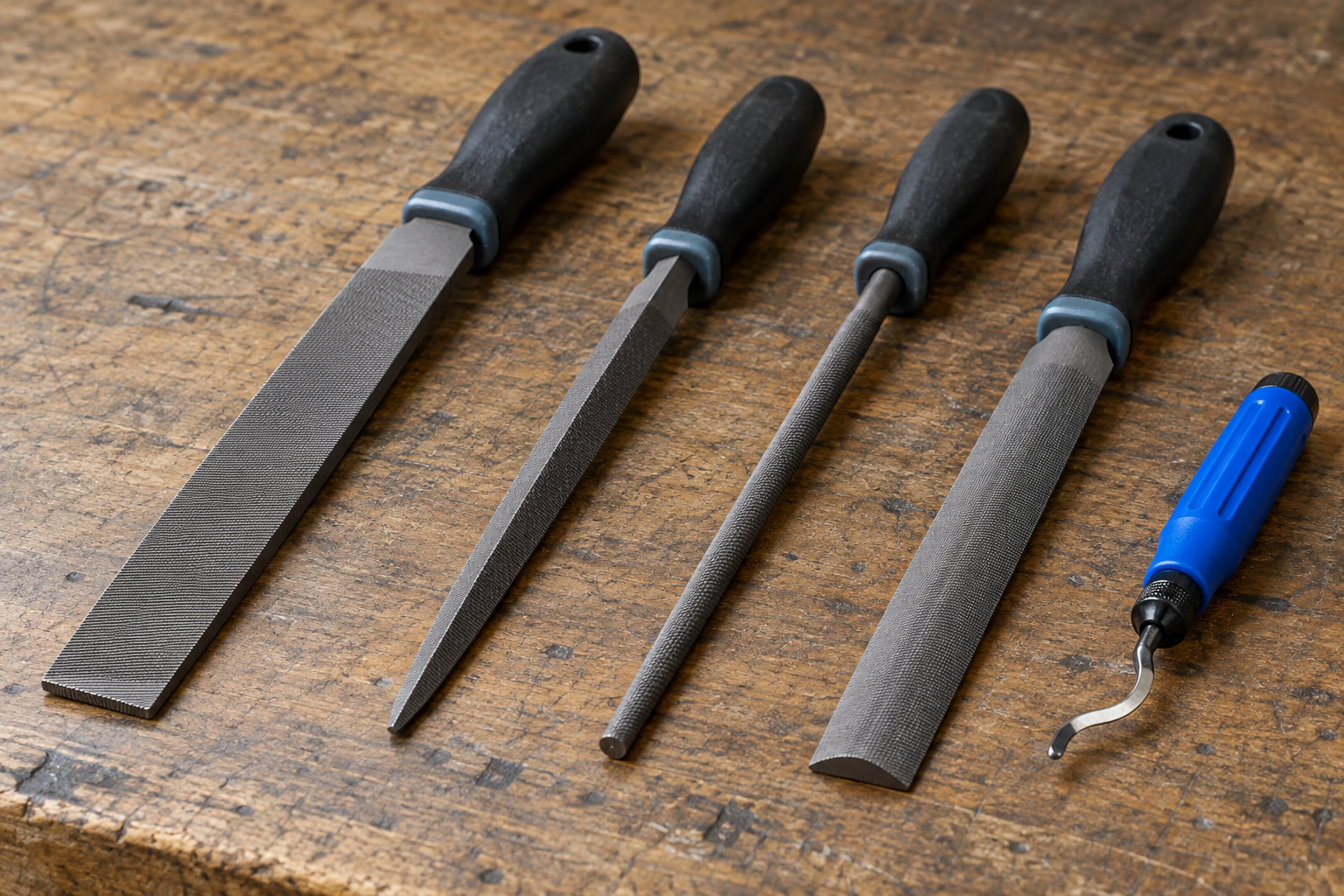
Choose a flat mill file for flat edges and broad faces. Its parallel sides are useful for keeping a shoulder straight. A half-round file is better for inside curves, while a triangular file is intended for V-shaped grooves and saw teeth. A round file is the wrong tool for a flat steel edge because it concentrates pressure on a small area and can create a hollow.
A file with one smooth “safe” edge is useful when working against a finished shoulder. The safe edge does not cut, so it reduces the chance of widening an adjacent slot or damaging a perpendicular surface. If the job has no nearby shoulder, a conventional double-edged file generally removes material faster.
How to file the edge cleanly
Clamp the steel firmly in a vise, with the work extending only as far as necessary. Unsupported sheet or flat bar will vibrate, which makes the file chatter and rounds the edge. Protect finished surfaces with vise jaw covers or thin cardboard.
Hold the handle in your dominant hand and guide the nose with the other. Push the file forward with moderate pressure, then reduce pressure on the return stroke. Files cut on the push stroke; dragging them backward under pressure dulls the teeth. Use the full length of the file and occasionally change the angle slightly to avoid wearing one track into the edge.
For a straight edge, file lengthwise along the edge first. If you need to remove a burr from a thin sheet, use a shallow angle and light pressure. Heavy pressure on a thin edge can curl it over rather than cut it cleanly.
Start with a 10-inch double-cut bastard file only when significant material must come off. Switch to a single-cut bastard or second-cut file as soon as the edge is within about 1/64 to 1/32 inch of its final shape. Finish with 180- to 240-grit abrasive paper if paint or frequent handling demands a less noticeable scratch pattern.
Common mistakes and failure modes
If the file slides without cutting, the teeth may be packed with steel. Brush them with a file card, brushing in the direction of the grooves. Do not use a hard screwdriver or another file to scrape across the teeth; that can damage the cutting edges. Chalk can reduce clogging on softer metals, but mild steel usually needs regular cleaning more than heavy lubrication.
A file that leaves random deep gouges is often too coarse, being used with too much pressure, or contaminated with chips. A rounded edge usually means the file was rocked during the stroke or the work was not supported. A file with a loose or missing handle is a safety problem: the tang can puncture your hand. Replace the handle or the file before continuing, and wear eye protection because steel chips are sharp.
What to buy
If you want one file for ordinary mild-steel edge work, buy a quality 10-inch single-cut mill bastard file with a secure handle. The cheaper option is perfectly adequate for occasional deburring, especially if the file will see only a few projects. Pay more for a better-made file when you need a flatter edge, expect repeated use, or are fitting parts where a few thousandths of an inch matter.
For frequent fabrication, the practical combination is a double-cut bastard file for fast stock removal, a single-cut bastard or second-cut mill file for smoothing, and a safe-edge file for work near shoulders. That setup is more versatile than buying a large assortment of specialty shapes, while still keeping the finish and control appropriate for mild steel.