What's inside
As an Amazon Associate I earn from qualifying purchases. This post may contain affiliate links at no extra cost to you.
Our Top Picks


Best Magnetic Indicator Base for Checking Drill Press Spindle Runout
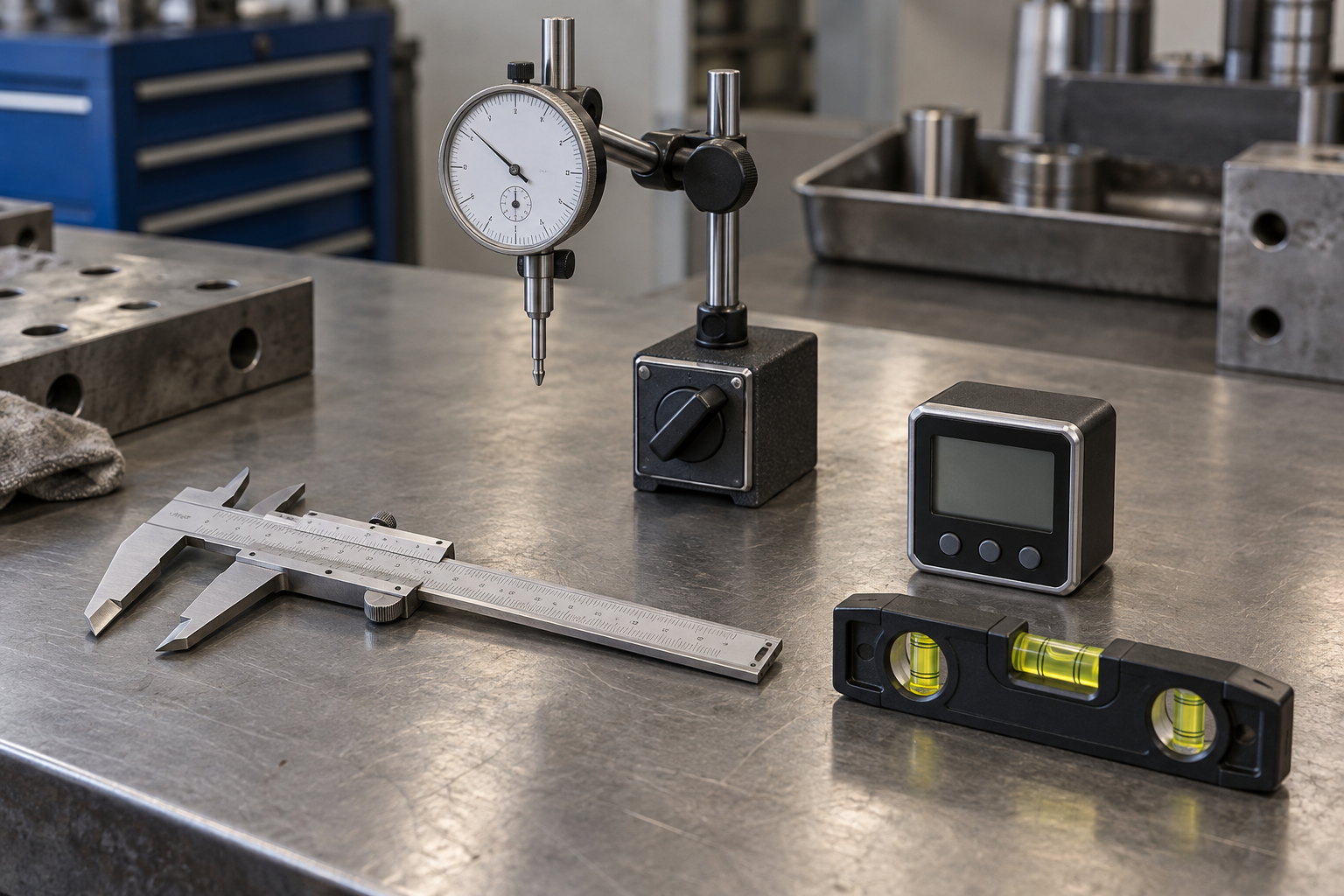
A magnetic indicator base is useful for checking drill press spindle runout, but the best one is not necessarily the largest or strongest base in the catalog. For this job, you need a base that holds its position while the spindle turns, fits into the limited space around the quill, and lets you position the indicator without running out of arm travel.
For most drill presses, a compact magnetic base with a mechanical locking arm is the best choice. A full-size base is more stable on a clean cast-iron table, but it can be awkward when the indicator must follow the spindle or chuck. A small articulated base is easier to fit around the quill, though it gives up some rigidity and magnetic holding power.
As an Amazon Associate we earn from qualifying purchases at no extra cost to you.


Quick comparison
| Base type | Best use | Main advantage | Main drawback |
|---|---|---|---|
| Compact magnetic base with fine adjustment | General drill press runout checks | Good access and easy positioning | Less stable if the magnet is small or the surface is dirty |
| Full-size articulated magnetic base | Maximum rigidity and larger machines | Strong magnet and long reach | Bulky around a small quill |
| Mini magnetic base | Benchtop drill presses and tight spaces | Fits almost anywhere | More sensitive to vibration and arm loading |
| Magnetic base with dovetail or fine-adjust slide | Repeatable indicator placement | Fast, precise setup | Costs more and adds another locking point |
What to look for when buying
Start with the magnet. A switchable permanent magnet is preferable to a weak horseshoe-style magnet for most drill press work. It should engage and release cleanly, with no noticeable sliding when the indicator arm is loaded. Magnetic holding-force ratings are usually measured on thick, clean, flat steel. A drill press table may be cast iron, painted, ribbed, or interrupted by slots, so the real holding force can be much lower.
For a typical benchtop drill press, a base around 2 to 3 inches long and 1.5 to 2 inches wide is usually easier to use than a large industrial base. If your drill press has a broad, flat cast-iron table and you are checking runout with the indicator mounted to the table, a full-size base is a sensible upgrade. A strong base is especially helpful when the table is raised, tilted, or not perfectly clean.
The arm matters as much as the magnet. Two short, rigid arms are generally better than one long arm because they reduce flex. Long reach is convenient, but every extra inch increases leverage against the magnet and magnifies vibration. Look for an arm system with positive locking joints rather than friction-only ball joints.
A fine-adjustment mechanism is useful but not essential. It saves time when the indicator tip must be placed exactly on a chuck body or test bar. If the base has no fine adjuster, you can still set it accurately by loosening one joint at a time. Do not pay extra for a fine adjuster if you only check runout a few times a year.
For a straightforward purchase, compare compact magnetic indicator bases with fine adjustment. For a larger floor-standing drill press, look instead at full-size articulated magnetic bases.
How to use the base to check spindle runout
Clean the table and the bottom of the base first. A thin chip under the magnet can tilt the base or let it move as you tighten the arm. Retract the drill press quill, stop the motor, and remove the drill bit. For the most useful check, install a clean, straight test bar or a known-good chuck arbor. Measuring directly on a rough chuck body can confuse chuck surface variation with spindle runout.
Place the magnetic base on a flat part of the table. Put the indicator tip against the test bar as close to the chuck as practical, normally within about 1 inch of the chuck jaws. A longer distance makes angular error more visible. Set the indicator roughly perpendicular to the surface being measured. If the tip contacts at a steep angle, the reading can include cosine error and the tip may drag.
Turn the spindle by hand through one complete revolution. Do not use the motor. Note the total indicator reading from the lowest to highest position. Repeat the test two or three times, rotating the test bar in the chuck if possible. If the high spot moves with the bar, the bar or its seating is suspect. If it stays in the same spindle position, the spindle, arbor, or chuck may be contributing to the runout.
As a practical guide, under 0.001 inch of total indicated runout is very good for a general-purpose drill press. Around 0.001 to 0.003 inch can be perfectly usable for ordinary drilling. Readings above 0.003 inch deserve investigation, particularly if holes are oversized or drills wander. These are not universal pass/fail limits; the machine’s age, chuck quality, and intended work matter.
Common setup failures
The most common failure is mounting the base on a dirty or uneven surface. The second is using too much arm extension. If the indicator moves when you touch the test bar, shorten the arm, move the base closer, or use a stronger base.
Another mistake is checking a drill bit instead of a test bar. Twist drills are rarely straight enough for a meaningful spindle measurement, and their flutes give the indicator an uneven surface. A chuck can also show more apparent runout near its nose than at the arbor because the chuck body is not a precision reference surface.
Watch for quill movement. If the indicator base sits on the drill press table and the quill is extended, any looseness in the quill or spindle bearings can affect the reading. Check runout with the quill retracted, then repeat with it extended to the working position. A large difference points to quill or bearing condition rather than simply a bad chuck.
Is the cheaper base good enough?
Yes, if the magnet locks firmly, the arms do not flex, and the base fits your machine. A basic compact base is enough for occasional checks on a small drill press. Spend more for a larger magnet, better arm locks, and fine adjustment when you work with larger machines, need repeatable measurements, or regularly check vise and table alignment as well as spindle runout.
An inexpensive mini magnetic indicator holder can be fine in a tight benchtop setup, but keep the arm short and avoid pushing the indicator sideways. If you want one base for several inspection jobs, a magnetic base with fine adjustment is the more versatile choice.
For most owners, the sensible buy is a compact, switchable magnetic base with two rigid locking arms and a standard indicator stem clamp. It provides enough stability for honest runout measurements without becoming a bulky fixture around the drill press quill.