What's inside
- Best Driveway Gate Openers for Swing and Slide Gates
- Quick picks by driveway situation
- Gate opener comparison: ratings that affect fit
- Swing versus slide: choose the mechanism first
- AC power versus solar power
- Duty cycle matters more than occasional maximum weight
- Decision matrix for common buyers
- Installation details that determine reliability
- Ownership costs and common failure points
- Frequently asked questions
As an Amazon Associate I earn from qualifying purchases. This post may contain affiliate links at no extra cost to you.
Our Top Picks
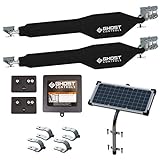
 GHOST CONTROLS Solar Heavy-Duty Automatic Gate Opener KitSolar Single Swing Gate Opener37.8 x 9.25 x 7.5 inches26 poundsCheck on Amazon
 Ghost Controls TDS2XP Heavy-Duty Solar Dual Automatic GateSolar Dual Swing Gate Opener41 x 8.5 x 10.5 InchesCheck on Amazon


Best Driveway Gate Openers for Swing and Slide Gates
The best driveway gate openers are matched to the gate’s type, weight, length, daily traffic, and available power—not simply to the highest advertised weight rating.
Quick picks by driveway situation
- Best for a frequently used residential slide gate: a 24-volt commercial-duty rack-and-pinion slide opener rated for at least 1,000 pounds and 50 cycles per hour.
- Best for a heavy residential swing gate: a linear or articulated-arm opener with a 1,000-pound-plus rating, adjustable limit stops, and separate photocell inputs.
- Best where utility power is unavailable: a 12-volt swing or slide opener designed for solar charging, paired with a deep-cycle battery and a correctly sized panel.
- Best for occasional-use, budget installations: a residential-duty swing opener, provided the gate is light, well balanced, and used fewer than roughly 10 to 20 cycles per day.
- Best for long or heavy gates: a commercial-duty 24-volt opener. Its extra margin matters more than a low purchase price when wind, slope, and frequent use are involved.
Gate opener comparison: ratings that affect fit
The figures below are useful buying targets rather than universal limits. Manufacturers measure capacity differently, and a gate’s wind load can reduce its practical rating substantially. Always compare the opener’s current manual with the measured gate.
As an Amazon Associate we earn from qualifying purchases at no extra cost to you.



| Opener category | Typical gate type | Practical gate weight | Typical gate length | Typical duty cycle | Power options |
|---|---|---|---|---|---|
| Light residential swing | Single or dual swing | Up to 600–850 lb per leaf | Up to 12–16 ft per leaf | About 10–20 cycles/day | 120V transformer or solar battery |
| Heavy residential swing | Single or dual swing | About 850–1,500 lb per leaf | Up to 14–18 ft per leaf | About 20–50 cycles/day | 120V, 24V battery, or solar |
| Residential slide | Rolling or cantilever slide | Up to 600–1,000 lb | About 12–30 ft | About 10–30 cycles/day | 120V or solar-compatible battery |
| Commercial slide | Rolling or cantilever slide | About 1,000–2,000 lb or more | About 20–50 ft | 50–100 cycles/hour on some models | 120V AC with 24V backup battery |
Swing versus slide: choose the mechanism first
Swing gates
Swing openers work with one or two hinged leaves. Linear actuators are usually the cleanest choice when the opener can be mounted between the hinge and the gate post with the required clearance. Articulated-arm openers are more forgiving on large masonry posts or unusual hinge geometry.
Weight is only part of the load. A solid wooden or steel gate may catch far more wind than an open picket gate of the same weight. A 10-foot privacy gate can therefore require the same opener class as a much heavier but open-frame gate. For dual gates, check whether the rating is stated per leaf or for the complete gate.
Slide gates
Slide openers pull the gate along a level track or guide it through a cantilever system. They generally tolerate heavy gates better than swing openers, but only when the gate rolls freely. A motor should not be used to compensate for seized rollers, a bent track, inadequate end stops, or a sagging frame.
Measure the entire sliding travel, not just the opening. A 16-foot opening may require a 32-foot gate if the gate must slide completely beyond the driveway. The opener’s published gate-length limit normally refers to the moving gate, not the clear opening.
AC power versus solar power
AC-powered openers are the dependable choice for high traffic, cold weather, shaded properties, and large motors. A 120-volt installation can support a battery backup, so the gate may continue operating during a short outage. It does require permitted wiring, conduit, and a suitable disconnect where local rules require them.
Solar power avoids trenching but introduces battery maintenance and weather dependence. The panel must replace the energy used by the gate plus losses from the controller, battery, and winter conditions. A small panel can appear adequate in summer yet leave the battery depleted after several cloudy days.
As a sizing example, suppose a gate uses 0.01 kWh per open-and-close cycle and makes 20 cycles each day. That is 0.2 kWh daily before charging losses. At an estimated 70% overall charging efficiency, the system needs roughly 0.29 kWh of solar energy per day. Four hours of effective winter sun would require about a 73-watt panel, so a practical design might use a 100-watt panel rather than a marginal 75-watt unit. Local shade, snow, battery age, and colder temperatures may justify more capacity.
Duty cycle matters more than occasional maximum weight
Duty cycle describes how often the opener can operate without overheating or wearing prematurely. A gate used twice each morning and twice each evening has a very different requirement from one serving a workshop, rental property, or small business.
Count every opening and closing as a cycle according to the manufacturer’s definition. Ten vehicles entering and leaving may create 20 motor operations. Add keypad deliveries, guests, and automatic reclose events. If your estimate is close to the opener’s limit, choose the next duty class rather than operating at the ceiling.
Commercial-duty slide operators often use brushless or industrial motors, metal gearboxes, adjustable acceleration, and active cooling. Residential units can be quieter and less expensive, but their plastic gears, lighter control boards, and smaller transformers are less suitable for constant traffic.
Decision matrix for common buyers
| Your situation | Recommended specification | Why |
|---|---|---|
| Short, open-frame swing gate; fewer than 10 cycles/day | 600–850 lb rating, 12–16 ft rating, residential duty | Avoids paying for commercial capacity you will not use |
| Wood privacy swing gate in a windy location | At least 1,000 lb per leaf, heavy-duty arms, wind-resistant hinges | Wind can overload the actuator even when the gate is relatively light |
| Rolling slide gate used 30–60 times/day | 24V commercial-duty slide operator, 1,000 lb or greater rating | Provides thermal and mechanical margin for repeated starts |
| Remote property with no trenching | Solar-ready 12V system, 80–150W panel, sealed deep-cycle battery | Allows independent operation but leaves reserve for cloudy weather |
| Driveway with little side room | Swing gate only if the leaf can clear the road; otherwise a slide gate | Prevents the gate from projecting into traffic or requiring unsafe clearance |
Installation details that determine reliability
- Measure the gate. Record each leaf’s length, approximate weight, frame material, and whether it is solid or open. Do not rely on a guessed weight.
- Check movement manually. A swing leaf should move smoothly on properly sized hinges. A slide gate should roll with one hand on level ground. Repair binding before installing the motor.
- Confirm geometry. Actuator mounting dimensions control leverage and the opening angle. An opener that technically fits may still stall if mounted too close to the hinge.
- Install safety equipment. Use photo eyes, edge sensors where appropriate, manual-release hardware, and physical stops. A timer-to-close is not a substitute for obstruction protection.
- Protect the wiring. Use rated conduit, weatherproof junction boxes, and low-voltage cable sized for the run. Voltage drop can cause nuisance resets and weak motor performance.
- Set limits and force carefully. The gate should stop against mechanical stops, not repeatedly slam into the motor’s travel limit. Force settings should be high enough for normal movement but not used to overcome a defective gate.
Ownership costs and common failure points
Rollers, hinges, guide brackets, batteries, and rack hardware usually need attention before the motor itself. Slide-gate rollers collect grit and rust; swing-gate hinges sag; exposed rack bolts loosen; and lead-acid batteries commonly lose capacity after several years, sooner in extreme heat.
Clean leaves, mud, and ice from the travel path. Lubricate hinges and rollers only with products recommended for the hardware—excess grease can attract abrasive dust. Inspect the rack-to-pinion gap on slide systems and check that safety sensors remain aligned. Solar systems need periodic panel cleaning and a battery-voltage check, especially after extended cloudy weather.
The most costly mistake is buying by maximum weight alone. A long, solid, wind-exposed gate or a heavily used entrance needs reserve capacity, correct geometry, and a suitable duty cycle. Match all three, and the best driveway gate openers are the ones that operate below their limits for years rather than the cheapest unit that moves the gate once in a showroom.
Frequently asked questions
Can a solar opener run a heavy gate?
Yes, if the opener is specifically designed for solar operation and the panel, battery, and gate mechanics are correctly sized. Heavy gates and high traffic may require a larger panel and battery than the standard kit includes.
Is a heavier-rated opener always better?
No. Excess capacity does not fix poor hinges, a sloping track, or incorrect mounting geometry. It is useful as a margin against wind and frequent use, but the gate must still move freely.
How much clearance does a slide gate need?
Plan for the full gate length to move beside the driveway, plus room for the operator, end stops, and service access. Confirm the required side clearance before selecting a slide design.