What's inside
As an Amazon Associate I earn from qualifying purchases. This post may contain affiliate links at no extra cost to you.
A carpenter’s square can look substantial and still be wrong enough to spoil cabinet parts, framing marks, or a row of cuts. Check it before relying on it, especially if it has been dropped, stored loose in a toolbox, or used as a hammer. The basic test needs only a straight edge, a sharp pencil, and a flat surface.
Our Top Picks


What you need and how to set up
Use a flat sheet of plywood, MDF, or a workbench top that is flat enough for the job. You will also need a straightedge with a verified straight edge, a fine pencil, and a way to measure or magnify small gaps. A reliable ruler or tape helps, but the test is only as trustworthy as the straight reference you use.
Brush dust and chips off the square’s stock and blade. Check that the blade is not bent, the stock is not loose, and there are no burrs or dents where the square contacts the work. A burr can hold the tool off the surface and imitate an angle error. If you are choosing a replacement for frequent layout, compare steel carpenter’s squares with lighter aluminum options; steel is durable, while aluminum is easier to handle but can be more easily damaged by a hard impact.
The reverse-line test
1. Set the square’s stock firmly against a straight reference edge on your work surface. Keep it seated without forcing it sideways.
2. Draw a fine line along the blade, starting at the stock and extending several inches. A longer line makes a small angle error easier to see.
3. Flip the square over so the opposite face of the blade rests against the same reference edge. Put the stock at the same starting point and draw a second line beside the first, using the same edge of the blade.
4. Compare the lines. If they diverge, the square is out of square. If they remain parallel, the square passes this check within the limits of your marking and reference surface. A narrow gap at the far end is more informative than judging by eye at the stock.
For a rough measurement, check the separation near the far end with a ruler. For example, if the two lines differ by 1/16 inch over 12 inches, the square is not a good choice for precise cabinet layout. The exact tolerance you need depends on the work: framing marks can often tolerate more than fine joinery. Do not assume a line that looks close is accurate enough for every task.
Read the result—and check your references
The reverse test doubles the apparent error: each line is made with the square in the opposite orientation, so the gap between them is about twice the square’s deviation from 90 degrees. If the lines are 1/16 inch apart over 12 inches, the square’s error is roughly half that amount in each direction. Treat this as an estimate, not a precision calibration; pencil width, pressure, and edge quality all affect the result.
Before rejecting a square, verify the reference edge. Turn the workpiece around and repeat the test from the other end. If the result changes, the reference edge or the way you are seating the stock may be the problem. Test on another flat surface if possible. A twisted work surface, sawdust under the stock, or a damaged reference edge can make a good square appear bad.
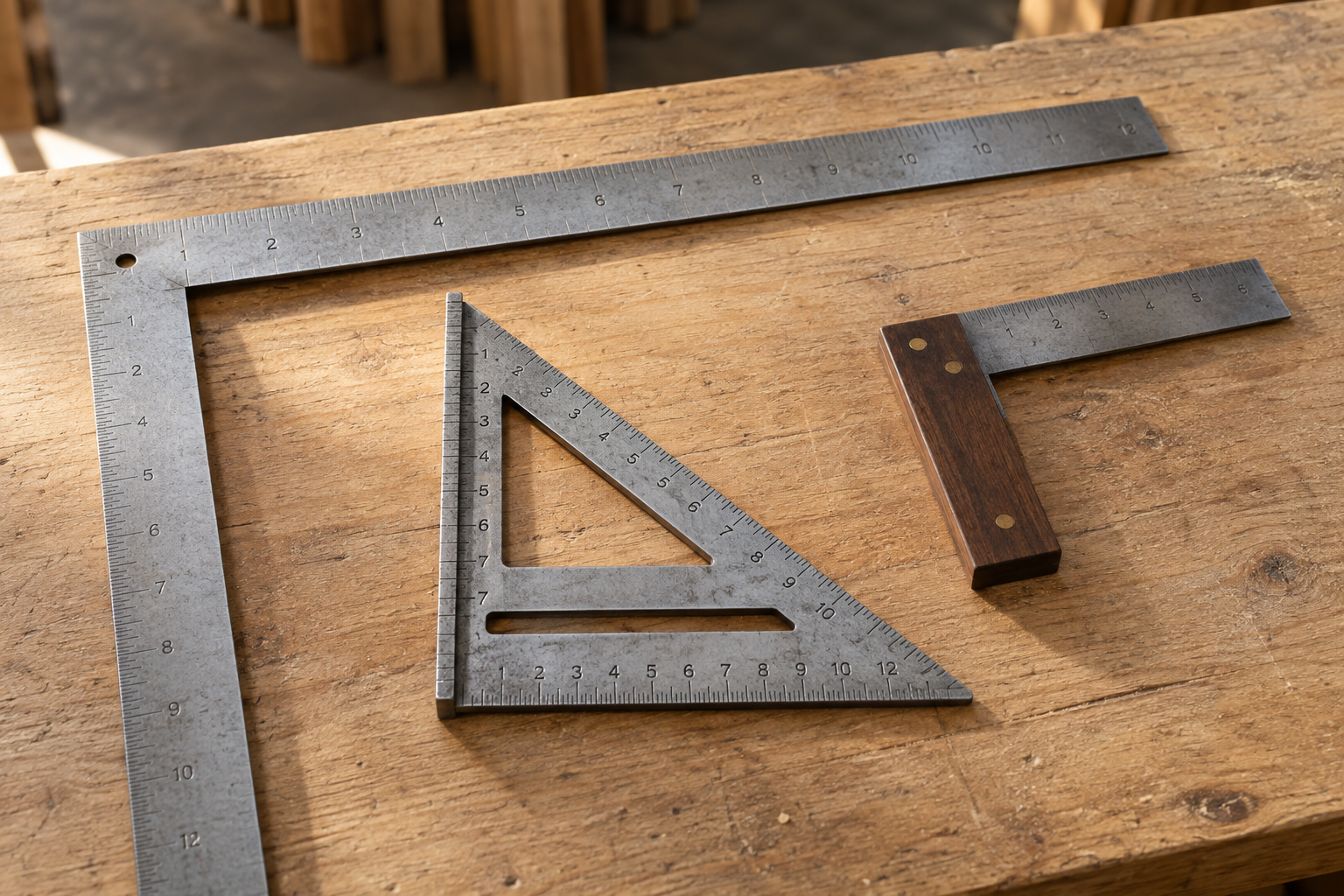
For a closer check, use a second square that has already passed the reverse test, or compare the blade against a verified straightedge and a reliable setup. A framing square is useful for longer marks, but its size makes it easier to bump or seat unevenly. A compact machinist’s square set can help with small parts and close checks; it is not a substitute for a full-size square when laying out long boards.
Which square suits the work?
| Type | Useful for | Trade-offs |
|---|---|---|
| Framing square | Long layout lines, rafters, and framing | Large and fast to use, but awkward on small parts; can be bent or damaged if stored loosely |
| Combination square | General layout, checking 90-degree and 45-degree angles, and measuring depth | Adjustable and versatile; the head can slip or wear, so check its lock and repeatability |
| Try or machinist’s square | Short, precise marks and checking smaller assemblies | Convenient for fine work, but its short blade does not verify a long line as easily |
A combination square deserves its own check. Lock the head, make a line, reverse the tool against the same reference, and compare as above. Then loosen and relock the head and repeat. If the line changes each time, the head is slipping or its seating surfaces are dirty or worn. A basic 12-inch combination square is a practical all-around choice, but a cheaper one is fine for rough layout if it locks firmly and passes the test. Pay for a better tool when repeatability matters, not just because the packaging claims precision.
When to adjust, replace, or keep using it
Do not bend a blade to correct an error unless the tool is designed to be adjusted and you know how to verify the result afterward. On many squares, bending can leave a twist or create a new error in another direction. If the square has a loose stock, damaged blade, or results that vary when you repeat the test, replace it rather than trying to compensate during layout.
If the square is slightly off but still useful for rough work, label it clearly and keep it separate from tools used for fine layout. For critical cuts, check the square before starting and transfer marks from a verified reference. A square that passes today can be knocked out of alignment tomorrow, so repeat the test after a hard drop or any suspicious impact.
For actual layout, keep the stock seated against a clean edge, use a sharp pencil or marking knife, and avoid pressing hard enough to shift the tool. Accuracy is a chain: a square, reference edge, and mark all have to be dependable. A quick reverse test catches the most common problem before it multiplies across a project.