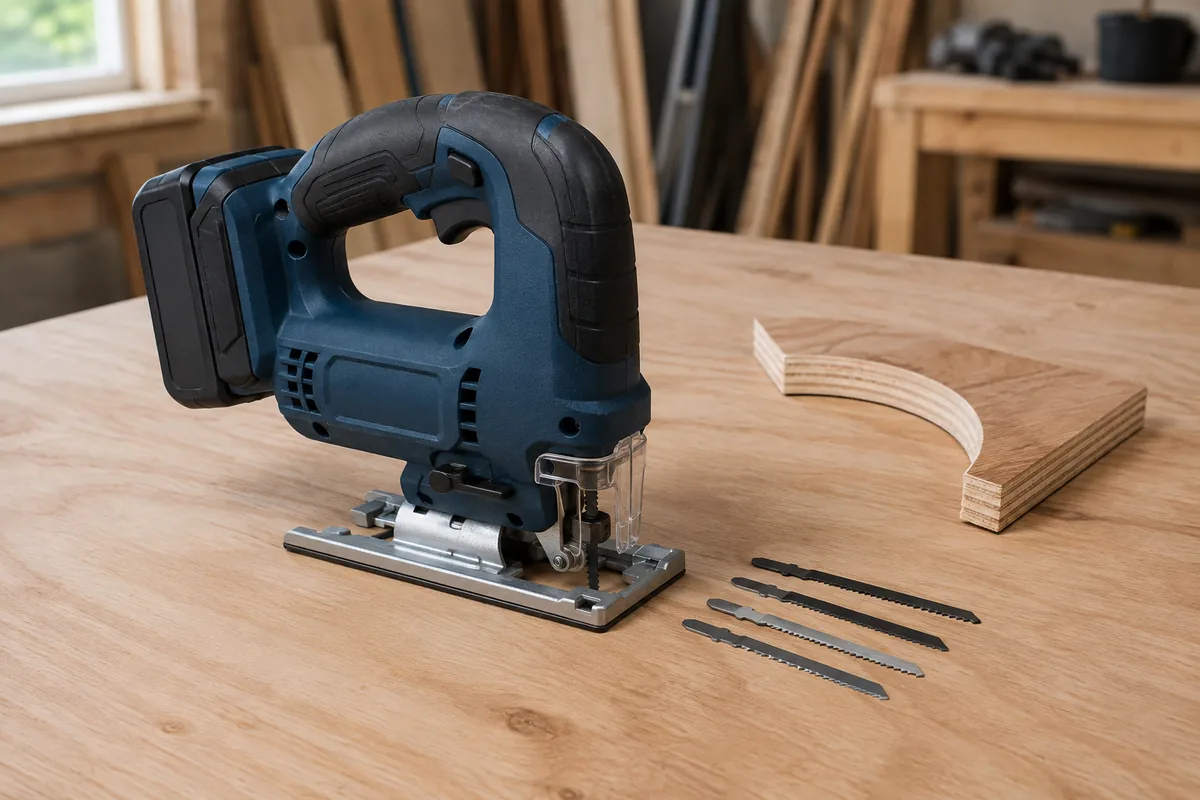
What's inside
As an Amazon Associate I earn from qualifying purchases. This post may contain affiliate links at no extra cost to you.
For most current jigsaws, T-shank blades are the more practical choice. They are widely available, usually install without a tool, and fit a larger range of newer saws. U-shank blades still have a place: they can be perfectly adequate for older jigsaws and are often inexpensive. The important point is that shank shape affects compatibility and convenience more than cutting performance.
As an Amazon Associate we earn from qualifying purchases at no extra cost to you.


Our Top Picks


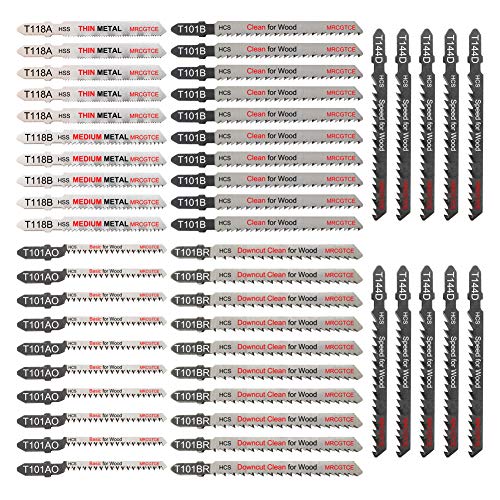

What the Shank Does
The shank is the top end of the blade that locks into the jigsaw. It does not cut the material; the toothed portion does that. A correctly fitted blade must sit fully in the clamp and remain straight while the saw moves it up and down, often at several thousand strokes per minute.
A T-shank blade has a shaped tang that engages a slot or clamp in the tool. Most modern jigsaws use a tool-free lever or button to secure it. A U-shank blade has a rounded or U-shaped notch and is typically held by a screw or clamp. Some U-shank systems also require a small adapter, depending on the saw.
Neither design automatically makes cleaner or faster cuts. Tooth geometry, blade thickness, material, orbital action, speed control, and operator technique have a much larger effect.
T-Shank vs. U-Shank at a Glance
| Feature | T-shank | U-shank |
|---|---|---|
| Typical saw compatibility | Most newer consumer and professional jigsaws | Many older or basic jigsaws |
| Blade installation | Usually tool-free | Often requires a screw or tool |
| Blade changes | Fast, commonly taking a few seconds | Slower, especially when changing between materials |
| Availability | Broad selection in wood, metal, laminate, and specialty types | Good selection, but less universal in stores |
| Risk of buying the wrong blade | Low if the saw specifies T-shank | Higher because some saws accept only specific U-shank patterns |
| Best reason to choose it | Convenience and long-term compatibility | Using an existing older saw cheaply |
Why T-Shank Is Usually More Practical
The main advantage is speed. On a tool-free jigsaw, you can remove a hot or worn blade and install a new one without searching for a hex key or screwdriver. That matters when switching from a coarse wood blade to a fine blade for plywood, or when a blade becomes dull halfway through a cut.
T-shank blades are also the default format for much of the current market. You can find short blades for thin sheet metal, long blades for thick lumber, narrow blades for curves, and flush-cut or laminate options. A larger selection makes it easier to match the blade to the job rather than forcing one general-purpose blade to do everything.
The locking system can also reduce user error. With a screw-held blade, a partially tightened clamp may let the blade twist, wander, or pull out. A T-shank blade is not foolproof, but a proper tool-free mechanism gives a clear installation point. You still need to pull down on the blade after installation to verify that it is locked.
If you are buying a new jigsaw, a T-shank jigsaw blade set is generally the safer accessory purchase. Check the saw manual first; a few tools use proprietary or unusual systems.
When U-Shank Is Still a Good Choice
U-shank is not inherently weak or inaccurate. If you already own a reliable U-shank jigsaw, there is no need to replace it just because T-shank is newer. For occasional cutting of pine, plywood, plastic, or thin metal, inexpensive U-shank blades can do the job well.
They are especially reasonable when the saw stays in a workshop and you rarely change blades. The extra minute spent loosening and tightening the clamp is insignificant if you make only a few cuts each month. A basic U-shank jigsaw blade assortment can also be cheaper than buying a new saw simply to gain tool-free blade changes.
The catch is compatibility. “U-shank” is not always enough information. The blade must match the saw’s clamp depth, retaining screw arrangement, and clearance around the shank. Consult the manual or compare the old blade with the replacement before ordering. Do not force a T-shank blade into a U-shank clamp or modify either part.
Cutting Performance and Failure Modes
In identical lengths and tooth patterns, a T-shank and U-shank blade can produce similar cuts. A fine-tooth blade with 10 to 14 teeth per inch is suitable for cleaner cuts in plywood or laminate, while a coarse blade with roughly 6 to 10 teeth per inch removes wood faster but leaves a rougher edge. Metal blades commonly use much finer teeth.
Most cutting problems blamed on the shank have another cause. A blade that bends away from the cut may be too narrow, dull, too long for the material, or being pushed too hard. Burning usually indicates excessive pressure, an unsuitable tooth pattern, or a dull blade. Splintering is often controlled with a fine blade, masking tape, a sacrificial backing board, or cutting with the finished face oriented appropriately.
A loose U-shank clamp can allow the blade to rotate slightly on every stroke. The result is a wandering cut, vibration, and sometimes a broken blade. A T-shank can fail too if the locking collar is dirty, the shank is not fully inserted, or the blade is damaged. Stop using the saw if the blade moves sideways in the holder or the clamp will not retain it securely.
What to Buy
Choose T-shank if you are purchasing a jigsaw, expect to change blades regularly, or want the broadest future selection. Look for a saw with a genuinely secure tool-free clamp, a visible blade-release mechanism, and a guide roller that supports the blade close to the workpiece. A mixed T-shank wood and metal blade set is useful for general household work, but specialized blades are better for repeated cabinet, flooring, or metal projects.
Choose U-shank if your existing saw is compatible, works reliably, and blade changes are infrequent. The cheaper option is fine for light work; there is no practical reason to upgrade solely for the shank shape. Before starting, install the blade, unplug or remove the battery while checking it, and make a test cut in scrap material. Secure the workpiece, keep the base flat, and let the blade’s teeth—not excessive forward pressure—do the cutting.