What's inside
As an Amazon Associate I earn from qualifying purchases. This post may contain affiliate links at no extra cost to you.
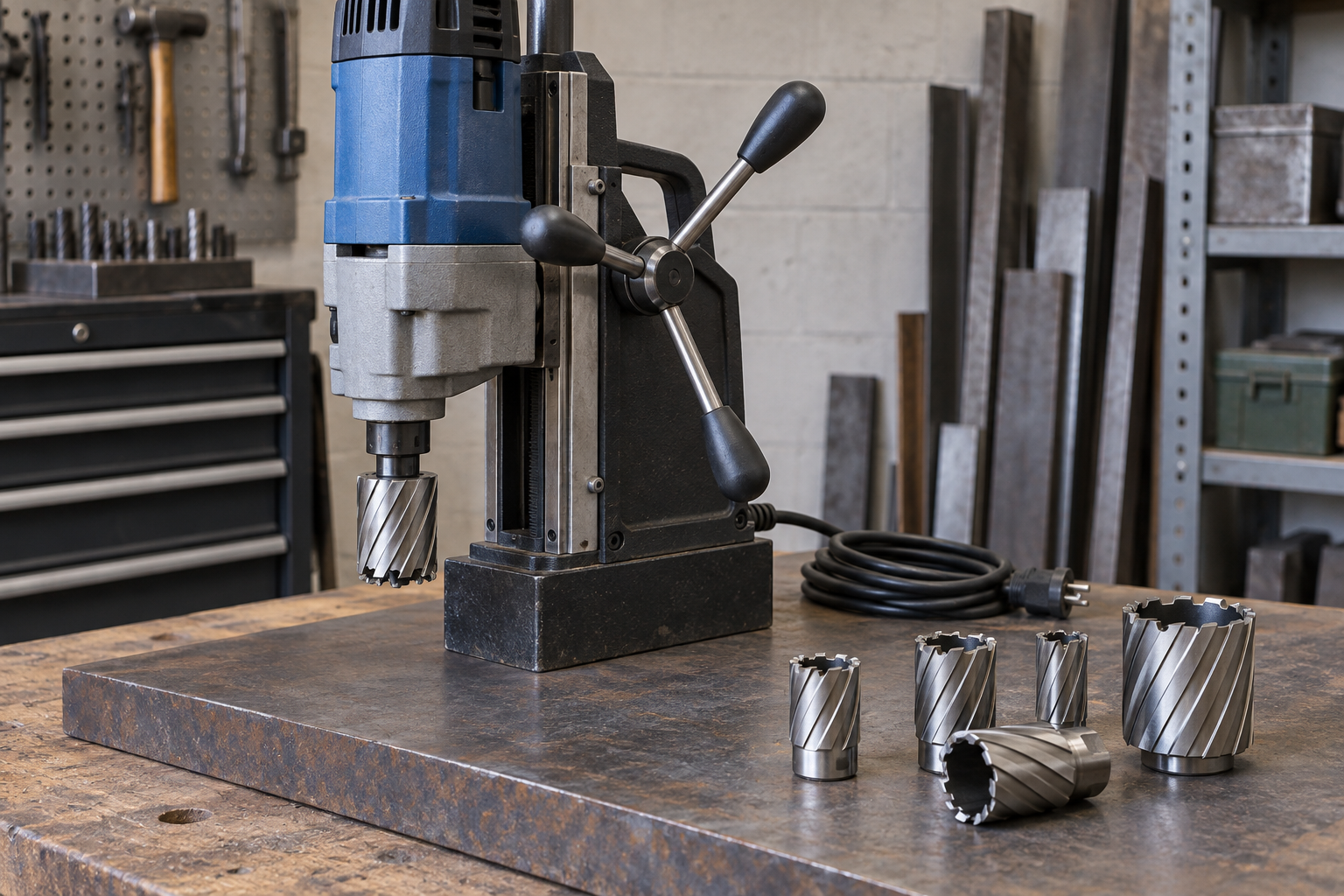
An annular cutter removes a ring of metal instead of grinding out the entire hole. That makes it much faster than a twist drill for larger holes, especially when paired with a magnetic drill press. The right cutter depends on the hole diameter, material, required depth, drill interface, and how well you can control heat and chips.
Buy the cutter for the job rather than choosing the largest or cheapest set. A mismatched cutter can stall the drill, damage its teeth, or leave a hole that is undersized and rough.
Match the Cutter to the Material
Most annular cutters are made for mild steel, but not every cutter handles stainless steel, cast iron, or hardened material equally well. Check the manufacturer’s material rating before buying.
| Cutter type | Best use | Main advantage | Common limitation |
|---|---|---|---|
| High-speed steel (HSS) | Mild steel, structural steel, aluminum | Lower cost and good general-purpose performance | Teeth dull faster when overheated or used on stainless |
| HSS with cobalt | Stainless steel and tougher alloys | Better heat resistance and edge life | Costs more and still requires proper speed and coolant |
| Carbide-tipped | Stainless, hardened or abrasive materials, production work | Fast cutting and long life in suitable applications | Expensive and more vulnerable to impact, vibration, and crooked starts |
For occasional holes in 1/4- to 1/2-inch mild-steel plate, a conventional HSS annular cutter set is usually the sensible choice. If you regularly cut stainless, a cobalt HSS set is a better investment. Carbide is not automatically better for a homeowner; it is costly insurance when the work justifies it.
Choose Diameter and Cutting Depth
Annular cutters are commonly sold in metric and fractional sizes. Confirm the required hole size, especially when installing conduit, cable glands, bolts, or pipe fittings. A 1-inch cutter and a 25-millimeter cutter are close, but they are not interchangeable in every application.
Cutting depth is equally important. Common lengths include approximately 1 inch, 2 inches, and 3 inches. A cutter rated for 1 inch cannot safely cut through 1-1/4-inch material. Do not count the pilot pin as cutting depth; the annular teeth must extend fully through the workpiece.
For material thicker than the cutter’s rated depth, use a longer cutter or drill from both sides. Drilling from both sides can work, but alignment is rarely perfect, and the two openings may not meet cleanly. For deep holes, look for an extended-depth annular cutter that matches your drill’s arbor.
Check the Arbor and Pilot Pin
The cutter must fit the magnetic drill’s arbor. Popular interfaces include Weldon shanks, often 3/4 inch or 1-1/4 inch, along with smaller shanks used on compact drills. Some cutters use two flats for set screws; others use a different locating arrangement. A cutter that is the correct diameter but has the wrong shank will not install securely.
Verify three measurements before ordering:
- The cutter shank diameter and flat arrangement
- The drill arbor’s accepted shank size
- The pilot pin diameter and length
The pilot pin centers the cutter, retracts as the cutter enters the metal, and helps eject the slug. It is not merely a spare accessory. A wrong-length pin may prevent the teeth from engaging, fail to eject the core, or interfere with the drill’s coolant path. Keep replacement pins on hand, particularly if the tool uses separate pins for different cutter lengths.
Use the Correct Speed and Coolant
Annular cutters generally need slower speeds than twist drills. A useful starting formula is:
RPM = (surface speed × 12) ÷ (π × cutter diameter in inches)
For example, a 1-inch HSS cutter at a starting surface speed of about 60 feet per minute works out to roughly 230 RPM. Use the cutter maker’s speed chart when available. Reduce speed for stainless steel, thicker material, interrupted cuts, or a less rigid setup. Do not compensate for a slow magnetic drill by forcing the feed.
Flood coolant or a steady cutting-fluid supply extends tooth life and reduces heat. On vertical or overhead work, use a paste or heavy cutting oil that stays on the cut instead of running away. Dry cutting may be acceptable for some short holes in mild steel, but it is harder on HSS teeth. Never let a cutter turn blue from heat; the teeth have likely lost useful hardness.
Consider the Magnetic Drill
Match the cutter to the drill’s capacity, not just its advertised maximum hole size. A compact magnetic drill may handle a 1-inch cutter in mild steel but struggle with a 2-inch cutter or thick plate. Check the drill’s rated cutter diameter, speed range, arbor size, and available torque.
Magnet strength and surface condition matter. Paint, rust, scale, gaps, and thin material reduce holding power. Clean the contact area and make sure the magnet sits completely flat. A magnetic drill should not be trusted on a surface too thin for the manufacturer’s minimum holding requirement.
For larger holes, thick steel, and frequent work, an magnetic drill and annular cutter kit can cost less than assembling compatible parts. For occasional small holes, buying individual cutters for the sizes you actually need is usually cheaper and avoids a case full of unused sizes.
Avoid Common Failure Modes
Apply steady feed pressure. Too little pressure lets the teeth rub and overheat; too much pressure can stall the motor, strip teeth, or shift the magnet. If the cutter squeals, chatters, produces powder instead of curled chips, or stops making progress, stop and inspect the speed, lubrication, alignment, and cutter condition.
Do not start a large annular cutter on a sloped or uneven surface without a stable guide. Secure loose work, keep hands away from the rotating cutter, and use the drill’s safety strap where supplied. The steel slug can remain hot and may drop suddenly when the cut breaks through.
Replace a cutter when several teeth are missing, the kerf is visibly oversized, or cutting requires excessive force even at the correct speed. Sharpening may be worthwhile for expensive HSS cutters, but for inexpensive cutters, replacement is often more predictable. A sharp, correctly sized cutter is safer and usually faster than trying to rescue a damaged one.