What's inside
As an Amazon Associate I earn from qualifying purchases. This post may contain affiliate links at no extra cost to you.
Our Top Picks
 DEWALT FLEXVOLT 60V MAX* Reciprocating SawOne Size19.4 x 7.3 x 4.21 Inches7.43 PoundsCheck on Amazon


DeWalt DCS386 vs Bosch GSA18V-28: What Separates Them
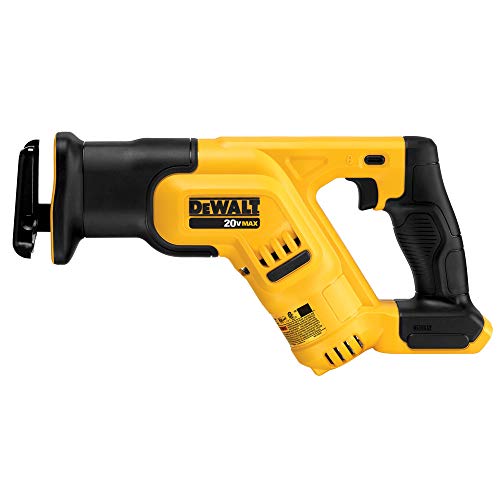
The DeWalt DCS386 and Bosch GSA18V-28 are both cordless reciprocating saws aimed at framing, remodeling, and demolition work. Both use a 1-1/8-inch stroke and reach about 2,900 strokes per minute, so neither is a slow, light-duty saw on paper.
The important difference is size and system design. The DeWalt is a compact 20V MAX saw built for working between studs, overhead, and in awkward renovation spaces. The Bosch is a larger 18V BITURBO model with more emphasis on cutting speed, vibration control, and sustained heavy work. The Bosch can be the better production tool, but the DeWalt is easier to carry and is often the more practical purchase for general demolition.
As an Amazon Associate we earn from qualifying purchases at no extra cost to you.



| Feature | DeWalt DCS386 | Bosch GSA18V-28 |
|---|---|---|
| Battery platform | DeWalt 20V MAX | Bosch 18V |
| Stroke length | 1-1/8 inches | 1-1/8 inches |
| Maximum speed | 2,900 SPM | 2,900 SPM |
| Tool weight | About 3.1 lb bare | About 5.7 lb bare |
| Blade change | Tool-free, multi-position clamp | Tool-free blade clamp |
| Best fit | Compact demolition and framing | Heavy-duty cutting and reduced vibration |
Where the DeWalt DCS386 Works Better
The DCS386’s main advantage is its compact body. At roughly 3.1 pounds without a battery, it is dramatically easier to control than the Bosch when cutting above shoulder height or reaching through a narrow wall opening. Its compact length also helps when removing trim, cutting between pipes, or opening a section of drywall without much room to swing.
The saw has a brushless motor, variable-speed trigger, LED work light, pivoting shoe, and a multi-position blade clamp. The clamp lets you install the blade with the teeth facing different directions, which is useful for flush cuts and for reaching around framing. It is a meaningful feature during remodeling, although it does not make the saw a substitute for a dedicated flush-cut tool.
For ordinary framing demolition, the DCS386 has enough power. It will cut dimensional lumber, nails, plastic pipe, copper, and light-gauge steel with the right blade. A 6.0Ah battery provides a useful balance of runtime and handling, while a compact 2.0Ah pack makes the saw noticeably lighter for short cuts.
Its limitations show up in long, aggressive cuts. The compact motor and lighter body can bog down sooner when the blade is buried in wet lumber, doubled-up framing, or nail-filled material. Pressing harder does not solve that problem; it usually increases vibration, stalls the motor, and overheats the blade. Let the blade do the cutting and use a coarse demolition blade for wood with embedded nails.
Where the Bosch GSA18V-28 Makes Sense
The Bosch GSA18V-28 is the heavier-duty choice. Its BITURBO motor is designed to work best with Bosch high-output ProCORE batteries, and it has a larger, more substantial chassis than the DeWalt. That added mass is a disadvantage in tight spaces but can make the cut feel steadier in heavy framing and metal work.
Bosch also puts more emphasis on vibration control. That matters when cutting for several hours, particularly through nail-laden lumber or steel studs. Lower vibration does not mean no fatigue—the saw is still around 5.7 pounds before adding a battery—but it can reduce the harshness transferred to your hands compared with a small, aggressively used reciprocating saw.
The Bosch is a better match for repeated cuts through thick lumber, demolition where the tool is run continuously, and users who already own Bosch 18V high-output batteries. With a smaller standard battery, it will still operate, but you may not get the same performance or runtime that the BITURBO system is designed to deliver.
The main failure mode is simply using too much saw for the space. Its longer, heavier body can be awkward inside stud bays and tiring during overhead work. If your projects involve more window replacement, bathroom remodeling, and occasional wall openings than full-time structural demolition, the Bosch’s extra capacity may spend more time in the truck than on the cut.
Cutting Performance in Framing and Demolition
Both saws use the same basic 1-1/8-inch stroke, so blade choice and technique often matter more than the printed specifications. Use a six-to-nine-teeth-per-inch demolition blade for fast wood cuts, a finer bi-metal blade for clean metal cuts, and a carbide-tooth blade for thick cast iron or heavily embedded fasteners. A dull blade can make either saw appear underpowered.
For framing, start the blade at low speed, set the shoe against the work, and increase pressure only after the teeth have established a cut. Keep the shoe planted. Pulling the saw away from the material turns the blade into a vibrating lever and increases the chance of a bent or broken blade.
Neither model has a meaningful reason to replace a circular saw for straight lumber cuts. A recip saw is slower and less precise, but it handles nails, awkward angles, embedded screws, and demolition where a circular saw would be unsafe or likely to hit hidden metal.
Battery, Blades, and Total Cost
The cheaper option is fine if you already own the matching battery platform and only need a general-purpose demolition saw. In that situation, the DCS386 is especially easy to justify because its bare-tool price is commonly lower than the Bosch’s, and its compact design covers more remodeling tasks than its weight suggests.
Buyers starting from scratch should compare the entire platform rather than the saw alone. A battery and charger can cost as much as the bare tool, and a high-output Bosch battery is important if you want the GSA18V-28 to deliver its intended performance. DeWalt users should also budget for quality blades; reciprocating saw blades are consumables, not accessories you buy once.
For a useful starter selection, consider a reciprocating saw blade set containing wood, metal, and demolition blades. If you cut a lot of framing, a carbide demolition blade can last considerably longer in nail-filled lumber than inexpensive bi-metal blades.
Which One Should You Buy?
Choose the DeWalt DCS386 for remodeling, framing punch-list work, overhead cutting, and demolition in confined spaces. It is the better everyday carry tool, especially if you already own DeWalt 20V MAX batteries. Its lower weight is not a minor convenience; it changes how long you can work accurately.
Choose the Bosch GSA18V-28 for frequent heavy demolition, long cuts, and users who value vibration control more than compact size. It is also the logical choice for an established Bosch 18V owner with high-output batteries.
If the jobs are mixed and the price difference is significant, buy the DeWalt and spend the savings on good blades and a second battery. The Bosch earns its higher cost mainly when its heavier construction and high-output system will be used regularly.