What's inside
As an Amazon Associate I earn from qualifying purchases. This post may contain affiliate links at no extra cost to you.
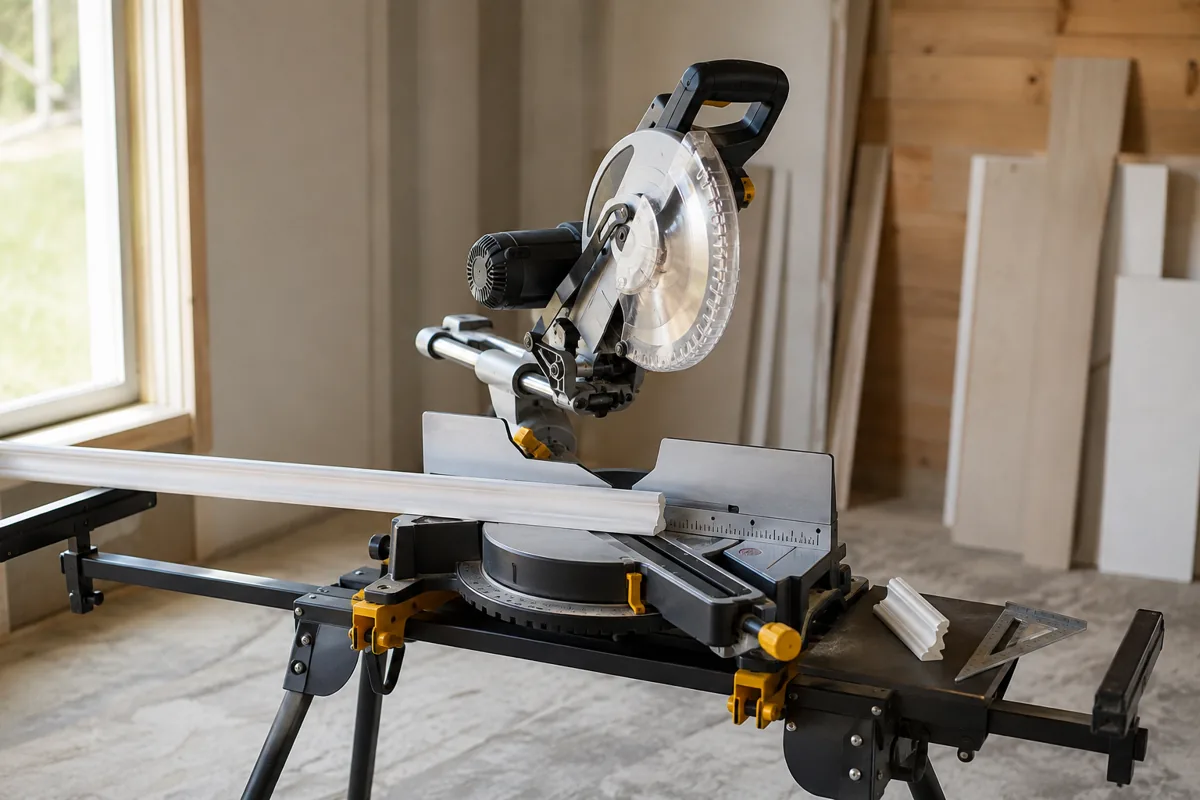
On crown molding, a dual-bevel miter saw can save time, but it does not automatically make every cut faster. The real advantage is that you can tilt the blade left or right without turning the molding over. That matters most when you are cutting long pieces, repeating compound angles, or working with tall crown against a fence. For a small room with straightforward corners, a single-bevel saw and a careful setup may be just as efficient—and cheaper.
As an Amazon Associate we earn from qualifying purchases at no extra cost to you.



Our Top Picks
 SKIL 10" Dual Bevel Sliding Compound Miter Saw-MS6305-0010''35.43 x 22.44 x 14.17 inches39.4 poundsCheck on Amazon



What the bevel does on crown molding
Crown molding sits between the wall and ceiling at an angle, so a corner joint usually needs both a miter and a bevel. A miter turns the cut across the board; a bevel tilts the blade through its thickness. On a single-bevel saw, the blade tilts in only one direction. On a dual-bevel saw, it tilts both left and right.
There are two common ways to cut crown. The first is to lay it flat on the saw table and use a compound miter-and-bevel setting. The second is to hold it nested against the fence at its installed spring angle and make a miter-only cut. The nested method often avoids bevel adjustments altogether, but it requires a saw and fence that support the molding’s height and a reliable way to hold the stock at the correct angle.
Where a dual-bevel saw saves time
When crown is laid flat, opposing pieces often call for opposite bevel directions. With a single-bevel saw, you may need to flip the molding end-for-end or face-over to make the matching cut. That can mean resetting the stop, checking which edge is against the fence, and confirming that the finished face has not been confused with the back. A dual-bevel saw lets you tilt the blade the other way instead.
The minutes add up on repetitive work. Suppose a room has four inside corners and four outside corners, with two mating cuts at each corner: that is 16 cuts before you account for test pieces, waste, and any extra joints on long walls. If flipping and reorienting each piece takes 20–30 seconds, avoiding that handling can save several minutes. More importantly, it reduces opportunities to cut the wrong end or reverse the molding.
That benefit is strongest with long, fragile, or wide stock. A 12-foot length is awkward to turn around without a helper or good support. On a dual-bevel saw, you can keep the same reference face against the table and make the opposite bevel by changing the saw’s tilt. The saw does not eliminate measuring, test-fitting, or angle errors, but it can make repeated compound cuts less fiddly.
When a single-bevel saw is enough
A single-bevel saw is a sensible choice if you are installing crown in one room, cutting only a few joints, or using the nested method. With the molding held in its installed position, many inside and outside corners can be cut by changing the miter angle and keeping the blade square at zero bevel. You still need to keep the crown consistently nested, and the saw must have enough capacity for its height and spring angle.
A single-bevel saw can also handle flat compound cuts. You will have to flip or reposition the molding for cuts that require the other bevel direction, then verify the orientation before cutting. Make a marked scrap piece showing “wall,” “ceiling,” and the finished face. That simple reference helps prevent a costly reversed cut, especially when the molding profile looks similar on both edges.
If you are shopping, compare capacity and fence support before paying extra for bevel direction. A single-bevel compound miter saw may be the better value for occasional trim work. If you expect to install crown regularly, a dual-bevel compound miter saw is easier to justify.
Single-bevel vs. dual-bevel for crown
| Factor | Single-bevel | Dual-bevel |
|---|---|---|
| Blade tilt | One direction; opposite cuts require repositioning the work | Tilts left and right without turning the molding over |
| Best fit | Occasional trim, simple rooms, or nested cutting | Repeated flat compound cuts and frequent trim work |
| Setup risk | More chances to reverse or misorient a piece when flipping | Less handling, but angles and orientation still need checking |
| Cost | Usually the lower-cost option | Usually costs more for the added bevel convenience |
| What it cannot fix | Bad measurements, inaccurate saw settings, unsupported stock, or a crown spring angle that does not match the setup | |
Accuracy matters more than bevel count
Neither saw automatically produces tight corners. Walls are rarely a perfect 90 degrees, and crown spring angles vary by profile. A common crown spring angle is 38 degrees, but 45-degree and other profiles are sold too. Use the molding maker’s angle when available, and test the setup on offcuts from the actual stock. A small error in the spring angle or miter setting can leave a visible gap along the ceiling or wall.
Support long molding at the same height as the saw table so it does not sag or twist. Clamp it where safe, keep hands clear of the blade path, and let the blade reach full speed before cutting. Check that the crown is seated firmly against both the table and fence; a gap of even a few millimeters can change the effective angle. For a stubborn corner, measure the wall angle rather than forcing the joint closed with filler.
Which one should you buy?
Choose single-bevel if price is the priority, you have a limited amount of crown to install, or you plan to cut it nested and your saw has sufficient capacity. The extra flipping is manageable when the job is small, and careful labeling plus test cuts can keep mistakes down.
Choose dual-bevel if you routinely cut crown flat, work alone with long lengths, or expect to repeat compound cuts across several rooms. It saves handling and makes left- and right-hand cuts more convenient. It is a time-saving feature, not a guarantee of a better joint: a stable setup, correct spring angle, and a test fit still matter more. If your crown can be nested accurately and the project is a single room, put the price difference toward a sharp blade, sturdy supports, or quality trim instead.