What's inside
- Quick comparison: the countertop systems that actually avoid plumbing
- Best choices by kitchen situation
- Filtration stages: more is not automatically better
- Pure-to-drain ratios: the calculation that matters
- Remineralization: useful preference, not a universal requirement
- Which systems truly need no plumbing?
- Ownership realities: what wears out first
- Space, noise, and daily convenience
- Final verdict
As an Amazon Associate I earn from qualifying purchases. This post may contain affiliate links at no extra cost to you.
The best countertop reverse osmosis systems for most kitchens are the AquaTru Countertop, Bluevua ROPOT, and SimPure Y7P: all can produce purified water without a permanent plumbing connection, but they differ substantially in waste-water ratio, tank size, filtration stages, and whether minerals are added back.
As an Amazon Associate we earn from qualifying purchases at no extra cost to you.


Our Top Picks
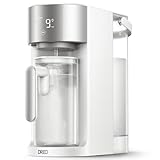
 DREO Reverse Osmosis Water Filter Countertop5L15.67 x 6.73 x 13.35 inches10.78 poundsCheck on Amazon
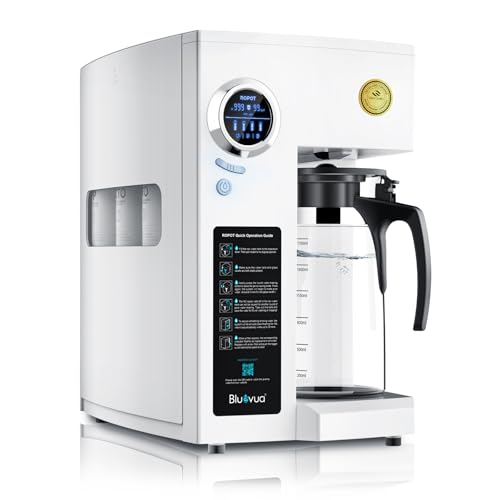 Bluevua RO100ROPOT Countertop Reverse Osmosis Water Filter SystemROPOT-UV10.9 x 15.4 x 14.3 Inches17.8 PoundsCheck on Amazon
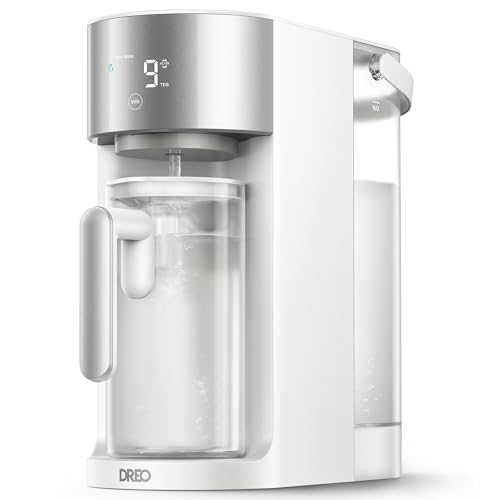 DREO Reverse Osmosis Water Filter System Countertop3L14.51 x 6.73 x 13.35 inches9.46 PoundsCheck on Amazon
Quick comparison: the countertop systems that actually avoid plumbing
These are countertop appliances with a feed-water tank and a separate pure-water container or dispenser. They do not require drilling, cutting a water line, installing a faucet, or connecting to a drain. You fill the reservoir manually and empty the reject-water tank when prompted.
| System | Filtration configuration | Approx. purified-water capacity | Manufacturer-stated water ratio | Remineralization | Permanent plumbing? |
|---|---|---|---|---|---|
| AquaTru Countertop | Four stages: sediment, activated carbon, RO membrane, activated carbon | About 0.75 gal clean-water tank | Approximately 1:3 pure-to-drain | No standard remineralization stage | No |
| AquaTru Carafe | Four-stage filtration, including RO membrane | About 0.75 gal carafe | Approximately 1:3 pure-to-drain | No standard remineralization stage | No |
| Bluevua ROPOT | Multi-stage RO system, commonly sold with sediment, carbon, RO, and polishing or mineral stages | Roughly 0.8–1.3 gal, depending on version | Often marketed around 1:1 to 1:1.5 | Some versions include a mineral filter; verify the exact model | No |
| SimPure Y7P | Four-stage RO filtration, with UV treatment on applicable versions | About 1.3 gal feed-water tank | Approximately 1:1.5 to 1:3, depending on water conditions | Not included on every version | No |
Capacities and ratios can change by model revision and water pressure. Treat the table as a buying comparison rather than a guarantee: check the specification sheet for the exact unit before ordering.
Best choices by kitchen situation
| Your priority | Best fit | Why | Trade-off |
|---|---|---|---|
| Small household and simplest operation | AquaTru Carafe | Compact footprint and a removable serving carafe | Smaller batches and relatively high reject-water volume |
| Established four-stage design | AquaTru Countertop | Clear stage layout and separate clean-water tank | Uses more feed water than the most efficient newer designs |
| Lowest practical water waste | Bluevua ROPOT, if the exact model lists a low ratio | Several versions emphasize improved pure-to-drain efficiency | Model names and remineralization features vary |
| Larger daily demand or UV preference | SimPure Y7P | Larger reservoir and versions with UV treatment | More counter space and more components to maintain |
| Mineral taste after RO | A unit supplied with a confirmed remineralization cartridge | Adds selected minerals after the RO membrane | Extra cartridge cost and a different water profile |
Filtration stages: more is not automatically better
A typical countertop RO system begins with a sediment filter that catches particles, followed by activated carbon that reduces chlorine and protects the RO membrane. The reverse-osmosis membrane does the main dissolved-solids reduction. A final carbon filter improves taste before dispensing.
Some systems add UV treatment, a mineral cartridge, or a second polishing stage. UV is a treatment feature, not a replacement for the sediment, carbon, or RO stages. A mineral cartridge is also not a purification stage in the same sense: it deliberately adds calcium, magnesium, or other minerals after filtration.
For city water with chlorine, a sediment-plus-carbon prefilter is especially important because chlorine can damage many thin-film composite RO membranes. If the product uses a proprietary combined cartridge, examine its replacement interval and cost rather than counting the marketing number of stages.
Pure-to-drain ratios: the calculation that matters
A ratio of 1:3 means the system produces one gallon of purified water while sending approximately three gallons to the reject tank. That is four gallons of input water per gallon of output. A 1:1 system needs about two gallons of input for one gallon of purified water.
For a household using 2 gallons of RO water each day:
- At 1:3, reject water is about 6 gallons per day, or 180 gallons per 30 days.
- At 1:1, reject water is about 2 gallons per day, or 60 gallons per 30 days.
- The nominal difference is about 120 gallons per month.
In practice, the ratio worsens when incoming water is cold, pressure is low, the membrane is nearing replacement, or the reject tank is not emptied promptly. Do not compare a manufacturer’s ideal laboratory ratio with a competitor’s measured household result as though they were identical tests.
Remineralization: useful preference, not a universal requirement
RO water commonly tastes flatter than unfiltered tap water because many dissolved minerals have been removed. A remineralization cartridge can restore some mineral content and alter the taste and pH. Choose it when flavor matters to you or when the manufacturer specifies which minerals are added.
Do not assume that “alkaline,” “mineral,” and “RO” mean the same thing. Alkaline claims describe a water characteristic, while RO describes a filtration process. A mineral cartridge also becomes a consumable item and can complicate comparison between total ownership costs.
Which systems truly need no plumbing?
A system qualifies as genuinely no-plumbing only when all of the following are true:
- The feed-water tank is filled by hand.
- Purified water is collected in an integrated tank, carafe, or dispensing chamber.
- Reject water is collected in a removable tank or container.
- The unit does not require a faucet diverter, saddle valve, drain clamp, or permanent inlet hose.
A countertop unit that includes an optional direct-water kit may still work without plumbing, but read the setup instructions carefully. Some tankless “countertop” products require a pressurized water connection, while many under-sink systems require both a drain connection and a dedicated faucet. Those are not no-plumbing systems simply because they occupy little space.
Ownership realities: what wears out first
Filter life depends on feed-water quality and daily volume, but a practical planning range is 6–12 months for sediment and carbon stages and approximately 12–24 months for an RO membrane. Follow the replacement indicator or manufacturer schedule where available. High sediment, hard water, and heavy use shorten these intervals.
The storage tanks and dispensing paths also need attention. Empty leftover water rather than allowing it to sit for days, wash removable tanks with mild dish soap, and rinse thoroughly. Never use abrasive cleaners on transparent reservoirs. If water begins to smell, flow slows, or the system repeatedly reports a full reject tank, clean the tanks and inspect the filters before assuming the membrane has failed.
The most common mistake is treating the reject-water tank as optional. A countertop RO unit still creates concentrate water; it simply stores it instead of sending it down a drain. Another is filling the feed tank above its marked line, which can cause spills when the system transfers water internally. Leave clearance above the unit for opening the lid and below it for removing tanks.
Space, noise, and daily convenience
Measure the counter depth and the vertical clearance beneath cabinets. Many countertop RO machines occupy roughly 9–14 inches of width, 14–18 inches of depth, and 14–20 inches of height. A unit that fits with the lid closed may still be inconvenient if the feed tank cannot be removed without moving it.
Expect a pump sound during filtration, followed by a waiting period for a full batch. A 0.75-gallon clean-water tank suits drinking and occasional cooking for one or two people. Larger households should favor a unit with at least a 1-gallon feed reservoir or plan to refill it several times daily.
Final verdict
Choose the AquaTru Carafe for compact, low-volume use; the AquaTru Countertop for a familiar four-stage arrangement; the Bluevua ROPOT when verified water-efficiency specifications are the priority; and the SimPure Y7P when a larger reservoir or applicable UV configuration is more important. For any choice, confirm the exact pure-to-drain ratio, cartridge prices, remineralization stage, tank dimensions, and manual-fill requirements. Those details determine whether the machine is truly convenient after the first month—not the headline number of filtration stages.