What's inside
- Cordless vs. Air-Powered: What Changes in a Tight Space
- Drive Size and Head Clearance Determine Fit
- Spec Comparison: Real Models by Size, Weight and Speed
- Top Picks for Tight Spaces by Situation
- Battery vs. Air System Requirements: Calculate Before You Buy
- Fastening Speed and Control in Real Use
- Durability and Ownership Realities
- Decision Matrix: Match Your Situation to the Right Type
- Frequently Asked Questions
- Related Guides
As an Amazon Associate I earn from qualifying purchases. This post may contain affiliate links at no extra cost to you.
The best power ratchet wrench for most people working in tight spaces is a cordless 3/8-inch model like the Milwaukee M12 FUEL 2557 or DeWalt 20V Max DCF503, while air-powered ratchets like the Ingersoll Rand 107XPA remain the better value if you already own a compressor that delivers 4+ CFM at 90 PSI.
Cordless electric ratchets win on portability and low head clearance, air ratchets win on sustained use and lower tool weight, and the right drive size matters more than maximum torque for whether you can actually reach the fastener. Below is how to choose based on your space, system, and workload.
As an Amazon Associate we earn from qualifying purchases at no extra cost to you.


Our Top Picks
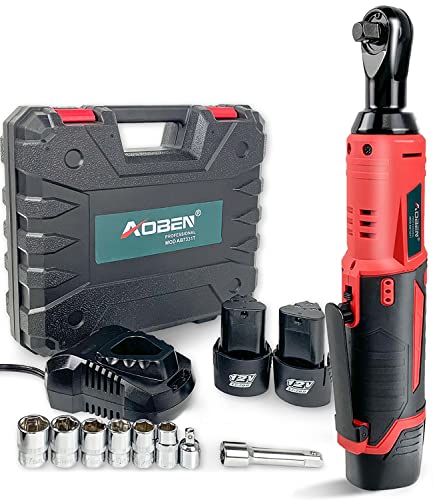 AOBEN Cordless Electric Ratchet Wrench Set3/8" 12V with 2 Batteries12 x 10 x 3.5 inches4.4 poundsCheck on Amazon


Cordless vs. Air-Powered: What Changes in a Tight Space
Cordless and air-powered ratchets do the same job differently, and that changes how they fit and feel overhead or inside an engine bay.
- Cordless electric ratchet wrenches use a 12V or 20V battery integrated into the handle. You get instant start, no hose drag, and better maneuverability. The trade-off is more weight at the handle and a wider battery base that can interfere when you are working vertically.
- Air-powered ratchets need a compressor, hose, and fitting. They are typically slimmer at the grip and lighter without a battery, which helps for long sessions under a dash or fender. The trade-off is hose management and CFM requirements that limit speed if your compressor is small.
For the search for the best cordless electric ratchet wrench, the practical difference is that 12V platforms dominate tight-space work. A 12V Milwaukee M12 or 12V Bosch or Makita system will have a lower profile head and shorter overall length than most 20V tools, even if the 20V offers more torque.
Drive Size and Head Clearance Determine Fit
Do not choose drive size by torque alone. Choose it by fastener size and head clearance.
- 1/4-inch drive: Best for small engine work, motorcycles, HVAC panels, and interior trim where fasteners are M6-M8 (1/4″ to 5/16″). Heads are thinnest, often under 1 inch tall, and overall length is shortest. Torque is typically 30-40 ft-lbs.
- 3/8-inch drive: The most versatile for automotive and general mechanical work. Fits M8-M12 fasteners, works with the widest range of sockets, and still fits where a 1/2-inch cannot. This is why the best cordless ratchet wrench 3/8 is the most searched configuration.
- 1/2-inch drive: Only makes sense for suspension and larger truck work. Heads are tall and long, making them poor for tight spaces despite high torque.
Head clearance is more important than overall length. Two ratchets can both be 11 inches long, but the one with a 0.75-inch head height will swing where a 1.4-inch head will not. Low-profile anvil and flush head bolts let you slide under intake manifolds and brake brackets without removing other components.
Spec Comparison: Real Models by Size, Weight and Speed
These are representative 2026 models that are widely available. Specifications are manufacturer published and reflect bare tool without socket.
| Model | Drive | Power Source | Head Height | Overall Length | Weight (Bare Tool) | Max Torque | No-Load Speed |
|---|---|---|---|---|---|---|---|
| Milwaukee M12 FUEL 2557-20 | 3/8″ | 12V Battery | 1.35 in | 11.1 in | 1.9 lbs | 55 ft-lbs | 200 RPM |
| Milwaukee M12 FUEL 2566-20 | 1/4″ | 12V Battery | 0.98 in | 10.8 in | 1.7 lbs | 40 ft-lbs | 280 RPM |
| DeWalt 20V Max DCF503B | 3/8″ | 20V Battery | 1.42 in | 11.75 in | 2.4 lbs | 70 ft-lbs | 280 RPM |
| Ingersoll Rand 107XPA | 3/8″ | Air – 4 CFM @ 90 PSI | 1.25 in | 10.5 in | 2.6 lbs with fitting | 54 ft-lbs | 160 RPM |
| Aircat 805-HT | 3/8″ | Air – 4 CFM @ 90 PSI | 1.30 in | 10.0 in | 2.2 lbs with fitting | 70 ft-lbs | 200 RPM |
Takeaway: If head clearance is your absolute priority, the 1/4-inch M12 platform is thinnest. For general use, the 3/8-inch M12 offers the best balance of slim head and usable torque. The 20V DeWalt is faster and stronger but longer and heavier at the handle. Air models are not automatically more powerful, but they maintain that power without battery swaps.
Top Picks for Tight Spaces by Situation
Best Overall for Tight Spaces: Milwaukee M12 FUEL 3/8-Inch 2557
This is the default answer for best power ratchet wrench in automotive and maintenance work. The 55 ft-lbs is enough to break loose intake, valve cover, and bracket bolts without a breaker bar, and the 200 RPM speed is controllable for threading. With a 2.0Ah battery you get a compact balance; with a 3.0Ah or 6.0Ah high-output battery you get extended runtime at the cost of added handle thickness.
Best for Ultra-Tight Clearance: Milwaukee M12 FUEL 1/4-Inch 2566
When a 3/8-inch head will not swing, this is the tool that fits. At under 1 inch head height it slides behind timing covers and inside appliance cabinets. It is not for lug nuts or suspension, but for M6 and M8 fasteners it prevents rounding by keeping the socket fully seated in a shallow recess.
Best Cordless Power on a 20V System: DeWalt 20V Max DCF503
If you are already on DeWalt 20V, this ratchet avoids buying into a new battery platform. It is the fastest cordless 3/8-inch ratchet in this group at 280 RPM and delivers 70 ft-lbs, so it covers more breakaway torque before you need an impact wrench. The trade-off is length and weight, which matters for overhead work.
Best Air-Powered for Shop Use: Ingersoll Rand 107XPA or Aircat 805-HT
For a shop with a 20-gallon or larger compressor delivering 5+ CFM at 90 PSI, an air ratchet is lighter to hold for hours and has no battery to charge. The 107XPA is known for durability and a sealed head that resists shop dust. The Aircat 805-HT is slightly shorter with higher torque output. Both require an inline oiler or daily oiling and will slow noticeably on compressors under 4 CFM or with 25-foot 1/4-inch hoses.
Battery vs. Air System Requirements: Calculate Before You Buy
The tool price is only half the system cost.
Cordless runtime calculation: A Milwaukee M12 2.0Ah battery holds about 24 watt-hours (12V x 2.0Ah). A 3/8-inch ratchet draws roughly 80-120 watts under light fastening. That equals 12-18 minutes of continuous trigger time, which translates to 80-150 fasteners per charge for typical M8 bolts run at low load. Idle and breakaway bursts use less energy. A 6.0Ah battery roughly triples that runtime but adds about 0.4 lbs and 0.5 inches to the handle base.
Air system calculation: Most 3/8-inch air ratchets consume 3.5 to 4.5 CFM at 90 PSI at free speed. If your compressor is rated at 2.6 CFM at 90 PSI, the tool will run but pressure will drop after 15-20 seconds of continuous use, reducing RPM by 30-40% until the tank recovers. For continuous use, match the compressor’s delivered CFM at 90 PSI to the tool’s requirement, use a 3/8-inch ID hose for runs over 15 feet, and keep fittings to a minimum. Each quick-connect fitting can drop 2-5 PSI.
General market ranges in 2026: cordless bare tools run $150 to $280, kits with charger and two batteries $180 to $350. Quality air ratchets run $90 to $200, but a suitable compressor if you do not own one starts around $300 to $600.
Fastening Speed and Control in Real Use
No-load RPM is misleading. Actual fastening speed depends on variable-speed trigger control and brake. Milwaukee and DeWalt both offer variable-speed triggers that let you feather from 0 to max RPM, which is critical for avoiding cross-threading in aluminum. Air ratchets are typically single-speed with a throttle button, so control comes from airflow and how far you depress the lever.
For tight spaces, 150-200 RPM is often faster in practice than 280 RPM because you can start the fastener with fingertip control without backing it out. If you are removing 30+ fasteners in a row, like on a valve cover or skid plate, the higher RPM of the DeWalt or 1/4-inch M12 saves significant time.
Durability and Ownership Realities
What wears first is not the motor. It is the ratchet head.
- Anvil and pawl wear: The square anvil and internal pawl see impact when users use the ratchet to break torque at full power. Power ratchets are not breaker bars. Break loose with a hand ratchet, then spin with power. This extends head life from months to years.
- Head seal: Air ratchets need 3-4 drops of air tool oil daily if not on an inline oiler. Cordless heads need periodic cleaning and a light grease every 6-12 months depending on dust exposure. Neglect leads to a gritty swing and slipping.
- Battery care: Lithium batteries degrade fastest when stored fully charged in heat. Store at 40-60% charge if not used for weeks. Cold garages below 32F temporarily reduce runtime by 15-25%.
- Common mistakes: Using impact sockets that are too thick to seat fully, over-tightening small fasteners because the tool feels weak, and blocking the exhaust on air tools which slows the tool and blows debris into your face.
Consumables to budget for: replacement anvil kits ($15-$35), yoke kits for air tools, and an extra battery if you use the tool professionally. Air tools also need a water separator and regulator to prevent rust inside the motor.
Decision Matrix: Match Your Situation to the Right Type
| Your Situation | Best Choice | Why |
|---|---|---|
| Home garage, no compressor, occasional engine work | Cordless 3/8″ 12V | No extra system cost, best maneuverability, sufficient torque |
| Mobile tech, work in driveways and tight interiors | Cordless 1/4″ + 3/8″ 12V | Lightest head, no hose, batteries swap quickly |
| Shop with 60-gallon compressor, daily use | Air-powered 3/8″ | Lowest weight for long shifts, no downtime charging |
| Already on DeWalt 20V or Makita 18V platform | Same-voltage 3/8″ ratchet | Avoids new battery system, leverages existing chargers |
| Need maximum speed for production work | Cordless 20V 3/8″ or high-RPM 12V 1/4″ | 260-280 RPM saves time over 160 RPM air tools |
| Very small fasteners, electronics or small engines | Cordless 1/4″ with low torque setting | Prevents over-torque, thinnest head fits |
Frequently Asked Questions
Can a power ratchet replace an impact wrench?
No. Even the strongest 3/8-inch power ratchet at 70 ft-lbs cannot match a 1/4-inch hex impact driver or 3/8-inch impact wrench for breakaway torque. Use the ratchet to spin fasteners quickly and an impact or hand ratchet to break them loose and do final torque with a torque wrench.
Is 3/8-inch or 1/4-inch better for tight spaces?
1/4-inch has a thinner head and fits more places, but 3/8-inch handles a wider range of automotive sockets without adapters. If you can only own one for tight spaces, 3/8-inch is more versatile. Add a 1/4-inch later if you frequently hit clearance limits.
How long does a cordless ratchet battery last?
For light fastening, a 12V 2.0Ah battery typically drives 80-150 M8 fasteners. A 20V 2.0Ah battery lasts longer per charge but the tool is bulkier. Continuous trigger time is only 12-20 minutes on a small battery, so a second battery is recommended for extended jobs.