What's inside
As an Amazon Associate I earn from qualifying purchases. This post may contain affiliate links at no extra cost to you.
The best Miller wire welder for most home shops is the Millermatic 211 — its dual-voltage input, Auto-Set controls, and spool-gun compatibility for aluminum cover nearly every hobbyist and light-fabrication scenario — but if you’re strictly on 120V outlets the Millermatic 142 is the smarter buy, and serious steel fabricators should step up to the Millermatic 252.
As an Amazon Associate we earn from qualifying purchases at no extra cost to you.


Our Top Picks
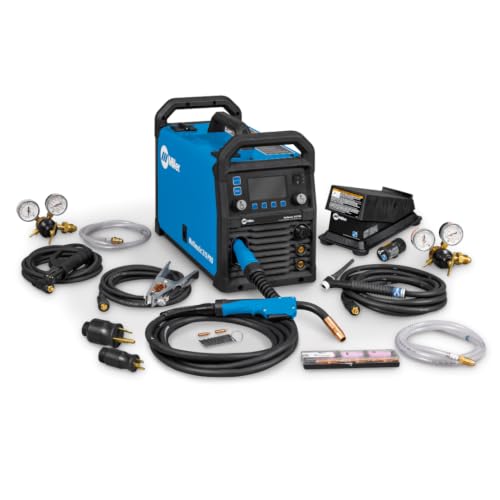


Miller Wire Welders at a Glance
Miller’s wire-feed lineup in 2026 spans three tiers: portable 120V units for garage work, dual-voltage machines that grow with your shop, and dedicated 240V welders for production fabrication. All run MIG (gas-shielded) and flux-core (gasless) wire, which is what makes the term “wire welder” accurate for the whole family. The key differences come down to input voltage, maximum output, duty cycle, and whether the machine can run a spool gun for aluminum.
| Model | Input Voltage | Max Output | Duty Cycle | MIG / Flux-Core | Spool Gun Option | Weight |
|---|---|---|---|---|---|---|
| Millermatic 142 | 120V | 140A | 30% @ 90A (120V) | Both | No | ~50 lb |
| Millermatic 211 | 120/240V (MVP) | 211A | 30% @ 150A (240V) | Both | Yes — Spoolmate 150 | ~63 lb |
| Multimatic 215 | 120/240V (MVP) | 230A (MIG) | 30% @ 150A (240V) | Both + TIG/Stick | Yes — Spoolmate 100/150 | ~56 lb |
| Millermatic 252 | 240V | 300A | 40% @ 250A | Both | Yes — Spoolmate 200 | ~207 lb |
What the Specs Actually Mean in Practice
Duty cycle matters more than peak amperage
Duty cycle is rated over a 10-minute window. The Millermatic 142’s 30% at 90A means three minutes of welding, seven of cooling — fine for brackets and lawn furniture, frustrating on a trailer frame. The 252’s 40% at 250A lets you lay long beads on 1/4-inch steel almost continuously, which is why fabrication shops buy it despite it weighing three times as much as the dual-voltage units.
Input voltage defines your ceiling
A 120V welder tops out around 3/16-inch mild steel in a single pass regardless of the badge amperage. The Miller MVP (Multi-Voltage Plug) system on the 211 and 215 is genuinely useful: you can weld thin sheet metal on a household outlet today, then swap the plug for 240V when you wire a dedicated circuit — no rewiring of the machine itself.
Aluminum requires a spool gun
Aluminum MIG wire is too soft to push through a standard 10-foot liner without bird-nesting. Spool guns mount a small spool on the gun itself, shortening the feed path to inches. The Millermatic 142 cannot accept one — it’s steel-only in practical terms. The 211, 215, and 252 each pair with a Spoolmate series gun (sold separately, typically $300–$450), making aluminum worth considering only if you plan to buy the accessory.
Which Model Fits Your Situation
| Your Situation | Best Pick | Why |
|---|---|---|
| Renter or 120V-only garage, projects under 1/8 in. | Millermatic 142 | Plugs in anywhere, Auto-Set, light enough to carry |
| Home fabricator, mixed steel and occasional aluminum | Millermatic 211 | Dual voltage, spool-gun ready, handles 3/8 in. on 240V |
| Hobbyist who also wants TIG and stick capability | Multimatic 215 | Four processes in one machine at similar cost |
| Small fabrication business, 1/4–1/2 in. steel daily | Millermatic 252 | 40% duty cycle at real output; won’t stall mid-beam |
Price-wise, expect roughly $1,000–$1,300 for the 142, $1,500–$1,900 for the 211 or 215, and $3,000+ for the 252 — before gas cylinders, wire, and PPE add another few hundred dollars.
MIG vs. Flux-Core on These Machines
Every Miller wire welder here runs both processes. MIG with shielding gas (typically 75/25 argon/CO₂) produces cleaner welds indoors and is easier on thin sheet metal. Flux-core self-shielded wire works outdoors in wind and requires no gas bottle — useful for fence repair or field work — but produces more spatter and slag cleanup. A practical setup: run gas-shielded MIG in the shop, keep a pound of .030 flux-core on hand for outdoor jobs.
Ownership Realities Listings Won’t Tell You
- Contact tips and nozzles wear fast. Expect to replace contact tips every 10–20 lbs of wire; a $15 multi-pack is a normal recurring cost. Drive rolls need swapping when you change wire diameter.
- The liner is the most common failure point. Grinding dust and wire shavings clog the gun liner, causing erratic feeding that beginners misdiagnose as a settings problem. Blow it out with compressed air every few spools.
- Gas isn’t optional for real MIG. A 40-cubic-foot cylinder of 75/25 costs modestly to fill but runs out surprisingly fast at 20–25 CFH — budget a refill roughly every 4–8 hours of arc-on time.
- Auto-Set is a starting point, not a finish. Miller’s Auto-Set gets you close on the 142/211/215, but thin material still needs voltage dialed down a notch or two from the chart.
- Common beginner mistake: welding flux-core with MIG polarity (electrode positive). Self-shielded flux-core runs DCEN — reverse the leads or you’ll get ugly, porous welds.
Frequently Asked Questions
Can a Miller wire welder weld aluminum?
Yes on the 211, 215, and 252, but only with a matching spool gun and 100% argon gas. The 142 cannot accept a spool gun and is effectively a steel-only machine.
Is the Millermatic 211 worth the extra cost over the 142?
For most buyers, yes — the dual-voltage input, roughly 50% more usable output, and aluminum upgrade path mean you won’t outgrow it. The 142 makes sense only if 120V is your permanent constraint.
What thickness can these welders handle?
Single-pass on mild steel: the 142 handles up to about 3/16 in., the 211 and 215 around 3/8 in. on 240V, and the 252 up to 1/2 in. Thicker material on smaller machines requires multi-pass technique and proper joint prep.
For a first Miller wire welder, the Millermatic 211 remains the safe recommendation: it’s the point in the lineup where capability, portability, and future-proofing intersect.