What's inside
As an Amazon Associate I earn from qualifying purchases. This post may contain affiliate links at no extra cost to you.
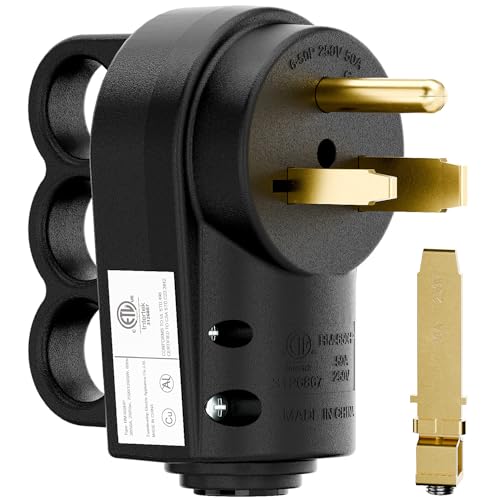
The right 220 welder plug depends on three things: your welder’s input amperage, the receptacle already in your wall, and the wire gauge feeding it. Most home-shop welders use one of three configurations — NEMA 6-50 (the most common welder plug), NEMA 14-50 (range/EV style), or NEMA 10-50 (older dryers and ranges). Get the match right and the install is an afternoon job; get it wrong and you’re buying adapters or rewiring.
As an Amazon Associate we earn from qualifying purchases at no extra cost to you.


Our Top Picks



Step 1: Read Your Welder’s Input Specs
Before shopping for a 220 volt welder plug, check the nameplate or manual for rated input current. This is the number that decides everything:
- Under 40A input: Most 110V/220V dual-voltage inverters (like typical 140–200A output machines) draw 20–35A at 240V. A NEMA 6-50 on a 50A circuit is standard.
- 40–50A input: Larger transformer MIGs and 250A-class machines. NEMA 6-50 or hardwiring; check the manual.
- Over 50A input: Industrial machines usually want hardwiring or a NEMA 14-60/CS-style connector — beyond the scope of a plug swap.
Important nuance: inverter welders often list a much higher “input amperage” than they continuously draw, because the rating is at max output on the thickest material. A machine rated 45A input may run fine on a 40A breaker for hobby work — but size the circuit to the nameplate, not your expectations.
The Three Plug Types You’ll Actually Encounter
| NEMA Type | Configuration | Amps | Ground? | Neutral? | Typical Use |
|---|---|---|---|---|---|
| 6-50 | Two hot + ground (3-prong, flat blades) | 50A | Yes | No | Modern welders — the de facto standard |
| 14-50 | Two hot + neutral + ground (4-prong) | 50A | Yes | Yes | Ranges, RV/EV outlets; works for welders that ignore neutral |
| 10-50 | Two hot + neutral (3-prong, no ground) | 50A | No | Yes | Pre-1996 ranges/dryers — common in older garages |
The NEMA 6-50 is what most welder cords ship with or are built for. If you’re installing a new outlet, this is the one to pick — it’s the welder plug 220 owners will find easiest to mate with adapters and extension cords.
The NEMA 10-50 is the trap. It looks similar to a 6-50 but has no dedicated ground — the neutral does double duty. Plugging a welder into an ungrounded 10-50 via a forced-fit adapter is a real shock hazard. If your shop has one, the correct fix is running a new grounded circuit, not an adapter.
Matching Wire Gauge and Breaker to the Plug
A 50A plug on undersized wire is a fire waiting to happen. Here’s the copper-wire sizing table for 240V welder circuits (THHN/THWN in conduit or NM-B):
| Breaker | Min. Wire Gauge (copper) | Matching Receptacle | Notes |
|---|---|---|---|
| 30A | 10 AWG | 6-30 | Small inverter welders, plasma cutters |
| 40A | 8 AWG | 6-50 (derated) | Acceptable for welders under 40A input |
| 50A | 6 AWG | 6-50 or 14-50 | The standard welder circuit |
| 60A | 4 AWG | 14-60 / hardwire | Large transformer machines |
Welder-specific wrinkle: NEC Article 630 allows derating circuit conductors for dedicated welder outlets based on duty cycle. A welder with a 20% duty cycle at max output can legally run on smaller wire than the breaker rating suggests. This is legitimate code, but it only applies to a dedicated welder receptacle — if you might ever plug in a kiln or compressor, size the wire to the breaker.
Decision Matrix: Which Setup for Your Situation?
| Your situation | Recommended setup | Why |
|---|---|---|
| New garage install, any welder under 50A | NEMA 6-50R receptacle, 6 AWG, 50A breaker | Universal welder standard; cheapest correct install |
| Existing range/EV 14-50 outlet nearby | 14-50P to 6-50R adapter cord | Welder ignores the neutral; fully safe and grounded |
| Old house with 10-50 outlet | New 6-50 circuit run by electrician | No ground on 10-50; adapters are unsafe |
| Welding 50+ ft from the panel (driveway work) | 6-50 extension cord, 6 AWG or thicker | Voltage drop at 40A over 75 ft on 8 AWG is borderline |
| Multiple welders / plasma cutter sharing one outlet | 6-50 receptacle + matching plugs on each cord | Standardizing avoids adapter stacks |
Buying the Plug Itself: What the Listing Won’t Tell You
Replacement 6-50P plugs are commodity items (roughly $10–$25 market range), but quality varies in ways listings don’t mention:
- Terminal screw design: Better plugs (brands like Leviton, Eaton/Cooper, Hubbell) use clamp-style terminals that capture the stranded conductor cleanly. Cheap set-screw-only plugs can loosen on 6 AWG wire — re-tighten after the first few heating cycles.
- Body material: Nylon housings survive being dropped on concrete; brittle phenolic plastic cracks. In a shop, you’ll drop it.
- Cord grip range: Check the clamp accepts your cord diameter — SOOW 6/3 is fat, and a loose grip means the terminals take the strain instead.
- Angle vs. straight: Angle-body plugs sit flush against the wall and resist being kicked loose. Worth the small premium for a receptacle near floor level.
What wears first in real use: the cord grip screw, the ground pin (from sideways yanks), and the terminal screws backing out from heat cycling. Inspect yearly — a discolored or warm plug body means a loose connection that’s already arcing.
Pre-Purchase Safety Checks
- Verify the outlet’s actual NEMA type with the chart above — don’t guess from prong count alone.
- Confirm the breaker size and wire gauge at the panel before assuming the outlet can carry your welder.
- If installing new, check local code for GFCI requirements in garages — 2020+ NEC cycles expanded them, and some inspectors require GFCI breakers on new 240V receptacles.
- Never file down a neutral blade to fit a 4-prong plug into a 3-prong outlet.
- Label the breaker “welder outlet” — it prevents someone repurposing the circuit later on derated wire.
FAQ
Can I use a 14-50 range outlet as a 220 plug for welder use?
Yes — it’s actually the safest adapter scenario. Welders use only the two hots and ground, ignoring the neutral. A 14-50P to 6-50R adapter cord does this cleanly.
My welder has a 6-50 plug but my outlet is a dryer outlet (14-30).
A 14-30 is a 30A circuit. A welder drawing over 30A will trip it or, worse, run hot continuously. Either verify your welder’s input is under 30A and use a proper adapter, or have a 6-50 circuit installed.
Does wire gauge matter if my welder has a low duty cycle?
Legally, yes — NEC 630 permits smaller conductors on a dedicated welder circuit based on duty cycle. Practically, if you ever upgrade machines, oversized wire is future-proofing that costs little now.