What's inside
As an Amazon Associate I earn from qualifying purchases. This post may contain affiliate links at no extra cost to you.
Rusted exhaust fasteners are a poor test of an impact wrench’s headline torque rating. They are often heat-cycled, contaminated with road salt, and partly fused by corrosion. A wrench that removes ordinary suspension bolts may still round an exhaust nut or stall before the fastener moves. The right choice depends on access, available power, and whether you need controlled tightening as well as removal.
Start With the Fastener, Not the Tool
Most exhaust hardware is between 10 and 19 mm, with 3/8-inch and 1/2-inch drive sockets covering nearly all passenger-car work. The fastener size does not tell you how difficult it will be. A small 12 mm flange nut exposed to years of heat can require more force than a clean 19 mm chassis bolt.
Before shopping, inspect the space around the fastener. A compact tool may fit between the floorpan and muffler where a high-torque wrench will not. Measure the available height and note whether the tool must approach straight-on. Universal joints and long extensions reduce the useful force and make rounding more likely.
For occasional brake and exhaust work, a compact 3/8-inch cordless impact wrench is often enough for small clamps and brackets. It is not automatically enough for seized manifold studs or large catalytic-converter flange bolts.
Choose the Drive Size
| Drive size | Best use | Advantages | Limitations |
|---|---|---|---|
| 3/8 inch | Small exhaust nuts, shields, clamps, tight access | Compact, light, easier to control | Lower breakaway capacity and smaller battery options |
| 1/2 inch compact | General vehicle repair and stubborn exhaust fasteners | Good balance of reach, power, and size | Heavier; may not fit above a pipe or heat shield |
| 1/2 inch high-torque | Severely seized flange bolts, truck exhaust, large hardware | Highest removal force | Bulky, expensive, and easier to damage fasteners |
| 3/4 inch | Heavy trucks and industrial hardware | Very high torque reserve | Usually excessive for passenger-car exhaust work |
A 1/2-inch compact wrench is the safest general recommendation if you work on different vehicles. It accepts common impact sockets and normally has enough reserve for exhaust bolts after penetrating oil and heat. A high-torque 1/2-inch model makes sense for frequent professional work, diesel trucks, or fasteners that cannot be cut apart, but its extra power does not solve access problems.
Compare Cordless, Pneumatic, and Corded Tools
Cordless models are the practical choice for most home garages. Modern brushless tools can deliver several hundred foot-pounds of advertised nut-busting torque, but ratings vary between brands and test methods. Treat the number as a comparison within one product line, not a guarantee that the wrench will break every rusty nut free.
Battery voltage matters less than the complete tool system. A compact 18V or 20V wrench with a small battery may fit better but lose power under load. A high-output battery can improve performance, although it adds weight below your hand. Keep the battery fully charged and use the manufacturer’s larger recommended pack for repeated seized-fastener work.
Pneumatic impacts remain excellent in a well-equipped shop. A serious 1/2-inch air wrench can run continuously without waiting for a battery, but it needs a compressor that can maintain the specified air volume. A small compressor may spin the tool while failing to produce useful breakaway force. Long, narrow hoses and restrictive couplers also reduce performance.
Corded electric impacts are uncommon for vehicle repair because an extension cord is awkward under a car. They can be inexpensive for occasional work, but cordless tools are generally easier to position and more capable under load.
If you already own batteries from a tool platform, staying with that system is usually cheaper than buying a stronger standalone wrench, charger, and batteries. If you have no battery system, compare the kit price rather than the bare-tool price.
Look Beyond the Torque Number
For rusted exhaust hardware, prioritize breakaway or nut-busting torque over fastening torque. A tool advertised at 300 foot-pounds of fastening torque may list 500 or more foot-pounds of breakaway torque, but those figures do not describe a standardized real-world test. A useful general target is at least 300 foot-pounds of claimed breakaway torque for routine passenger-car work, with more reserve for badly seized hardware.
Speed settings are important. A low setting helps prevent snapping a small exhaust stud, while a higher setting provides short bursts when removal has stopped. A tool with three or four power modes is more useful than a single maximum-power trigger. A built-in brake or auto-stop mode can also prevent the nut from flying off, though these features vary in accuracy.
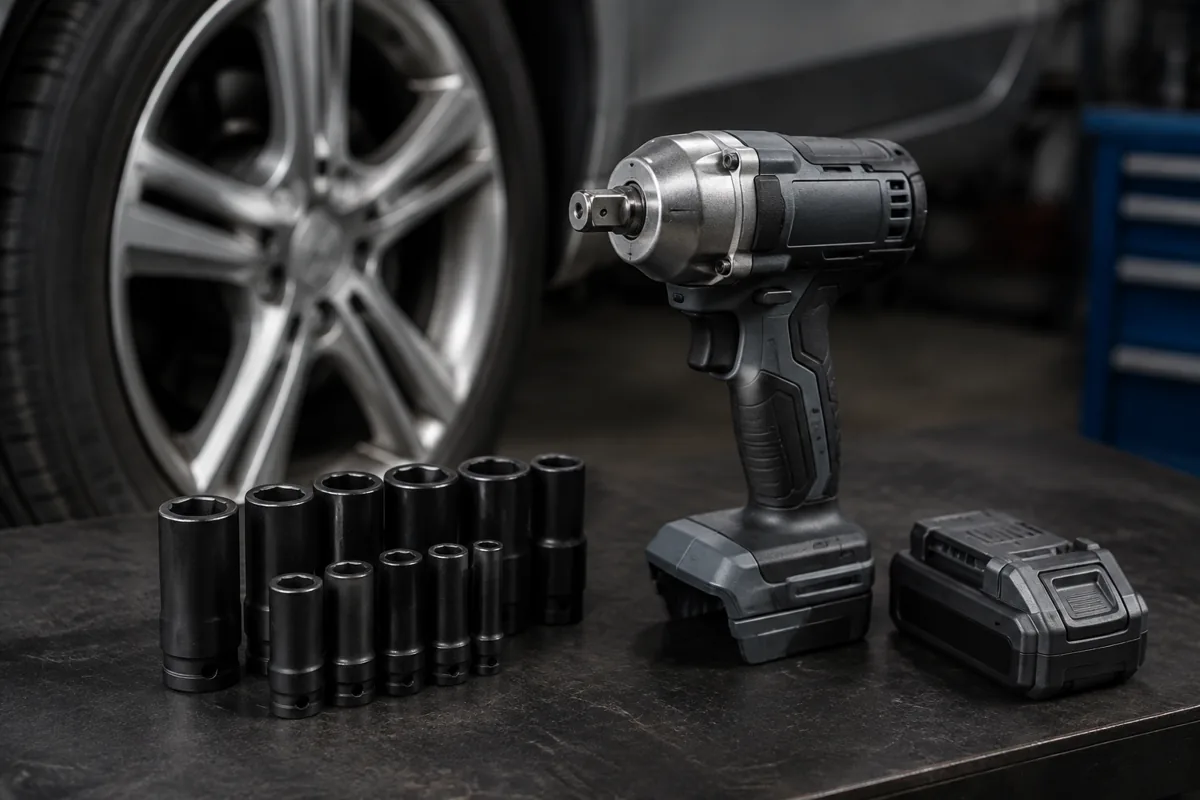
For a compact all-around option, compare 1/2-inch compact brushless impact wrench kits by length, bare-tool weight, battery size, and warranty—not just torque. A wrench that is 2 inches shorter may reach a flange without removing a heat shield, which is worth more than another 100 advertised foot-pounds.
Use the Right Accessories
Use six-point impact sockets, not chrome hand-tool sockets. A six-point socket spreads the load across the flats and is less likely to round a rusted nut. Deep sockets are useful on protruding studs, but they can bottom out on a long stud before the socket fully engages the nut.
Avoid standard universal joints when possible. They absorb impact energy and can twist under load. If an angled approach is unavoidable, use an impact-rated wobble extension or universal joint, keep it short, and expect less torque at the fastener. Never use a chrome adapter or a non-impact extension with a high-powered wrench.
Impact-rated thin-wall sockets help with tight clearances, but they wear faster and can split if abused. Inspect the socket after working on heavily rusted hardware. Replace it if the drive opening is stretched or the hex corners are visibly damaged.
Remove the Fastener Without Making It Worse
Clean loose scale from the nut with a wire brush, then apply penetrating oil and wait at least 10 to 15 minutes. Several applications are more useful than flooding the area once. Seat the socket squarely and run the wrench in short bursts. If the nut does not move after roughly 10 seconds of hard impact, stop and reassess rather than heating the tool and battery.
Heat is often more effective than more impact force. Warm the nut or surrounding flange with an appropriate torch while protecting wiring, fuel lines, plastic shields, and the catalytic converter. Do not heat a fastener soaked in penetrating oil until the solvent has evaporated. Heating the nut expands it; cooling the stud afterward can sometimes create enough clearance to break the corrosion bond.
Do not use the impact wrench for final tightening unless the vehicle manufacturer provides a procedure for it. Exhaust studs and flange bolts can snap from over-tightening. Run the fastener down gently, then use a torque wrench. If the nut rounds, the next step may be locking pliers, a nut splitter, or cutting the bolt—not a larger impact wrench.
When the Cheaper Option Is Enough
A budget 3/8-inch impact is fine if you mainly remove heat-shield screws, hose clamps, small brackets, and clean fasteners. It is also sensible when the vehicle’s exhaust hardware is accessible and you have a torch or cutoff tool available for the truly seized bolts.
Spend more on a 1/2-inch brushless model when you regularly service older vehicles, work outdoors without compressed air, or need one wrench for suspension and drivetrain jobs as well as exhaust work. Buy high-torque only when the additional size and cost fit your work. More force cannot compensate for a rounded nut, a broken stud, or a tool that cannot physically reach the fastener.