What's inside
As an Amazon Associate I earn from qualifying purchases. This post may contain affiliate links at no extra cost to you.
Shaping a chair leg is a different job from simply removing wood. You need to establish a consistent taper, preserve enough material for strength, and leave a surface that will not take hours to clean up. A drawknife and a spokeshave can both do this, but they occupy opposite ends of the process.
A drawknife removes wood quickly and works well on rough, oversized stock. A spokeshave is slower but gives much better control near the final shape. For most chair builders, the practical answer is not choosing one tool forever; it is using the drawknife for bulk removal and the spokeshave for refinement.
As an Amazon Associate we earn from qualifying purchases at no extra cost to you.


Our Top Picks
The Basic Difference
A drawknife has a long blade with handles at both ends. You pull it toward yourself, usually with the bevel facing up or down depending on the cut and the desired control. It can take a shaving several millimeters thick, making it effective on square or roughly octagonal chair-leg blanks.
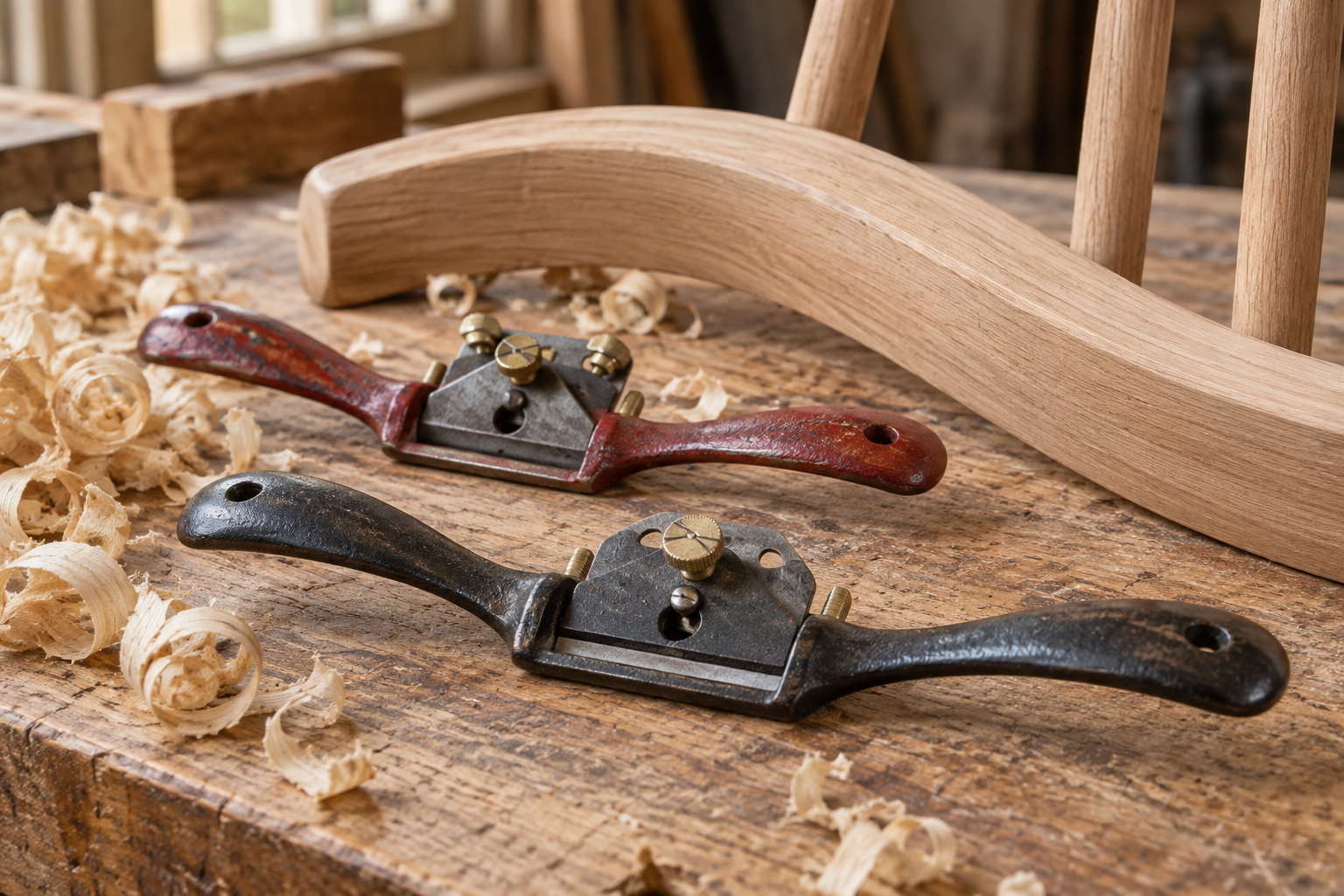
A spokeshave is a small plane with a blade set in a compact body. You push it across the work, taking thin, controlled shavings. Its short sole follows modest curves and transitions well around tapered legs, cabriole sections, and turned-looking shapes that are actually carved by hand.
That difference matters at the bench. The drawknife rewards confident, sweeping cuts and good body positioning. The spokeshave rewards careful blade adjustment, a sharp edge, and repeated passes.
Drawknife vs. Spokeshave
| Factor | Drawknife | Spokeshave |
|---|---|---|
| Best use | Fast stock removal and rough tapering | Controlled shaping and final fitting |
| Typical shaving depth | 1–3 mm when removing material aggressively | 0.1–0.5 mm for predictable cuts |
| Learning curve | Moderate; easy to remove too much | Moderate to high; setup affects everything |
| Grain handling | Can tear badly when cutting against rising grain | More controllable, but still prone to tear-out |
| Surface quality | Rough to good, depending on technique | Good to excellent with a sharp blade |
| Workholding | Needs very secure support because pulling loads the work | Needs support, but generally places less force on the blank |
| Typical cost | Often cheaper, especially used | Wide range; inexpensive examples may need tuning |
When a Drawknife Is the Better Choice
Choose a drawknife when your chair-leg blank is still substantially oversized. For example, if the finished leg needs a 35 mm section and your blank is 50 mm square, the drawknife can remove the corners quickly before you start worrying about exact lines. Taking the blank to an octagon first is a sensible target.
The tool is particularly useful for green wood, rungs, rustic chair legs, and designs with long tapers. A sharp 6- to 8-inch blade can remove a large amount of waste in minutes. The long handles also let you change the cutting angle by lifting or lowering one hand.
Its main failure mode is overcutting. A heavy pull can dive into the leg, create a hollow, or remove material below your layout line. This is costly because chair legs have limited spare material: a single 2 mm gouge can force you to reduce the entire leg or scrap the blank. Keep the first passes light, leave at least 1–2 mm outside the final line, and switch tools before the shape looks finished.
Use a woodworking drawknife if speed matters more than immediate surface quality. A cheaper drawknife is fine if the handles are secure, the blade is straight, and you are willing to sharpen it. Avoid blades with visible twists or loose tangs.
When a Spokeshave Is the Better Choice
A spokeshave is the better choice once the leg is close to its layout lines. It excels at blending facets, correcting small high spots, and creating a clean transition between a straight taper and a rounded section. On a 35 mm finished leg, you might use it to remove the last 1–2 mm rather than risk a deep drawknife cut.
It also handles short curves better. A flat-bottom spokeshave suits straight tapers and broad convex surfaces. A round-bottom version works better in hollows and tight concave areas, although it is less stable on flat faces. If you are buying only one, a flat-bottom model is usually the more useful general-purpose choice for ordinary chair legs.
Spokeshaves are sensitive to setup. The blade must be sharp, evenly projected, and held securely. A mouth opening around 0.5 to 1 mm is a useful starting point for general shaping. If the blade chatters, takes intermittent cuts, or leaves tracks, the issue may be blade projection or sole contact rather than your technique.
Look at adjustable woodworking spokeshaves if you want to tune the cut depth without removing the blade. A basic fixed spokeshave can be the cheaper option and is perfectly adequate for occasional work, but poorly fitted low-cost examples may require flattening, sharpening, and correcting the blade bed before they cut reliably.
A Practical Shaping Sequence
Start by marking the finished diameter or profile at several points along the leg. Use a gauge, template, or pencil lines running lengthwise. Secure the blank so it cannot shift: a vise with padded jaws, a shaving horse, or a solid workbench fixture is safer than holding the work by hand.
Use the drawknife diagonally to knock off the four corners, then reduce the remaining facets until the leg is roughly octagonal. Work down the length in overlapping strokes rather than making one deep cut in the middle. Check the diameter with calipers every few minutes. Leave 1–2 mm for cleanup, more if the grain is unpredictable.
Switch to the spokeshave and cut with the grain. If the fibers lift ahead of the blade, reverse direction or work from the other end. Keep the tool moving; stopping in the middle can create a hollow. Take several light passes and rotate the leg frequently so one side does not become smaller than the others.
Finish with a sharp spokeshave, cabinet scraper, or abrasive only after the profile is correct. Sandpaper should remove minor marks, not compensate for ridges and hollows. On a visible hardwood chair leg, sanding a badly uneven surface can easily add 30 minutes to the job.
Which Tool Should You Buy?
Buy a drawknife first if you regularly start with rough-sawn blanks, work green wood, or need to shape several legs quickly. Buy a spokeshave first if your stock is already close to size, you make occasional chairs, or surface quality and control matter more than speed.
For a first serious setup, a sound drawknife plus a reliable flat spokeshave is more versatile than an expensive specialty shave. If your budget is limited, spend money on sharpening supplies and workholding before upgrading either tool. A sharp inexpensive tool used on a firmly supported blank will outperform a premium tool with a dull edge and poor control.