What's inside
As an Amazon Associate I earn from qualifying purchases. This post may contain affiliate links at no extra cost to you.
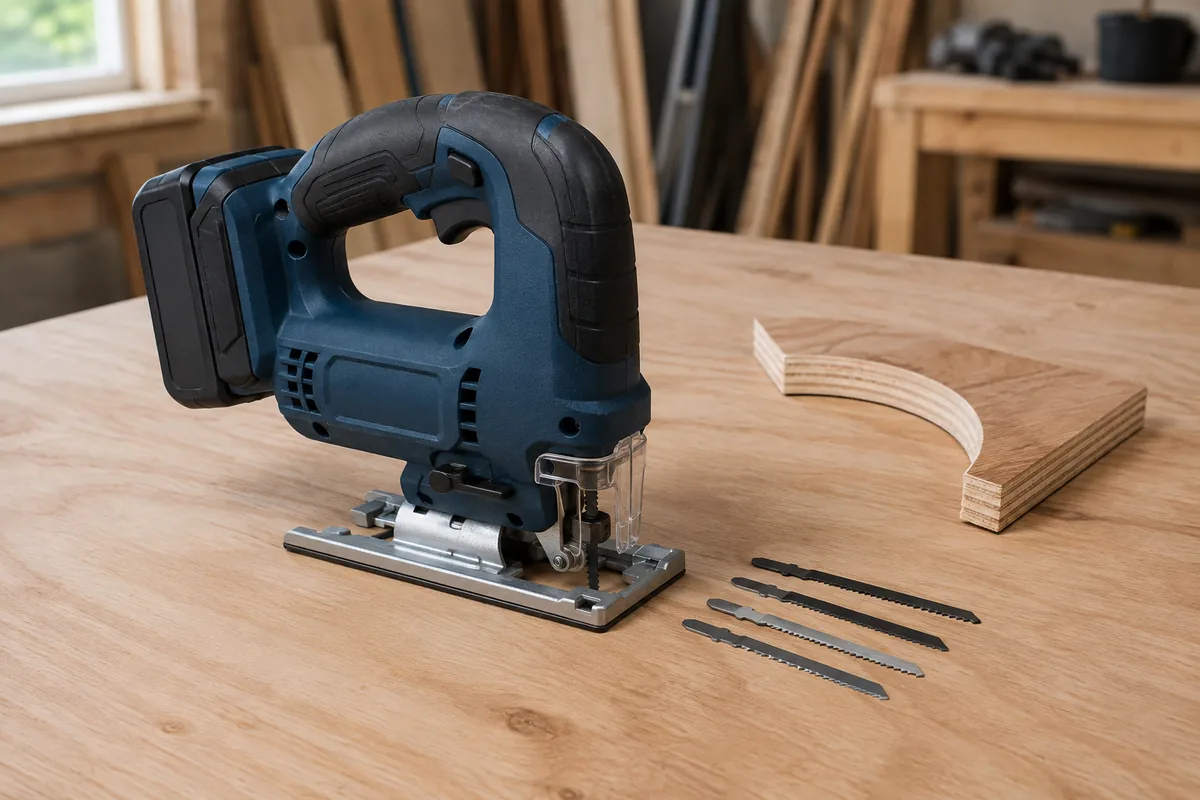
Veneered panels are easy to cut badly. The core may be plywood, MDF, or particleboard, but the thin face veneer behaves like a brittle finish: a coarse jigsaw blade can lift fibers ahead of the cut, while an ordinary upward-cutting blade tears the visible surface as it exits. The best blade depends on which face must stay clean, how thick the panel is, and whether you can accept a slower cut.
As an Amazon Associate we earn from qualifying purchases at no extra cost to you.


Our Top Picks
 DEWALT DW3762H 4" 10TPI Laminate Down Cutting HSCOne Size6.8 x 2.9 x 0.1 Inches0.09 poundsCheck on Amazon



The best blade type for most veneered panels
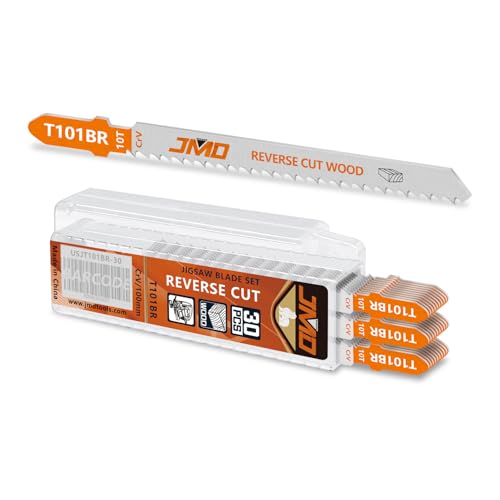
For a clean cut on the finished face, start with a reverse-tooth jigsaw blade. Its teeth cut on the downward stroke, pressing the veneer against the panel instead of lifting it. This is the safest choice when the finished face points upward and you need to follow a line without turning the panel over.
Reverse-tooth blades are not magic. They cut more slowly than standard blades, tend to push the saw upward, and can leave a rougher underside. They also demand a firm grip and a stable workpiece. Use a moderate feed rate rather than forcing the saw through the panel.
If the finished face can point downward, a conventional fine-tooth wood blade is often better. The blade cuts cleanly on the upward stroke, so the visible face is supported against the shoe and the rougher breakout occurs on the underside. This arrangement usually gives better control and faster cutting than a reverse-tooth blade.
Jigsaw blade choices compared
| Blade type | Best use | Typical tooth pitch | Main advantage | Main drawback |
|---|---|---|---|---|
| Reverse-tooth wood blade | Finished face upward | About 2–3 mm | Reduces top-face splintering | Slower, more vibration and upward force |
| Fine-tooth standard wood blade | Finished face downward | About 2–3.5 mm | Clean, controllable cut on the upward stroke | Requires access to the back of the panel |
| Downcut laminate blade | Thin laminate or veneer surfaces | About 1.5–2.5 mm | Very clean top surface | Slow and prone to clogging in thick wood cores |
| Coarse wood blade | Fast rough cuts only | About 3–5 mm | Fast material removal | High risk of veneer tear-out |
For laminated shelving, melamine-faced board, and thin decorative surfaces, a downcut laminate blade can produce the cleanest visible surface. Choose one only when its cutting length covers the panel thickness. A short blade that barely clears the material can overheat and wander.
Choose tooth count and blade length carefully
A blade with roughly 10 to 14 teeth per inch is a useful range for veneer-faced plywood and MDF. Finer blades, around 14 to 20 TPI, reduce the size of each bite and can limit chipping, especially in thin panels. The trade-off is speed: very fine blades heat up quickly and may polish or burn the edge if you push too hard.
Avoid the longest blade that fits the job. For a 12 mm panel, a blade with 20 to 30 mm of usable cutting length is usually easier to control than a long, flexible blade. The teeth should pass fully through the material throughout the stroke, but excessive length increases deflection. On 18 mm or 19 mm cabinet panels, use a blade with at least 25 mm of cutting length and keep the saw moving steadily.
Blades marketed specifically for clean wood cuts are generally worth the small premium. The cheaper option is fine for hidden cuts, painted edges, or parts that will be covered by edging. For a visible cabinet side or shelf end, the cost of a better blade is minor compared with replacing a damaged panel.
How to make a splinter-free cut
Support the panel on sacrificial foam board or closely spaced battens. Unsupported material vibrates, and vibration is a major cause of veneer breakout. Clamp the workpiece near the cut without obstructing the jigsaw shoe. Mark the cut line on masking tape rather than directly on a pale veneer, then extend the tape several inches beyond both ends of the cut.
Fit the blade securely and check that it is straight. Set orbital action to zero or its lowest setting. Orbital motion makes the blade travel forward during part of the stroke, which speeds rough lumber cutting but increases chipping in veneered sheet goods. Use a medium speed setting. Maximum speed can overheat fine teeth; too little speed encourages the blade to catch and stall.
Let the shoe sit flat before starting the cut. Start beside the waste area or use a drilled entry hole for an internal opening. Do not twist the saw to correct a wandering cut. Stop, back out with the blade still moving, and restart along the line. Twisting loads the blade sideways and can tear the veneer several millimeters away from the cut.
For the cleanest straight edge, clamp a guide and run the jigsaw shoe against it. Leave the line on the waste side, allowing about 1 mm for final trimming. A jigsaw is useful for curves and short cuts, but a track saw or circular saw with a fine-tooth blade will usually produce a straighter edge on long cabinet cuts.
Extra protection for difficult veneer
Apply low-tack painter’s tape over the cut line and press it down firmly. Tape helps hold loose fibers, though it cannot compensate for a coarse blade or unsupported panel. On especially fragile veneer, score the line first with a sharp marking knife, cutting only the veneer layer. Make several light passes rather than one deep pass.
Keep the blade sharp. A dull blade often causes more damage than an inexpensive sharp blade because it rubs, heats, and forces the operator to feed faster. Replace it when the saw needs noticeably more pressure, the edge darkens from heat, or the cut begins wandering despite proper support.
What to buy
For one-off household work, buy a small pack of fine-tooth wood jigsaw blades and use the face-down method whenever possible. If the finished face must remain upward, choose a reverse-tooth pack instead. For frequent cabinet or furniture work, keep both types available, plus a few laminate and melamine jigsaw blades for brittle coated panels.
The blade is only part of the result. Correct face orientation, zero orbital action, solid support, masking tape, and a controlled feed rate usually matter more than buying the most expensive blade on the rack.