What's inside
As an Amazon Associate I earn from qualifying purchases. This post may contain affiliate links at no extra cost to you.
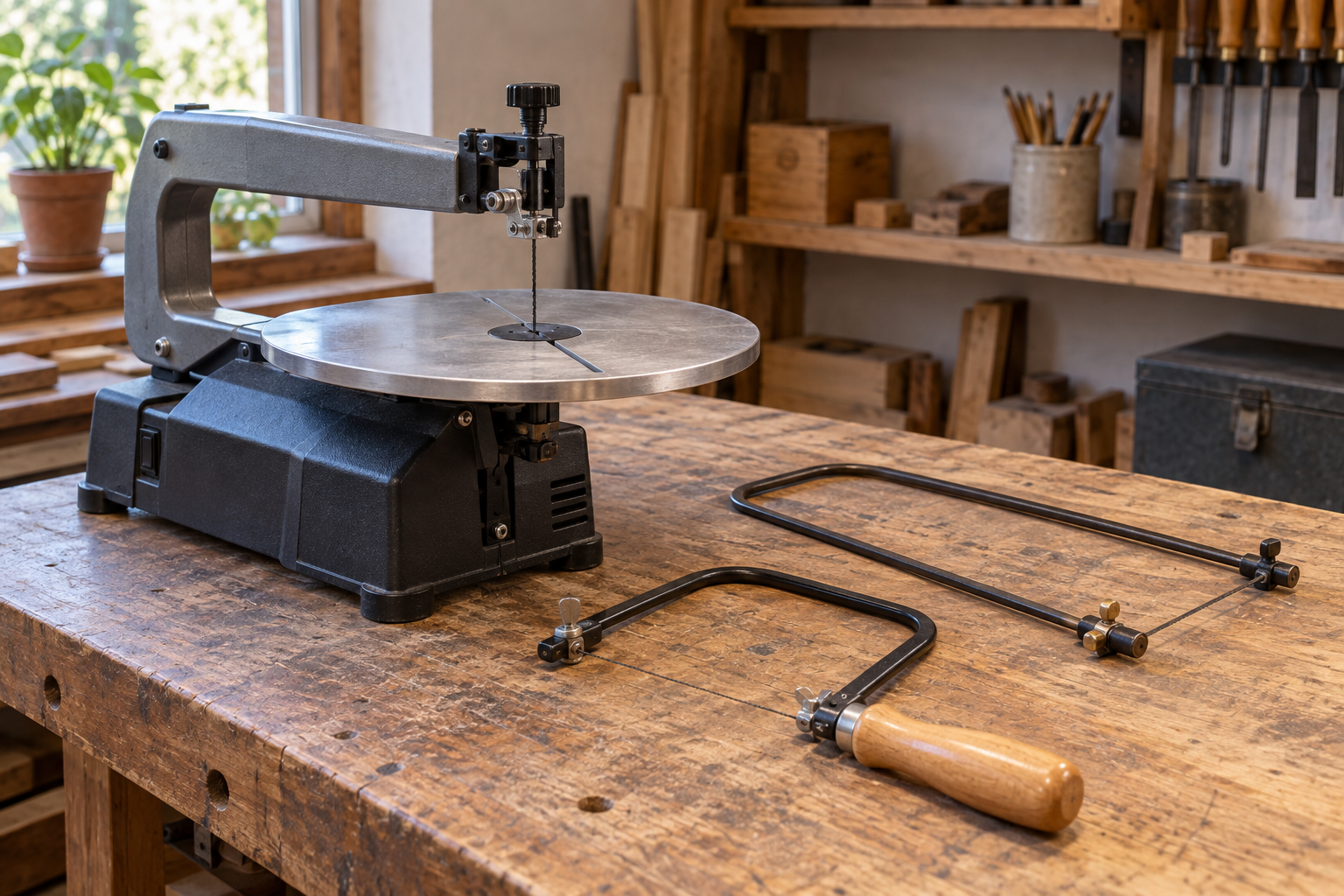
For cutting detailed interior profiles, a scroll saw and a coping saw can produce similar shapes, but they are not interchangeable in daily use. A scroll saw is faster and more consistent when you have many parts or thick stock. A coping saw is cheaper, quieter, and often better for one-off cuts already installed or held in awkward positions.
As an Amazon Associate we earn from qualifying purchases at no extra cost to you.


Our Top Picks
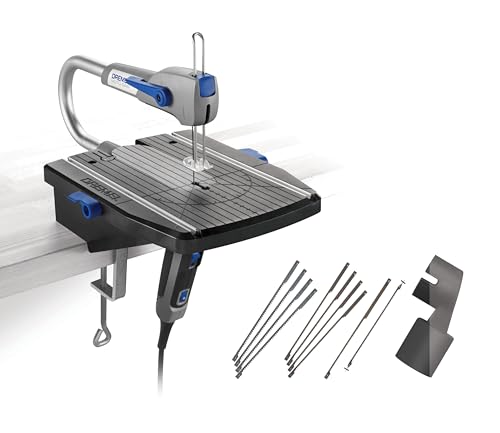 Dremel MS20-01 Moto-Saw Variable Speed Compact Scroll Saw9.84"L x 8.5"W x 10.6"H18.5 x 14.5 x 4.75 inches9.1 poundsCheck on Amazon


What the Cut Requires
“Interior profile” can mean several jobs: cutting a decorative opening in plywood, removing waste from a bracket, shaping a small wood part, or coping the end of baseboard and crown molding. The best tool depends on whether the workpiece is loose or installed, how thick it is, and whether the cut must begin inside the material.
Both saws use narrow blades that can turn much tighter corners than a jigsaw. Neither is the right choice for making a perfectly clean, machine-smooth edge without sanding. The blade leaves a small amount of tear-out, and the entry and exit faces can look different depending on the wood grain and blade direction.
Where a Scroll Saw Wins
A scroll saw is a benchtop machine with a short, narrow blade stretched between upper and lower arms. The blade moves rapidly up and down, usually through roughly 3/4 to 2 inches of material depending on the machine and blade. Its table supports the work continuously, which makes it easier to follow a pattern accurately.
Its biggest advantage is repeatability. You can cut several identical interior profiles, follow a printed template, and make tight turns without the fatigue associated with hand sawing. A variable-speed machine is especially useful: slower speeds reduce burning in hardwood and give better control near corners, while higher speeds are productive in softwood and plywood.
Many scroll saw blades can be released at one end and threaded through a drilled hole. That matters for fully enclosed openings. Drill a starter hole slightly larger than the blade, remove one end of the blade, pass it through the hole, and tension it again. For intricate fretwork, this is much faster than trying to create a large access cut.
A variable-speed scroll saw makes sense if you regularly cut plywood panels, ornaments, brackets, or small furniture parts. Look for tool-free or quick blade changes, a tilting table, and a throat depth of at least 16 inches if your patterns are larger than small craft pieces.
Where a Coping Saw Wins
A coping saw costs far less and takes almost no storage space. It has a U-shaped frame and a replaceable blade that can be rotated in the handles. The blade commonly cuts about 1/8 to 1/4 inch of wood per stroke, depending on tooth count and pressure.
It is particularly practical for coping molding. You can hold the trim in a miter box or against a bench, cut along the profile line, and refine the joint with a file or sanding tool. You can also use it in a room where bringing in a benchtop machine would be inconvenient. The saw produces no motor noise and little dust beyond the cut itself.
The limitations are speed and control over long cuts. A coping saw blade can wander if you push too hard, and its frame may hit the workpiece when cutting a deep interior opening. Thin blades also break when twisted or when the teeth become packed with resin. Keeping a few spare blades on hand is sensible; a coping saw blade assortment lets you match coarse teeth to softwood and finer teeth to hardwood or plywood.
Scroll Saw vs. Coping Saw
| Factor | Scroll saw | Coping saw |
|---|---|---|
| Best use | Repeated, detailed cuts in loose stock | One-off cuts, trim work, and portable repairs |
| Typical capacity | About 3/4 to 2 inches, depending on the machine | Usually practical below about 1 inch |
| Interior openings | Excellent with a drilled blade-entry hole | Possible, but slower and more awkward |
| Repeatability | High with a template and table support | Mostly dependent on operator skill |
| Cost and space | Higher cost and requires a bench | Low cost and fits in a drawer |
| Dust and noise | Some dust and motor noise | Very quiet, with minimal airborne dust |
Blade Choice and Cutting Technique
Blade selection can change the result more than the saw itself. Coarse blades remove material quickly but leave a rougher edge and can tear thin plywood. Fine blades make cleaner curves but cut slowly and clog faster. For 1/4-inch plywood, a fine-tooth blade is usually easier to control; for 3/4-inch softwood, a medium blade is a better starting point.
Mark the waste side clearly and leave the line visible. On a scroll saw, let the teeth do the cutting rather than forcing the stock. If the blade begins burning, you are either moving too slowly, using a dull blade, or using too many teeth for the material. On a coping saw, use short strokes as you approach a corner, then rotate the workpiece instead of bending the blade sideways.
For a closed profile, drill the entry hole in the waste area, not on the finished line. A 1/16-inch to 1/8-inch blade may need only a small hole, but the hole must be large enough to pass the blade without scraping its teeth. Make relief cuts into the waste on tight concave corners. These cuts divide the waste into smaller pieces and prevent the blade from binding.
Which Saw Should You Buy?
Buy a coping saw if you expect to cut only a few profiles each year, mainly work on trim, or need a tool that can travel to the job. The cheaper option is entirely adequate for a single bracket, a small notch, or coping baseboard. Spend more on a rigid frame, comfortable handles, and readily available replacement blades rather than decorative features.
Choose a scroll saw if detailed interior profiles are a regular part of your projects, especially when you need several matching pieces. The productivity gain is substantial once the pattern is set up. It is also the safer and more controlled choice for small parts that would be difficult to hold securely while hand sawing.
If your work is mostly molding installation, neither tool replaces a sharp coping technique, a rasp, and a sanding file. If it is mostly decorative panels and small shop-made parts, a wood scroll saw blade set and a decent bench setup will give you more value than upgrading to a larger saw. Use the coping saw for occasional work; choose the scroll saw when accuracy, volume, and repeatability justify the space and cost.