What's inside
As an Amazon Associate I earn from qualifying purchases. This post may contain affiliate links at no extra cost to you.
Cam-out happens when a driver bit climbs out of a screw’s recess instead of turning the screw. It chews up the recess, wears the bit, and can make a fast job frustrating. The fix is usually not more force: it is a better match between bit and screw, steady alignment, and a suitable driving method.
Identify the recess before choosing a bit
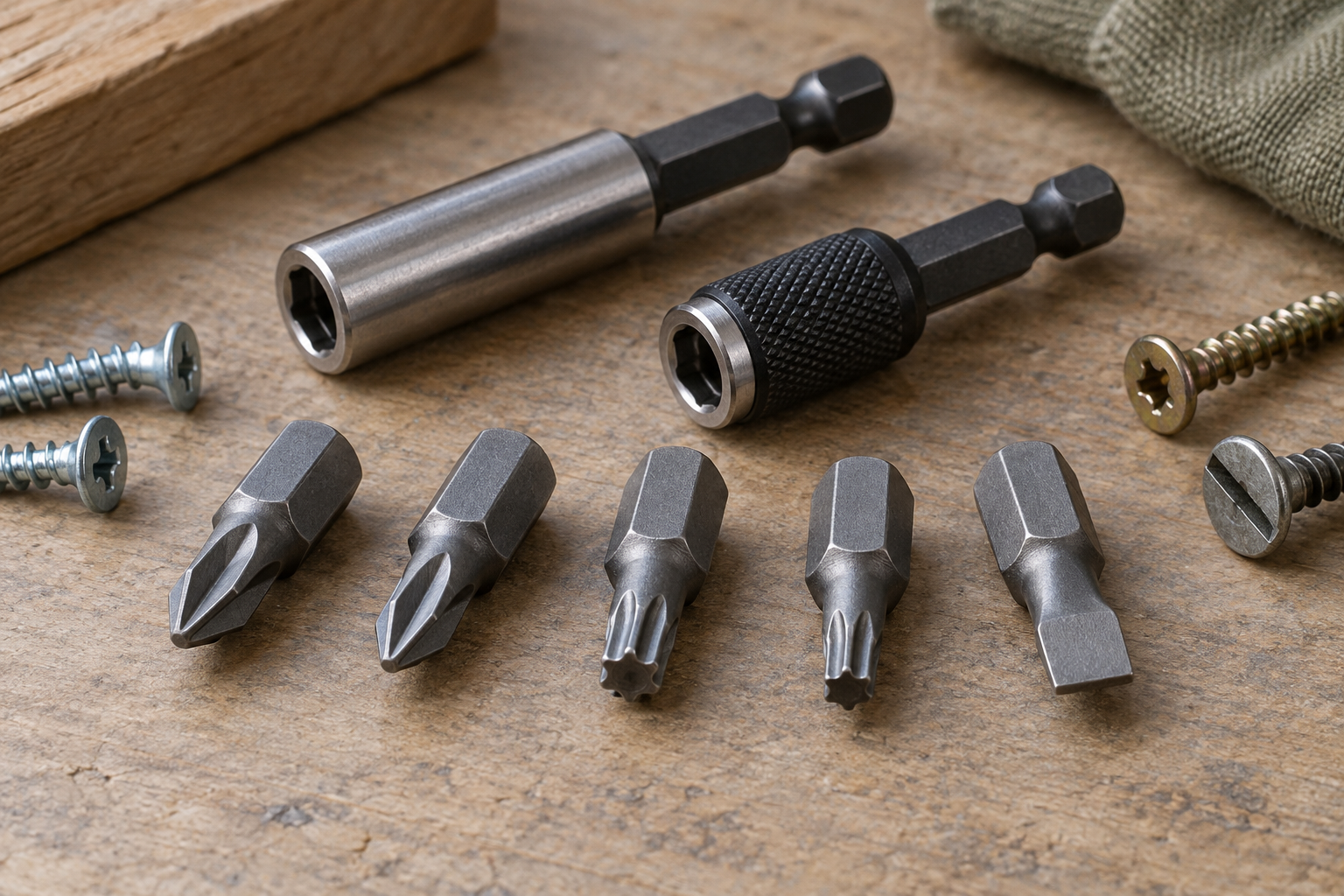
Phillips and Pozidriv screws look similar, but their recesses are different. A Phillips bit in a Pozidriv screw often feels loose and slips under load. Pozidriv screws have extra small marks between the main slots; use a bit marked PZ, not PH. Likewise, Torx, hex, and square-drive recesses need their matching profiles. A bit that seems to fit can still be the wrong size.
Try the bit by hand before powering up. The correct bit should sit fully in the recess with little side-to-side movement. If it rocks, protrudes, or engages only at the tip, test the next size or the correct drive type. For Phillips, common sizes include PH1, PH2, and PH3; many general-purpose screws use PH2, but that is not a reason to assume every cross-head screw does.
For frequent assembly or repair work, a labeled driver bit set with Phillips, Pozidriv, and Torx sizes is more useful than a large collection of duplicate PH2 bits. For occasional household jobs, a small, inexpensive set is usually sufficient.
Match the bit’s fit and condition to the screw
A worn bit has rounded edges that cannot grip the recess walls. Replace it when it spins, rattles, or leaves shiny, rounded marks on the bit’s working end. A fresh bit is often a cheaper fix than trying to rescue a screw with a damaged recess. Do not keep using a bit that has already slipped several times.
Bit length also matters. Long bits flex more and make it easier to tilt the driver. Use a short bit when the screw is accessible; choose a longer bit only when reach requires it. Magnetic bit holders help keep screws in place, but they do not correct a poor fit. For repeated high-load work, consider a purpose-made impact-rated bit set. Its tougher construction and torsion zone can reduce breakage with an impact driver, though it cannot prevent cam-out caused by the wrong bit or poor technique.
Choose the driving method for the fastener
A drill, impact driver, and hand screwdriver each have advantages. The right choice depends on screw size, material, access, and how much control the job needs.
| Tool or feature | Best use | Cam-out risk and trade-off |
|---|---|---|
| Hand screwdriver | Small screws and careful final tightening | Good speed control, but needs hand pressure and takes longer. |
| Drill/driver with clutch | General screwdriving in wood or sheet goods | Easy to control; set a low clutch level first. A high setting can strip the recess. |
| Impact driver | Long screws and repeated driving into wood | Fast and powerful, but can damage small screws or soft materials if run too long. |
| Torsion bit | Higher-torque power driving | Can absorb some twisting shock; does not compensate for a loose-fitting bit. |
An impact driver is not automatically the best anti-cam-out tool. Its hammering action helps drive long screws, but it can make a slipping bit chew up a head quickly. For small cabinet hardware, electronics, or delicate trim, a hand screwdriver or a drill on a low clutch setting is usually easier to control.
Keep the bit square and control the speed
Seat the bit firmly in the recess before pulling the trigger. Hold the driver in line with the screw, not at an angle, and apply steady pressure along that same line. If the bit starts to climb, stop immediately. Continuing to drive usually rounds the recess and makes the next attempt harder.
Start slowly until the screw threads have taken hold. On a variable-speed drill, use the trigger rather than full speed from the start. A practical approach is to drive most of the screw at moderate speed, then slow down as the head nears the surface. Set the clutch low and increase it only if the tool stops before the screw is seated. There is no universal clutch number: settings differ between tools and materials.
In dense wood, a pilot hole reduces the force needed to turn the screw. Choose a pilot hole based on the screw’s core diameter and the wood; a hole that is too small does little to ease driving, while one that is too large can weaken the hold. With metal or fragile plastic, follow the fastener or material guidance rather than forcing a screw through resistance.
If the recess is already damaged
Stop before the bit removes more material. Try a fresh, correctly sized bit and maintain firm, straight pressure. If the screw head is accessible, locking pliers may grip its outside edge. A manual impact driver can help with some stuck screws, but use the correct bit and protect the surrounding work. Screw extractors are a last resort: they require careful drilling and can break if overloaded. On a small or valuable part, replacement or professional help may be safer than escalating.
For routine work, the most reliable prevention is simple: identify the drive type, use a snug and unworn bit, align the driver, and match tool speed and torque to the screw. Spend extra on impact-rated bits only if your jobs regularly involve an impact driver; for light household use, a basic, correctly sized set and careful technique are usually enough.