What's inside
As an Amazon Associate I earn from qualifying purchases. This post may contain affiliate links at no extra cost to you.
When a benchtop planer leaves a deep dip at the beginning or end of a board, the machine has snipe. The DeWalt DW734 and Ridgid R4331 both have folding infeed and outfeed tables intended to support stock and reduce that problem, but they approach the job differently.
The short answer is that the DW734 has the more predictable snipe performance straight out of the box, while the R4331 can match it when its tables are aligned carefully. The Ridgid’s wider capacity and generally lower used-market price make it attractive for larger projects. The DeWalt is the safer choice if minimizing setup time matters more than maximum width.
As an Amazon Associate we earn from qualifying purchases at no extra cost to you.


Our Top Picks
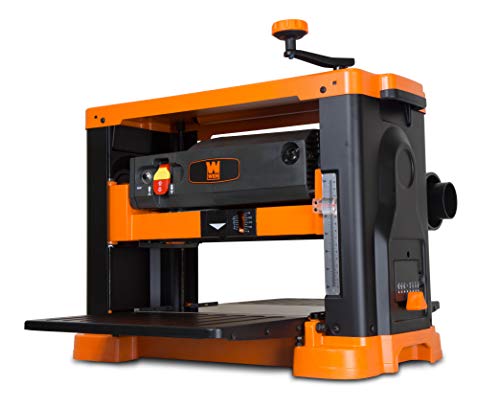 WEN PL1326 15-Amp 13-Inch Spiral Benchtop Thickness PlanerSpiral, 13-Inch, Single Speed81 poundsCheck on Amazon


Specifications That Affect Snipe
| Feature | DeWalt DW734 | Ridgid R4331 |
|---|---|---|
| Maximum width | 12 1/2 inches | 13 inches |
| Maximum depth of cut | 3/32 inch at narrower widths | 3/32 inch at narrower widths |
| Cutterhead knives | Three disposable knives | Three disposable knives |
| Motor | 15 amps | 15 amps |
| Table design | Folding extension tables | Folding extension tables |
| Typical snipe control | Good after basic table adjustment | Good, but more dependent on alignment |
Neither planer eliminates snipe through cutterhead design alone. Snipe happens when the board is supported by only one set of rollers as it enters or leaves the machine. The board can rise slightly under the cutterhead, causing a deeper cut over the first or last 2 to 6 inches. A machine that is perfectly level on the floor can still produce snipe if its tables are not aligned with the bed.
How the DeWalt DW734 Handles Snipe
The DW734 has a solid reputation because its infeed and outfeed tables are relatively easy to tune, and the planer’s cutterhead assembly maintains consistent pressure on the board. With the tables adjusted correctly, many users see little or no noticeable snipe on ordinary 3/4-inch boards. That does not mean the machine is immune; long, heavy boards can still lever upward at the exit.
The most common DW734 failure mode is an outfeed table that sits slightly low. A board leaving the cutterhead then drops as soon as its weight moves past the rear roller. The result is a visible dip near the trailing end. An infeed table that is too low creates the same problem at the leading end.
Use a straightedge across the planer bed and table surfaces rather than relying on the printed height markings. The table should be close to level with the bed, with no noticeable gap under the straightedge. Support stock on both sides with rigid stands or long tables. For a 6-foot board, support several feet before and after the planer; the folding tables alone are not enough.
The DW734’s three-knife cutterhead also makes knife condition important. A nick in one knife creates a repeating defect across the width, which can be mistaken for snipe. If the defect appears at every point along the board rather than only at its ends, inspect the knives first.
How the Ridgid R4331 Handles Snipe
The R4331 offers a slightly wider 13-inch capacity, which is useful for cabinet parts and wide glue-ups. Its folding tables can control snipe well, but table alignment and external support have a larger effect than many first-time owners expect. A small height error becomes obvious when planing a long board or taking a heavy cut.
The Ridgid’s typical failure mode is not that it produces unavoidable snipe; it is that the extension tables may need more careful adjustment after transport or repeated folding. If the rear table is a fraction of an inch low, the last several inches of a board can show a shallow but obvious taper. Check the table position whenever you move the planer or notice a sudden change in results.
Feed technique matters with both machines. Keep the board flat against the bed, but do not force it upward or downward as it enters. Once enough stock is under the outfeed roller, support the board from below without lifting it into the cutterhead. A helper should support long material at the same height as the planer bed, not pull it away from the machine.
Setup Changes That Reduce Snipe on Either Planer
Start with a shallow pass, around 1/32 inch, while checking the first and last 6 inches. Heavy cuts increase the lifting force and make end defects worse. Remove more material only after the tables and support stands are confirmed level.
When a board is long enough, run several pieces end to end. The leading board supports the next board through the cutterhead, and the trailing board supports the previous one. This “gang feeding” can keep snipe off the usable ends, though it requires boards of similar thickness and careful hand placement.
Mark the final length after planing and cut away the affected ends. For furniture parts, leave at least 4 inches of waste when rough-cutting boards for the planer. That is often faster and more reliable than trying to eliminate every last trace of snipe.
Keep knives sharp and replace them as a matched set. Dull knives increase drag, encourage uneven feeding, and can make a minor support problem much worse. If replacement parts are needed, compare current DW734 replacement knives carefully by dimensions and mounting-hole pattern.
Which Planer Is the Better Buy?
Choose the DeWalt DW734 if your priority is repeatable results with relatively little tuning. Its 12 1/2-inch capacity handles most furniture boards, and its table setup is straightforward. It is especially suitable for a small shop where the planer is moved, stored, and set up for occasional projects.
Choose the Ridgid R4331 if the extra half-inch of width is useful, you find it at a substantially lower price, or you are comfortable checking table alignment yourself. The cheaper option is perfectly reasonable for shelving, workbench parts, and general construction stock. If you already plan to use long support tables, the R4331’s snipe disadvantage largely disappears.
Neither machine is the right answer if you routinely plane boards wider than 13 inches or need production-level thickness consistency. In that case, consider a larger planer or a helical-head upgrade where available. For ordinary rough lumber, however, both can produce clean, usable surfaces. The deciding factor is setup discipline: level tables, sharp knives, shallow final passes, and support that keeps the board from tipping at the cutterhead.
If you are buying new rather than comparing these older machines, current 13-inch benchtop thickness planers may offer improved dust collection or replacement-parts support. But for controlling snipe specifically, a well-adjusted DW734 or R4331 is more important than a small difference in motor speed or advertised feed rate.