What's inside
As an Amazon Associate I earn from qualifying purchases. This post may contain affiliate links at no extra cost to you.
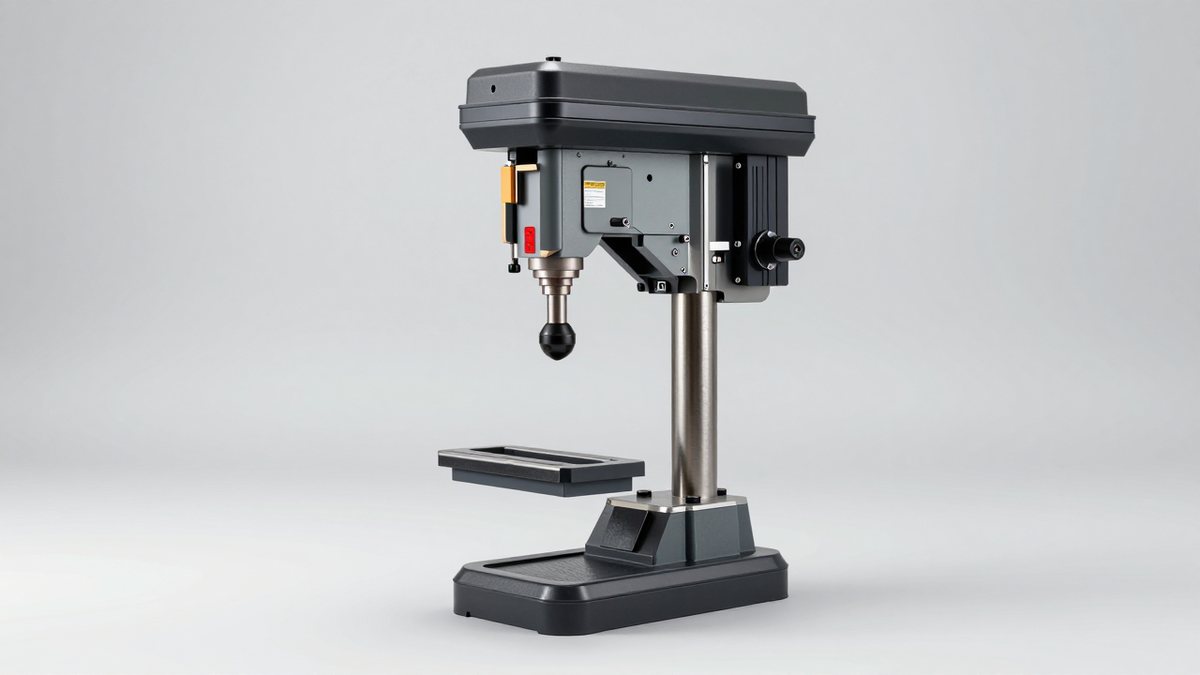
The best industrial drill press for metalworking for most shops is a 20-inch floor-standing variable-speed model with at least 1 to 1.5 HP, 150-3000 RPM range, 4-6 inches of quill travel, and a cast-iron head and column weighing over 400 lbs for rigidity, with the JET JDP-20MF, Baileigh DP-1000VS, Ellis 9400, and Clausing 20VS as the top proven options in 2026.
As an Amazon Associate we earn from qualifying purchases at no extra cost to you.


Our Top Picks
 Hougen HMD934 Industrial Magnetic Drill Four Speed 70/120/200/33217.75 x 10 x 26.25 inches72 PoundsCheck on Amazon

What Makes a Drill Press “Industrial” for Metal
Woodworking drill presses prioritize high RPM and light construction. Metalworking requires the opposite: low-speed torque, minimal runout, and mass to resist deflection when feeding a large twist drill or annular cutter through steel. If the machine flexes or the spindle has 0.005″ runout, your holes will be oversized, your bits will chatter, and you will burn up tooling. For thick stock over 1/2″, rigidity matters more than horsepower alone.
Key differences to prioritize:
- Spindle speed control: You need under 250 RPM for 3/4″ + drills in steel and annular cutters. Belt-only step pulley is durable but slow to change. Variable speed (mechanical Reeves drive or VFD/electronic) is far better for metal.
- Horsepower and torque: 3/4 HP is minimum for 1/2″ steel. 1 HP to 1.5 HP continuous duty lets you hold low RPM under load without stalling.
- Quill travel: Determines how deep you can drill in one stroke without repositioning the table. Critical for deep holes and using tapping heads.
- Runout: Look for factory spec of 0.0015″ or less TIR (Total Indicator Runout) at the spindle taper. Anything above 0.003″ will be noticeable in metal.
- Rigidity and weight: Column diameter, head casting, and base mass prevent column flex. Industrial presses use 4″+ diameter columns and weigh 350-700 lbs.
Top Industrial Drill Presses for Metalworking Compared
These four models represent the main classes of industrial metalworking presses available in 2026, from heavy variable-speed floor models to geared-head machines for production work.
| Model | Motor / Drive | Speed Range (RPM) | Drilling Capacity (Mild Steel) | Quill Travel | Table Size | Spindle Taper / Runout | Machine Weight |
|---|---|---|---|---|---|---|---|
| JET JDP-20MF (413550) | 1.5 HP, 115/230V, Mechanical Variable Speed | 150 – 4,200 ( stepless ) | 1-1/4″ cast iron / 1″ mild steel | 4-3/8″ | 18-1/8″ x 18″ | MT#3 / <0.0012″ TIR | ~490 lbs |
| Baileigh DP-1000VS | 1.5 HP, 220V VFD Variable Speed | 80 – 3,000 (electronic) | 1-1/4″ mild steel | 5-1/8″ | 17.7″ x 18.5″ | MT#3 / <0.001″ TIR | ~520 lbs |
| Ellis 9400 | 2 HP, 230V/460V 3-phase, Geared Head | 90 – 2,100 (12 speeds, geared) | 1-5/8″ mild steel / 2″ with annular cutter | 6-5/8″ | 20″ x 20″ (heavy ground) | MT#4 / <0.0008″ TIR | ~680 lbs |
| Clausing 2274 / 20VS Series | 2 HP, VFD Variable Speed | 75 – 3,500 | 1-1/2″ mild steel | 6″ | 19″ x 22″ | MT#3 or MT#4 / <0.001″ TIR | ~650 lbs |
1. JET JDP-20MF – Best Variable-Speed Value for General Metal Fabrication
The JDP-20MF is the standard for shops that drill steel, aluminum, and stainless without needing a full geared-head. Its Reeves-type mechanical variable speed lets you dial in any speed from 150 RPM for a 1″ twist drill in steel to over 4,000 RPM for small carbide drills in aluminum without stopping to move belts. The 1.5 HP motor holds torque well at the bottom end, and the large 18″ table with T-slots is ideal for vises and fixtures. Quill travel is shorter than geared machines, so for holes deeper than 4″ you will need to raise the table mid-operation.
Best for: Job shops, maintenance departments, and serious home shops that need one machine to cover 1/16″ to 1″ drilling in steel up to 1″ thick.
2. Baileigh DP-1000VS – Best Low-Speed Control for Thick Stock and Annular Cutters
The Baileigh DP-1000VS uses a VFD (Variable Frequency Drive) instead of a mechanical system, giving it the most useful range for metal: 80 RPM at the low end with constant torque. That extra-low speed is crucial for large-diameter hole saws and annular cutters in 3/4″ to 1-1/4″ plate where you must stay under 120 RPM to avoid burning the cutter. Digital RPM readout and forward/reverse tapping capability are standard. Its head casting and 4.72″ column are noticeably stiffer than 15-17″ benchtop presses, which reduces chatter when side-loading with a cross-slide vise.
Best for: Fabrication shops drilling thick plate, structural steel, and using annular cutters up to 2″ diameter.
3. Ellis 9400 – Best Geared-Head for Production and Heavy Drilling
The Ellis 9400 is a true industrial geared-head drill. Instead of belts, hardened gears deliver full torque at every speed. With 2 HP and a MT#4 spindle, it can push a 1-5/8″ twist drill through mild steel and has the power feed and rigidity to run 2″ annular cutters. The 6-5/8″ quill travel and power downfeed allow deep, repeatable holes without manual quill pressure variation. It is the heaviest and most rigid option here, but geared heads are noisier and speed changes require shifting the gear lever, not just turning a dial.
Best for: Production environments, tool rooms, and shops drilling 1″ + holes daily in steel where cycle time and hole finish matter.
4. Clausing 20VS Series (2274) – Best Precision and Longevity
Clausing presses are built for decades of use in tool rooms and industrial maintenance shops in the USA. The 20VS combines a VFD with an industrial 2 HP motor, a massive ground table, and a spindle ground to <0.001" TIR. The entire head, table, and base are meehanite cast iron, and the quill is hardened and ground with a 6" stroke. It is the most expensive category, typically in the $5,500 - $8,500 market range depending on configuration, but owners keep them for 20+ years with only belt and bearing service.
Best for: Machine shops and facilities where tolerance, repeatability, and serviceability outweigh initial cost.
Decision Matrix: Which Press Fits Your Situation
Choose by your primary material, frequency, and shop constraints rather than just horsepower.
| Your Situation | Recommended Type | Why |
|---|---|---|
| Budget under $2,500, mixed metal & occasional wood, single-phase garage shop | JET JDP-20MF or similar 20″ variable speed 1.5 HP | Lowest cost to get true low-speed torque and variable control without 3-phase power. Covers 90% of metalwork. |
| Drilling 3/4″ – 1-1/4″ plate regularly, using annular cutters or hole saws | VFD model like Baileigh DP-1000VS | Needs 80-150 RPM with full torque. VFD holds speed under load and allows tapping. MT#3 handles large cutters. |
| Daily production, 1″ + holes in steel, need power feed and maximum rigidity | Geared-head like Ellis 9400 | Gear drive prevents belt slip at high feed pressure. MT#4 and 650+ lbs eliminates deflection on thick stock. |
| Tight space or need to move machine: 300-400 sq ft shop | Avoid 22″+ floor models; choose 17″-20″ floor model under 550 lbs with 220V single-phase | Geared 20″+ presses need 3′ x 3′ footprint plus table swing. Lighter variable-speed models can be moved with engine hoist. |
| Precision milling-like operations with X-Y table or tapping | Clausing 20VS or other VFD with forward/reverse and <0.001" runout | Low runout and spindle reverse are required for precision reaming and power tapping without breaking taps. |
Durability and Ownership Realities for Metalworking
An industrial press lasts decades, but the consumables and wear points are different from woodworking.
- What wears first: The quill return spring and depth stop threads, followed by the spindle bearings if you regularly overfeed. Belt dust from Reeves drive systems builds up inside the head. Geared heads wear slower but need annual gear oil changes.
- Chuck and taper: Most 20″ presses ship with a JT33 keyed chuck. For metal, replace it with a quality keyed chuck (Röhm, Albrecht, Jacobs) or better, use MT#3 direct collets and drill holders. A cheap chuck adds 0.003-0.006″ runout even if the spindle is perfect. Clean the MT taper with a taper cleaner before every tool change.
- Coolant and cleaning: Metal chips and cutting fluid destroy woodworking-style tables. Use a vise with a coolant trough or a spray bottle with soluble oil. Clean and oil the column and table elevation rack weekly. Chips left on the column score the casting and cause the table to bind.
- Common mistakes: Running too fast is the number one killer of bits in steel. Use 100 RPM per inch of drill diameter as a starting point for mild steel (e.g., 200 RPM for 1/2″ drill, 100 RPM for 1″ drill). Never use your palm to clear chips from the table while the spindle is turning, and never hold small work by hand; a drill grabbing in steel will spin the part instantly.
- Speed calculation for steel: RPM = (SFM x 3.82) / Drill Diameter. For mild steel with HSS, use 80 SFM. So a 3/4″ drill needs (80 x 3.82) / 0.75 = 407 RPM. For stainless (40 SFM), the same drill needs 203 RPM. If your press cannot go that low, you must reduce SFM by using cobalt bits and cutting fluid, or you will harden the hole.
Final Recommendation by Use Case
For most metalworking shops buying their first industrial press, the best industrial drill press for metalworking is a VFD or mechanical variable speed 20-inch model with 1.5 HP and sub-150 RPM capability. It gives you the threading and reaming versatility without the cost and weight of a geared head.
If you drill plate thicker than 1″ more than twice a week, step up to a geared-head machine like the Ellis 9400. The extra quill travel, power feed, and MT#4 rigidity will pay for itself in cutter life and hole quality. For tool room and inspection-level work where every hole must be within a few thousandths, the long-term value is in a Clausing-class machine.
Frequently Asked Questions
Do I need 3-phase power for an industrial drill press?
Not necessarily. Many 1.5 HP variable-speed presses run on 115/230V single-phase. 2 HP geared models often come as 3-phase by default but can be ordered with a single-phase motor or run on a VFD or rotary phase converter. VFD models can convert single-phase input to 3-phase output for the motor.
Can I use an industrial drill press for milling?
No. Even rigid industrial drill presses are not designed for side loads from milling cutters. The spindle bearings, taper, and quill lack the preload for milling. Light spot-facing and countersinking is fine, but for milling use a milling machine or mill/drill.
What is acceptable runout for metalworking?
For general fabrication, 0.0015″ to 0.002″ TIR is acceptable. For precision reaming and tapping, aim for 0.001″ or less. Always measure runout with a test bar in the spindle taper, not just the chuck, to isolate chuck error from spindle error.