What's inside
As an Amazon Associate I earn from qualifying purchases. This post may contain affiliate links at no extra cost to you.
Our Top Picks
 DEWALT DCH273P2 20V Max Brushless SDS Rotary HammerOne Size19.29 x 11.93 x 4.72 inches11.68 poundsCheck on Amazon
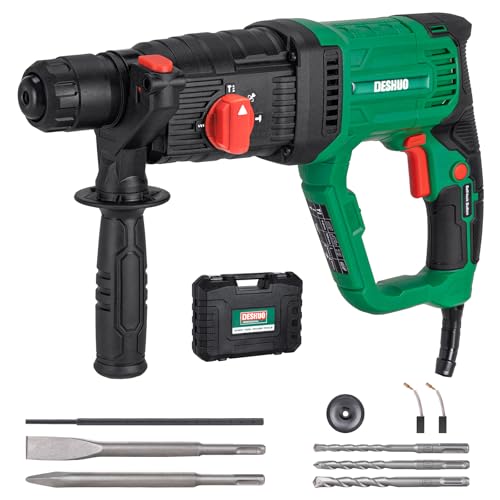 Deshuo 1" SDS-Plus Lightweight Rotary Hammer Drill forSmall15.15 x 8.85 x 3.93 inches7.19 PoundsCheck on Amazon


Quick verdict
Both the DeWalt DCH263 and Milwaukee 2715-20 have vibration-control features, but neither makes a rotary hammer vibration-free. The DeWalt uses SHOCKS active vibration control; Milwaukee lists an Anti-Vibration System (AVS). For repeated overhead or wall drilling, the DeWalt is a strong pick if reducing vibration exposure is your priority. The Milwaukee is a capable alternative, especially if you already own M18 batteries.
There’s an important limit to that verdict: published vibration figures are not always measured under matching conditions, and a manufacturer’s control-system name does not tell you exactly how much vibration you’ll feel on a particular job. Fit, bit condition, material and technique all affect the result.
As an Amazon Associate we earn from qualifying purchases at no extra cost to you.



Key differences
| Feature | DeWalt DCH263 | Milwaukee 2715-20 |
|---|---|---|
| Tool type | 18V cordless SDS-Plus rotary hammer | M18 cordless SDS-Plus rotary hammer |
| Vibration feature | SHOCKS active vibration control | AVS anti-vibration system |
| Impact energy | 2.6 joules | 2.1 ft-lb (about 2.8 joules) |
| Operating modes | Hammer drilling, drilling, and chipping | Hammer drilling, drilling, and chipping |
| Chuck | SDS-Plus | SDS-Plus |
Impact-energy figures are useful context, not a direct measure of speed or comfort. They are rounded here, and different manufacturers’ test methods may not be identical. Both tools are in the same general class: suited to anchor holes and modest chipping, not heavy demolition.
What the vibration systems mean in practice
SHOCKS and AVS are designed to reduce vibration reaching the operator. They do not eliminate the repeated impact that makes a rotary hammer effective. You’ll still feel vibration through the handles, especially when drilling hard concrete, using a large bit or working for long stretches.
DeWalt’s DCH263 is often the more appealing choice for someone who expects frequent drilling and places a high value on vibration control. But don’t treat that as proof it always produces less vibration than the Milwaukee: a fair comparison would need comparable vibration readings taken with the same bit, material, mode and test method. If exposure is a concern, check the manuals for declared vibration values and use those as part of your decision.
Either tool can feel rougher than expected if the bit is blunt, the dust is packing in the hole, or you’re forcing the machine. Let the hammer do the work, keep a firm but relaxed grip, and clear dust from deeper holes. Long sessions still call for breaks and appropriate hearing and eye protection.
Which one fits your work?
Choose the DeWalt DCH263 if you drill concrete regularly and want a tool whose design explicitly targets lower vibration. It also makes sense when you already have compatible DeWalt 20V MAX batteries. For occasional anchor holes, its vibration advantage may matter less than the cost of the tool kit and the batteries you need.
Choose the Milwaukee 2715-20 if you’re invested in the M18 system or find a better kit price. It has AVS, three useful modes and enough impact energy for typical small-to-medium concrete drilling. The cheaper option is fine for intermittent work, such as installing a few anchors or making occasional holes for conduit, provided the tool and bit are appropriate for the task.
These are tool-only model numbers, so check what a listing includes. A bare tool may look inexpensive until you add a battery and charger. If you’re starting from scratch, compare complete kits as well as the cost of DeWalt rotary hammer kits and Milwaukee M18 rotary hammer kits.
Limits, bits and common failure modes
Both machines use SDS-Plus bits. That is the right format for many anchor holes and light chipping, but it is not SDS-Max: don’t buy oversized bits or expect either tool to stand in for a demolition hammer. For repeated holes near the upper end of a tool’s stated capacity, expect slower progress and more fatigue than with a larger rotary hammer.
A dull or worn bit increases drilling time and can make the job feel harsher. A jammed bit can also twist the tool suddenly, so keep control of the handles and avoid leaning your full weight into the machine. In chipping mode, use a suitable pointed or flat SDS-Plus chisel and let it strike; don’t use the tool as a pry bar.
If the work is only a handful of small holes each year, either model may be more tool than you need. A corded rotary hammer can be a better value if you don’t need portability, while a hammer drill is generally a less effective choice for repeated concrete drilling. If comparing those categories, look at corded SDS-Plus rotary hammers too.
Buying choice
For vibration-conscious, frequent concrete work, lean toward the DeWalt DCH263, while treating SHOCKS as a useful design feature rather than a guarantee of a specific reduction. For occasional work or an existing M18 setup, the Milwaukee 2715-20 is a sensible choice and its AVS system means it is not simply a bare-bones alternative. In either case, the better buy is usually the model that fits your battery platform, comes with the right warranty and leaves room in the budget for sharp, suitable bits.