What's inside
As an Amazon Associate I earn from qualifying purchases. This post may contain affiliate links at no extra cost to you.
Our Top Picks
 TEKTON 3/8 Inch Drive Flare Nut Crowfoot Wrench8-24 mm11.2 x 2.4 x 2.5 inches1.76 poundsCheck on Amazon


What matters when tightening flare fittings
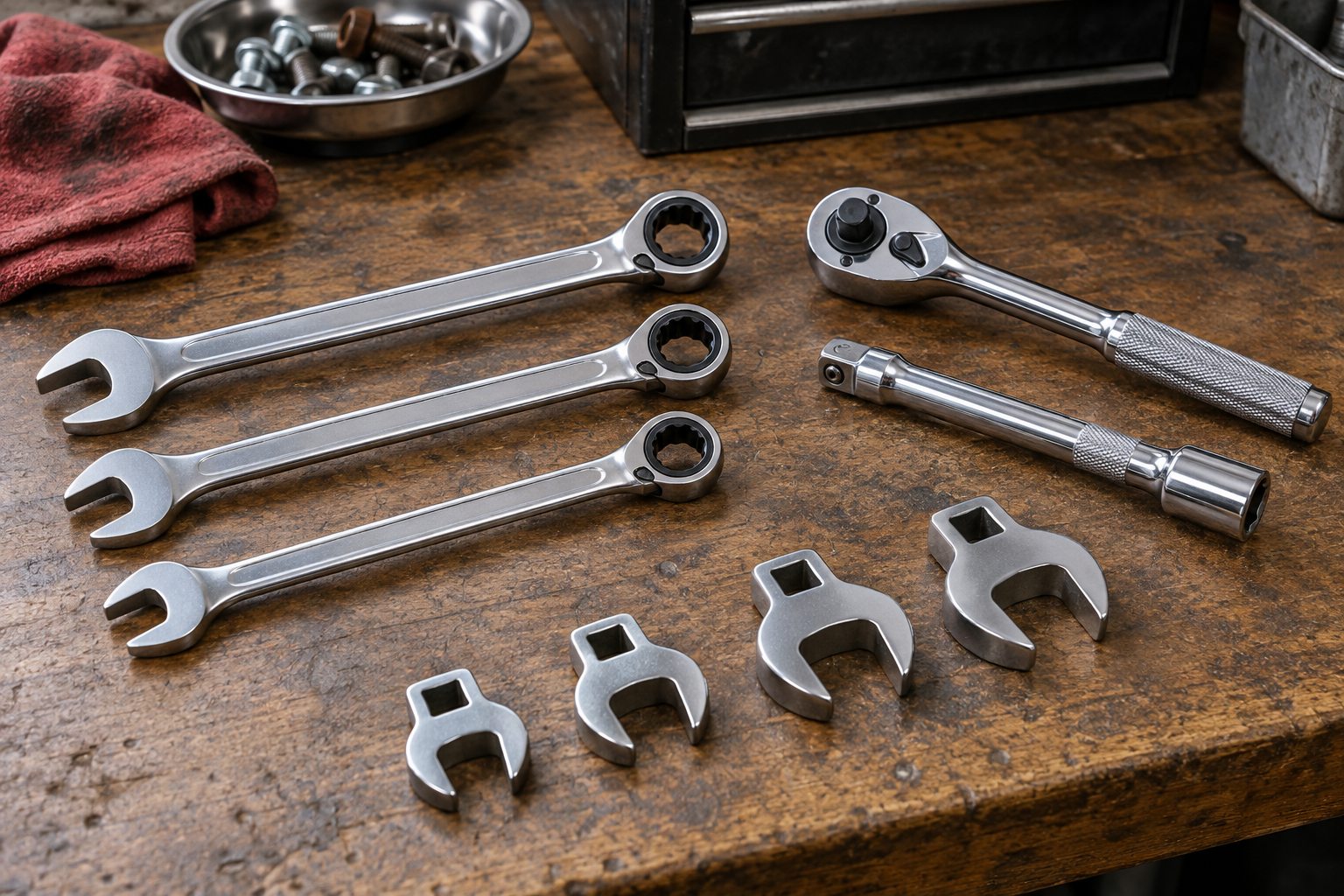
A crowfoot wrench lets you reach a fitting with a torque wrench when a regular socket or box wrench will not fit. That makes a set useful on brake, fuel, hydraulic, and air-conditioning lines, where the fitting needs to be held without rounding its flats and tightened to a specified torque.
For flare fittings, prioritize six-point openings, a close fit, and the correct drive size for your torque wrench. A six-point crowfoot bears on more of the nut’s flats than a twelve-point design, reducing the risk of slipping on a tight or soft fitting. Measure the fitting across its flats before buying: flare-nut sizes do not always match the nominal line size, and metric and SAE fasteners are not interchangeable.
As an Amazon Associate we earn from qualifying purchases at no extra cost to you.


Most crowfoots are open-ended, so they can slide over a tube and onto the nut. A flare-nut crowfoot has a wider opening than a conventional open-end crowfoot, leaving more contact around the nut. That is the style to choose for flare nuts. An ordinary crowfoot may still work when access is tight and the nut is not seized, but it provides less grip.
Crowfoot set types compared
| Type | Best for | Trade-offs |
|---|---|---|
| Six-point flare-nut crowfoot set | Routine work on brake, fuel, and hydraulic fittings | More secure grip; usually bulkier than an open-end crowfoot |
| Open-end crowfoot set | Occasional use where a flare-nut style will not fit | Often cheaper, but less contact can mean more slipping and rounded flats |
| Individual crowfoots | A known fitting size or one recurring repair | Lowest cost for a single job; less useful if the fitting size is uncertain |
| Deep or offset crowfoots | Recessed fittings or obstacles around the nut | Improves access, but added length and offset complicate torque setup |
For a regular repair kit, a six-point SAE flare-nut crowfoot set is a sensible starting point if your fittings are inch-sized. Choose metric instead if the vehicle or equipment uses metric hardware; buy both only when the work actually calls for both. Check the set’s size range against the fitting before assuming it covers the job.
How to choose a set
Check the drive. Common crowfoot drives include 1/4, 3/8, and 1/2 inch. The drive must match your torque wrench or an adapter. A 3/8-inch set suits many under-hood and light hydraulic jobs; larger fittings may justify 1/2 inch. The larger drive is not automatically better: the crowfoot and wrench still need room to fit on the fitting.
Compare the working end. Look for clearly marked sizes and accurately cut jaws with minimal play on a sample nut. A loose fit can round the corners before the wrench reaches the required torque. The wrench should sit fully on the nut, not just catch its outer edge. Do not use a crowfoot that spreads, rocks, or only engages part of the flats.
Choose a useful range, not the biggest kit. A metric six-point flare-nut crowfoot set is worth considering for metric systems. If you need only one size, buying a single quality wrench is cheaper and avoids unused tools. For mixed work, a case that keeps sizes organized helps prevent reaching for the wrong wrench in a cramped space.
Material and finish matter less than fit and construction, but the wrench must be strong enough for the specified torque. Chrome-vanadium steel is common in hand-tool sets. Avoid using a visibly bent or cracked crowfoot, and do not add a pipe to the torque wrench for extra leverage. If a fitting will not move at the proper setting, stop and investigate corrosion, wrong-thread engagement, or a damaged line rather than forcing it.
Using a crowfoot without changing torque
A crowfoot changes the effective length of a torque wrench when it is mounted straight out from the wrench head. If the torque wrench length from the center of its drive to the center of the handle grip is L, and the crowfoot adds length A, the corrected setting for a specified fastener torque T is:
Setting = T × L ÷ (L + A)
For example, with a 12-inch wrench, a 2-inch crowfoot, and a 24 ft-lb target, set the wrench to 20 ft-lb: 24 × 12 ÷ 14 ≈ 20.6, so use the maker’s guidance and the nearest appropriate setting rather than blindly rounding up. Measure from the wrench drive center to the middle of the crowfoot’s nut contact. Follow the torque-wrench manufacturer’s instructions for length measurement and allowable settings.
If the crowfoot is positioned at 90 degrees to the torque wrench, the added length generally does not increase the effective lever arm, so no length correction is needed. Keep that angle as close to 90 degrees as the work allows, and make sure the crowfoot cannot rotate out of position. This is often simpler than calculating a correction, but may be impossible in tight access.
Common mistakes and failure modes
Use a backup wrench where the fitting design calls for one, and support the line so tightening does not twist it. A twisted tube can crack later, even if the flare initially seals. Start threads by hand; cross-threading can damage the fitting before the crowfoot is applied. Tighten to the equipment maker’s torque specification, not a generic value, because fitting materials, flare designs, and sizes vary.
Do not keep tightening a leaking flare to “make it seal.” The flare may be damaged, contaminated, misaligned, or the wrong type. Loosen it and inspect the mating surfaces and tube alignment. A torque wrench controls applied torque; it cannot correct a poor flare or damaged threads. For a one-off job with a sound fitting and easy access, an inexpensive, correctly sized flare-nut crowfoot can be adequate. For repeated work or high-consequence hydraulic lines, better machining and a secure six-point fit are worth paying for.