What's inside
As an Amazon Associate I earn from qualifying purchases. This post may contain affiliate links at no extra cost to you.
Our Top Picks
 BOSCH LR1G 500 Ft. Green-Beam Rotary Laser Receiver58 in7.4 x 3 x 4.9 inches0.44 poundsCheck on Amazon


What a receiver adds outdoors
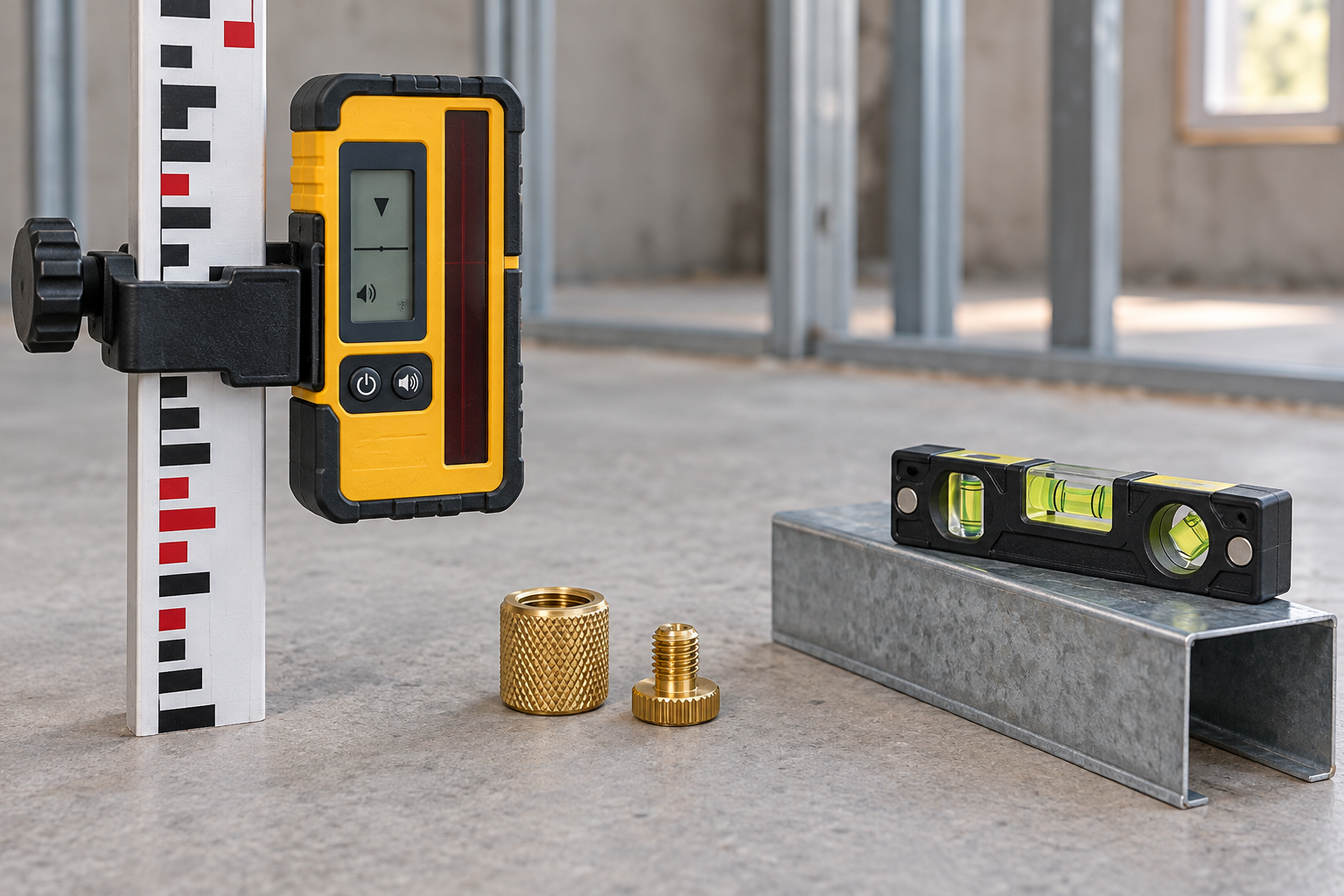
A rotary laser can project a level reference around a jobsite, but its visible beam becomes hard to see in sunlight. A compatible receiver solves that problem: its sensor detects the rotating beam and signals when the receiver is on the laser’s plane, usually with arrows, a tone, or both. You can then read the reference on a grade rod or attach the receiver to a machine.
A receiver does not increase the laser’s power or make an incompatible laser usable. The laser and receiver must use compatible beam wavelengths and rotation modes. Check the laser manual before buying; some kits use proprietary receivers, and a receiver made for a different type of laser may not detect the beam at all. Also check whether the advertised range is a diameter or a radius. A 1,000-foot diameter rating means roughly 500 feet from the laser, under the maker’s stated conditions.
As an Amazon Associate we earn from qualifying purchases at no extra cost to you.


What to compare before buying
For layout and grading, the useful specifications are detection range, accuracy setting, display visibility, clamp quality, and water and dust protection. Range claims are not guarantees: battery condition, setup, obstructions, and the specific laser all affect how reliably the receiver works. A broad reception window makes it easier to catch the beam when the rod is moved quickly, but does not improve the laser’s accuracy.
| Receiver type | Best fit | Trade-off |
|---|---|---|
| Basic single-sided receiver | Short-range DIY leveling and occasional use | May require turning the rod to find the display |
| Dual-sided receiver with arrows and tone | General outdoor grading and site work | Costs more; verify it matches the laser |
| Machine-control receiver | Repeated work from an excavator or other equipment | Higher cost and installation effort; often excessive for a homeowner |
For most users, a compatible, dual-sided rod receiver is the practical middle ground. It lets you see the reading from either side of the rod, while the tone helps when you cannot keep your eyes on the display. Browse dual-display rotary laser receivers, but compare each listing’s compatibility notes against your laser’s manual rather than choosing by range alone.
Accuracy, display, and tone
Receiver accuracy is commonly adjustable between fine and coarse settings. Fine settings are useful for establishing a precise reference over a short distance; coarse settings make it easier to find the beam quickly when moving a rod across a large area. The exact tolerance varies by product and setting, so read the specification in inches or millimeters rather than assuming “fine” means the same thing across brands.
For a typical yard project, a clear arrow display and an audible tone are often more useful than the smallest claimed tolerance. The arrows show which way to move the receiver; the tone changes or steadies at the beam center. If you work in noise, check that the volume can be adjusted. If you work alone, a display visible from both sides can save repeated turns and trips back to the laser.
Do not treat the receiver’s center indication as a check on the rotary laser’s calibration. A receiver can detect the plane accurately while the laser itself is out of level or out of calibration. Before relying on it for a slab, foundation, or long drainage run, perform the laser maker’s field check on a stable surface.
Getting dependable range in practice
Set the laser on a firm tripod, with a clear line of sight to the work. A receiver can detect a rotating beam that is not readily visible to your eye, but walls, vehicles, stockpiles, and terrain can still block the beam. For a long run, move the instrument or use a second setup rather than assuming the receiver will see through an obstruction.
At the rod, move the receiver slowly through the detection window until the indicator identifies the center. Lock it in place, take the reading, and avoid leaning the rod. A rod that is not plumb changes the apparent height: even a small tilt can introduce a meaningful error over a long rod. On sloped ground, keep the rod vertical and take readings at the points needed to set the grade.
Wind can shake a rod, sunlight can wash out a weak display, and a low battery can make tones or indicators unreliable. Carry spare batteries, check the receiver’s battery warning before starting, and test the display in the conditions where you will work. For dusty or wet sites, check the stated IP rating and keep the sensor window clean. A sealed receiver is a sensible upgrade for regular outdoor use; for occasional work in fair weather, paying extra for the highest protection rating may not be worthwhile.
Which option makes sense?
If you already own a rotary laser and only need to level a patio, fence line, or small garden, a basic compatible receiver may be enough. It can be a good value if you are comfortable turning the rod to read it and the working distance is modest. Do not buy a generic receiver on the assumption that all rotary lasers share a signal; confirm compatibility first.
For regular grading, building, or work across a broad site, choose a dual-sided receiver with adjustable accuracy, a visible display, an audible indicator, and a sturdy rod clamp. A receiver with a grade-rod clamp is easier to move and hold at a repeatable height than a handheld unit. If you are still choosing the laser, buying a matched laser-and-receiver kit can avoid compatibility uncertainty and may cost less than purchasing parts separately.
Machine-control receivers are a different purchase. They make sense when an operator needs continuous grade information from the cab and the equipment will be used that way often. For occasional excavation or landscape work, a rod-mounted receiver is usually cheaper, simpler to set up, and easier to use across multiple jobs.
The best receiver is the one that reliably detects your laser at the working distance you actually need. Confirm compatibility, understand the range rating, and prioritize a readable display and secure clamp. Those checks matter more on site than a long-range number that assumes an unobstructed beam and ideal conditions.