What's inside
- Best bat house choices by backyard situation
- What separates the best bat houses from decorative boxes
- Mounting height matters more than most buyers expect
- How to install a bat house for the best chance of occupancy
- Ownership realities: cleaning, wear, and common mistakes
- Are branded bat houses worth the higher price?
- Bottom line
As an Amazon Associate I earn from qualifying purchases. This post may contain affiliate links at no extra cost to you.
The best bat houses for backyard pest control are multi-chamber, untreated-wood boxes with roughened interior surfaces, a 3/4- to 1-inch entrance gap, and a mounting height of at least 12 feet in a sunny, open location.
A good bat house can provide a protected daytime roost for insect-eating bats, but it is not an instant mosquito-control device. Bats may take one or more seasons to occupy a new box, and their diet includes many kinds of insects rather than mosquitoes alone. The right purchase therefore depends on chamber size, construction quality, placement options, and how much maintenance you are willing to do.
As an Amazon Associate we earn from qualifying purchases at no extra cost to you.



Our Top Picks
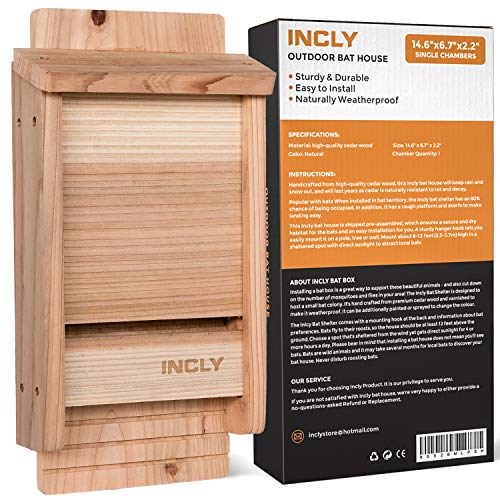 INCLY Small Bat House Kit for Outdoors 14.6"x6.7"x2.2"6.7 x 14.6 x 2.2 inches0.8 poundsCheck on Amazon


Best bat house choices by backyard situation
| Backyard situation | Best choice | Useful specifications | Why it fits |
|---|---|---|---|
| First-time buyer with limited budget | Single-chamber cedar or exterior-plywood house | Approximately 14–18 inches wide, 20–24 inches tall, 3/4–1 inch entrance | Lower cost and simpler installation, although it offers less temperature choice for bats |
| Warm, open yard with room for a pole | Large multi-chamber house | Three or more chambers, 20–24 inches wide, 24–36 inches tall | More roosting surface and a better range of temperatures inside the box |
| House with a suitable south- or southeast-facing wall | Wall-mounted multi-chamber box | At least 12 feet above ground, with the bottom clear of branches and obstructions | Convenient access without installing a separate pole |
| Cool or windy location | Deep, well-sealed multi-chamber design | Two or more chambers, solid roof, protected seams, dark exterior finish | Reduces drafts and gives bats warmer interior options |
| Property with frequent pesticide use | Any durable, properly mounted house—but reconsider the site | Place away from sprayed areas and never treat the box with insecticide | Roost habitat cannot compensate for conditions that reduce available insects |
What separates the best bat houses from decorative boxes
Chamber size and number
Bats do not use a house the way people use a birdhouse. They cling to vertical interior surfaces in narrow spaces, so the key measurement is the chamber gap rather than the overall volume. A gap of roughly 3/4 to 1 inch suits many North American insect-eating bats. Gaps that are much wider can be drafty, while very narrow gaps may be difficult for larger bats to enter.
Single-chamber houses can work, but multi-chamber models are usually the better choice for backyard pest control. A box with three or four chambers gives bats alternatives when one section is too hot, cold, or exposed. Look for a wide backboard and several interior partitions rather than a tall, hollow cavity.
For a general-purpose purchase, choose a box at least 14 inches wide and 20 inches tall. Larger houses measuring about 20–24 inches wide and 24–36 inches tall provide more roosting surface, but size alone does not guarantee occupancy. A poorly placed large box is less useful than a correctly mounted smaller one.
Wood type and interior texture
Untreated exterior-grade wood is the safest default. Cedar resists rot and is naturally durable, while exterior-grade plywood can be a good value when its edges and roof are protected from rain. Avoid pressure-treated lumber, interior plywood, and wood coated with preservatives that could expose bats to unwanted chemicals.
The inside of the box must be rough enough for bats to grip. Many purpose-built houses have saw kerfs, grooves, or attached mesh on the backboard and partitions. Smooth wood can prevent bats from climbing into the chambers. If you build or modify a house, cut grooves approximately 1/8 inch deep and spaced about 1/4 inch apart, or use securely attached plastic mesh designed for outdoor use. Do not leave sharp staples, loose fabric, or protruding screws inside.
A dark brown, black, or other dark exterior finish can help the box absorb heat. Use only exterior water-based paint or stain on the outside, and allow it to cure fully before installation. Never paint or stain the interior.
Entrance design and ventilation
The entrance is normally a narrow slot at the bottom of the house, often with a landing board extending below it. A landing board at least 3–6 inches long gives bats a place to land and climb. The slot should remain open and free of splinters, caulk, and accumulated debris.
Ventilation needs to be balanced. Small screened vents near the upper portion can prevent overheating in hot climates, but large open seams can create drafts and admit rain. Favor a box with a sloped or overhanging roof, sealed side joints, and modest ventilation rather than a design that is open on several sides.
Mounting height matters more than most buyers expect
Mount the house 12–20 feet above ground, with 15 feet being a useful target when the site allows it. Pole mounting is often preferable because trees can shade the box, sway in the wind, and provide access for predators. Wall mounting can work on a tall building, garage, or barn if the face receives adequate sun and the box is clear of roof overhangs and nearby branches.
Choose a location with a clear flight path. Keep the entrance at least 10–20 feet from nearby branches, fences, and other obstacles where possible. Bats should be able to approach, drop below the box, and leave without weaving through dense vegetation.
In many regions, a south- or southeast-facing box receives the warmth needed for successful roosting. In very hot climates, partial afternoon shade may be safer. Aim for several hours of direct sunlight, then adjust for local weather: cool regions generally need more sun, while hot regions may need a lighter finish, extra ventilation, or morning rather than late-afternoon exposure.
How to install a bat house for the best chance of occupancy
-
Select the structure. Choose a multi-chamber box if your budget and mounting space permit. Confirm that the interior contains grooves or mesh and that the wood is untreated.
-
Measure the mounting point. Position the lower edge at least 12 feet above ground and preferably 15–20 feet. Check that a ladder or lift will not be needed for routine inspection if the box is mounted on a pole.
-
Face the entrance appropriately. Start with south, southeast, or southwest exposure depending on climate. Use a compass rather than estimating by the shape of the yard.
-
Secure the box firmly. A pole-mounted house should not wobble excessively. Use exterior-rated fasteners, keep the pole plumb, and avoid crushing the wood around screw heads.
-
Leave the flight path open. Remove tall weeds, branches, and dense growth immediately in front of the entrance. Do not place the box directly over a frequently used door, patio, or walkway.
-
Give it time. Occupancy may take weeks, a season, or longer. Avoid moving the house after installation unless the location is clearly unsuitable.
Ownership realities: cleaning, wear, and common mistakes
The roof and bottom edge usually show weather damage first. Inspect the box annually for split boards, loose fasteners, water entry, and blocked vents. Recoat only the exterior when the finish begins to fail, and keep all paint away from the interior and entrance.
Do not routinely open or clean an occupied house. Bat droppings can accumulate below the entrance, but this is normal. If an empty box needs maintenance, wear gloves and a suitable dust mask, dampen dusty material before removal, and follow local wildlife guidance. Never disturb bats, pups, or other wildlife during a roosting period.
Common mistakes include installing the house too low, placing it in deep shade, using smooth untreated plywood inside, sealing the entrance with caulk, and mounting it directly beside bright nighttime lighting. Outdoor lights can make the approach less attractive and may alter insect activity around the box.
Another mistake is expecting a bat house to solve a mosquito problem by itself. Reduce standing water in buckets, clogged gutters, planters, and toys; use screens where practical; and follow local guidance on habitat and pesticide use. A bat house is best viewed as one habitat improvement among several.
Are branded bat houses worth the higher price?
Recognized bat-house brands such as BatBnB and Big Bat Box offer purpose-built designs, installation guidance, and larger multi-chamber models. These can be worthwhile when you want consistent construction, a tested mounting system, or a larger house for a prominent pole installation. Prices commonly range from about $30–$80 for basic single- or small multi-chamber houses and approximately $80–$250 or more for large, reinforced, multi-chamber models and pole systems.
A less expensive house can perform well if it has the same essential features: untreated exterior wood, textured interior surfaces, a suitable entrance gap, a weatherproof roof, and a safe mounting location. Pay for construction and placement flexibility rather than decorative cutouts, novelty shapes, or an unusually large cavity.
Bottom line
For most backyards, choose a dark, untreated-wood multi-chamber bat house about 20–24 inches wide, with 3/4- to 1-inch textured chambers, a landing board, modest ventilation, and a weatherproof overhanging roof. Mount it 12–20 feet high in a sunny, unobstructed location, then maintain nearby insect habitat and allow time for bats to discover it. That combination gives you a better chance of supporting local bats—and potentially reducing some flying insects—than simply buying the largest box available.