What's inside
As an Amazon Associate I earn from qualifying purchases. This post may contain affiliate links at no extra cost to you.
Our Top Picks
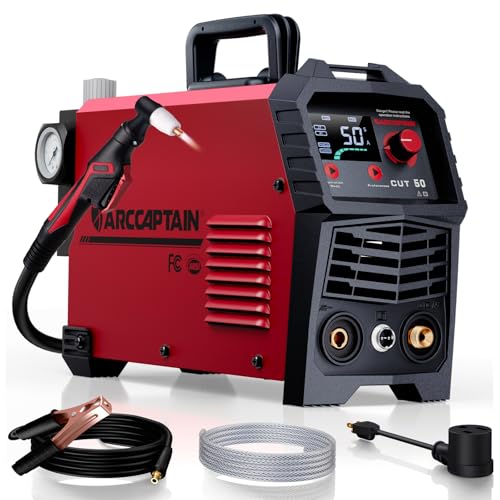
 Bestarc 50A Plasma Cutter Machine50A Pilot Arc V813.98 x 5.12 x 8.46 inches10.2 poundsCheck on Amazon


Best Handheld Plasma Cutters for Home and Jobsite Use
The best hand held plasma cutter is the one that cleanly cuts your usual metal thickness at the power available where you work—and whose air supply can keep up. For occasional home repairs, a 120V-capable inverter is often the practical choice; for frequent cutting of thicker steel, look for a 240V machine with a higher duty cycle and a compressor that meets its stated airflow requirement.
There is no single best choice for every buyer. A machine’s advertised maximum thickness is usually a severance figure, not a promise of a clean, square edge. Compare clean-cut capacity, input voltage, duty cycle, air demand, and the machine’s total carry weight before deciding.
As an Amazon Associate we earn from qualifying purchases at no extra cost to you.


Handheld plasma cutter comparison
The models below are established product lines. Specifications can vary by version and market, so confirm the manual for the exact model before buying—particularly air consumption, input requirements, and weight. “Clean cut” and “maximum cut” are not measured identically by every manufacturer.
| Product | Input power | Published cutting capacity | Duty cycle | Air and portability notes |
|---|---|---|---|---|
| Hypertherm Powermax30 AIR | 120–240V, single phase | Up to 10 mm (3/8 in) recommended cut; greater severance capacity | 35% at 30A on 120V; 50% at 30A on 240V | Built-in air compressor; about 13.5 kg (29.8 lb). Convenient where a separate compressor is impractical. |
| Hypertherm Powermax30 XP | 120–240V, single phase | Up to 10 mm (3/8 in) recommended cut; up to 16 mm (5/8 in) severance | 35% at 30A on 120V; 50% at 30A on 240V | Requires clean, dry compressed air; about 9.5 kg (21 lb) for the power supply. |
| ESAB Rogue CUT 45 | 120–240V, single phase | Up to about 16 mm (5/8 in), depending on voltage and conditions | Typically 25% at 40A on 240V | External compressed air required; about 8.5 kg (18.7 lb) for the power source. |
| Lincoln Electric Tomahawk 30 AIR | 120–230V, single phase | Up to 8 mm (5/16 in) recommended cut; higher maximum severance capacity | 30% at 30A on 120V; 40% at 30A on 230V | Integrated compressor; roughly 18 kg (40 lb). Check the manual for the exact version’s duty and input figures. |
Capacity figures are manufacturer specifications, not a guarantee for every cut. Steel grade, rust, paint, torch speed, tip condition, and the quality of the ground connection all affect the result. A built-in compressor also adds weight: the power supply alone does not tell you what the complete kit weighs.
Choose by thickness, power, and workload
For sheet metal and occasional home repairs
If most work is thin sheet, brackets, or repair patches, prioritize stable low-amperage control and access to a suitable outlet over maximum severance thickness. A 120V-compatible unit gives you more location flexibility, but it generally cuts more slowly and has a lower duty cycle than the same machine on 240V. A built-in-compressor model can simplify setup for light work, though it is not automatically the best option for long sessions or thicker material.
For a garage with a capable compressor
A conventional plasma cutter can be lighter and more productive than an air-integrated machine, provided your compressor can supply the required pressure and airflow continuously. Check the cutter’s air consumption in cubic feet per minute (CFM) or litres per minute (L/min), and compare it with the compressor’s delivered airflow at the relevant pressure—not its tank size or its advertised displacement alone. A large tank may buffer short cuts, but it cannot make up for a compressor that cannot recover between them.
For frequent cuts or thicker plate
Choose a 240V-capable machine with enough clean-cut capacity for your real workload, then check its duty cycle at the amperage you plan to use. Duty cycle is the percentage of a ten-minute period the cutter can operate at a specified output before needing to cool. For example, a 35% duty cycle means 3.5 minutes of arc time followed by 6.5 minutes of cooling at that rating. The rating changes with output current and input voltage, so compare like with like.
Will your compressor keep up?
Look in the cutter manual for minimum inlet pressure and air consumption. As a practical check, the compressor’s delivered airflow should meet or exceed the cutter’s requirement at the specified pressure, with some reserve for hose losses and normal variation. Use a suitable filter and water separator; moisture and oil can shorten consumable life and destabilize the arc. Drain the tank regularly, and avoid undersized, long hoses that restrict flow.
If your compressor falls short, the cutter may still strike an arc but cut inconsistently, overheat, or wear electrodes and nozzles faster. For occasional portable jobs without a compressor, an air-integrated model avoids that mismatch, but assess its weight, duty cycle, and performance on your thickest material before choosing it.
Portability means more than the machine’s weight
A handheld cutter is only portable if the whole setup is. Add the torch lead, work clamp, power cord, air hose or compressor, and any extension cord to the power-supply weight. On a jobsite, a compact external-air cutter may be easier to carry if a compressor is already there. For mobile repair work with no shop air, an integrated-air unit can be simpler, even if it is heavier.
Also verify the outlet and circuit. A dual-voltage label does not mean every outlet can deliver full cutting output: on 120V, you may need a lower amperage setting, and a long or light-gauge extension cord can cause voltage drop. Follow the manufacturer’s recommendations for circuit protection, cord size, and generator capacity.
Ownership costs and common mistakes
Consumables—especially electrodes and nozzles—wear with use. Their life depends on cutting technique, air quality, amperage, and how often the torch is started and stopped. Drag-cutting consumables are designed to contact the work surface; standard tips may be damaged if dragged. Inspect the nozzle opening and electrode regularly, and replace worn parts as a matched set when the manufacturer advises it.
- Keep the work clamp on clean, bare metal close to the cut. A poor ground can cause erratic arcs.
- Use the correct consumables and amperage for the material. Excessive current for thin sheet can make the cut rough and widen the kerf.
- Maintain consistent torch height and travel speed. Moving too slowly can leave heavy dross; moving too quickly can fail to cut through.
- Keep air dry and within the specified pressure range. More pressure is not always better.
- Allow for cooling when the duty-cycle limit is reached rather than repeatedly pushing the machine past its rating.
Plasma cutting creates intense light, hot metal, fumes, and fire risk. Use the eye and face protection, gloves, clothing, ventilation, and fire precautions specified for the work; remove flammable materials from the cutting area. Follow the machine manual and applicable workplace safety requirements.
Bottom line
For home use, choose a 120V-capable cutter if outlet flexibility and occasional light work matter most. Choose an air-integrated model when you lack a suitable compressor and can accept the added weight. For a workshop or jobsite with dependable shop air and 240V power, an external-air cutter with a suitable duty cycle is often the more flexible setup. Match clean-cut capacity—not just maximum severance—to your thickest regular material, and confirm that your compressor can supply the required air at pressure.