What's inside
As an Amazon Associate I earn from qualifying purchases. This post may contain affiliate links at no extra cost to you.
Cutting embedded nails is the awkward part of demolition — nails left in joists after you pull subfloor, nails buried in studs behind drywall, or fasteners you have to cut flush to salvage lumber. Both oscillating multi-tools and reciprocating saws will cut metal, but they do it in completely different ways and the right choice comes down to access, speed, and how clean the cut needs to be.
As an Amazon Associate we earn from qualifying purchases at no extra cost to you.


Our Top Picks


How Each Tool Actually Cuts a Nail
A reciprocating saw cuts with a long, straight stroke. A typical cordless model runs 0-3,000 strokes per minute with a 1-1/8 inch stroke length. The blade moves in and out, teeth tear through the nail, and the shoe braces against the wood. It’s aggressive and fast if the blade can get to the nail.
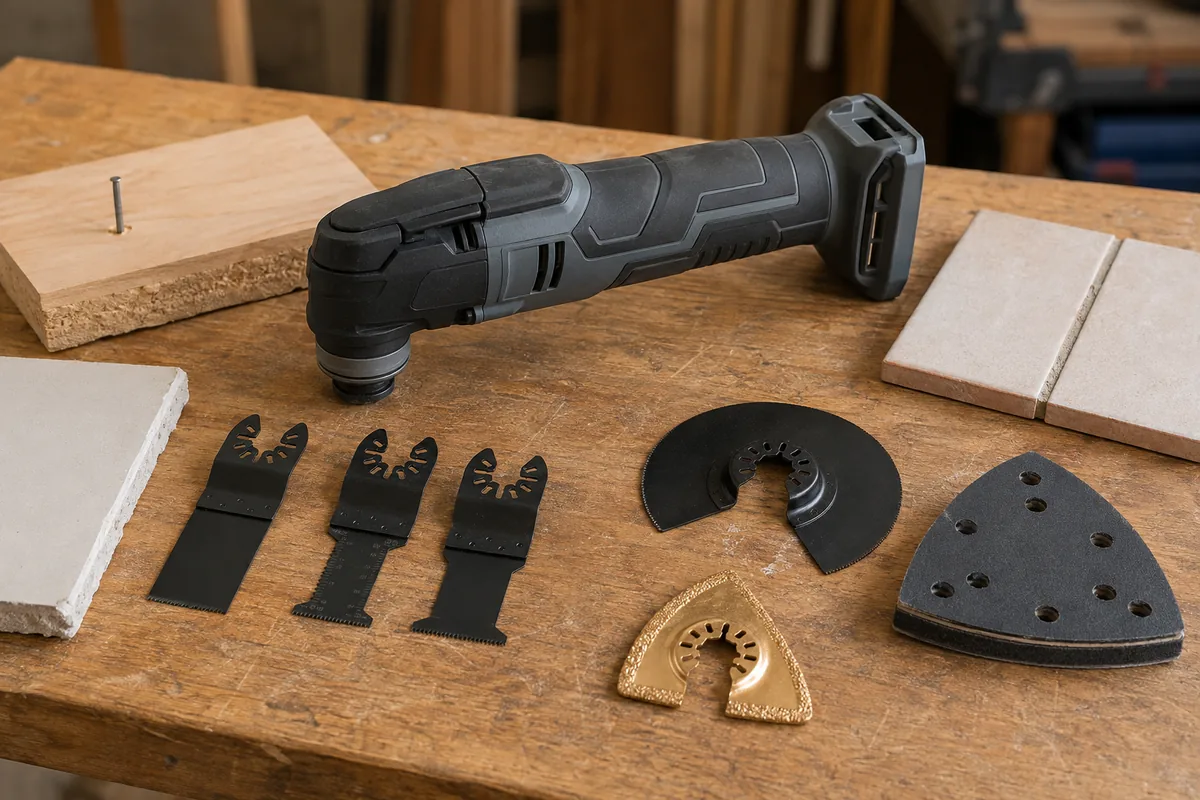
An oscillating multi-tool moves a small blade side-to-side about 3-4 degrees at 10,000-20,000 oscillations per minute. There is almost no kick and very little clearance needed. A flush-cut blade can slide flat along a surface and shave a nail off at the wood line. It doesn’t have stroke length, so it relies on the speed of those tiny oscillations and the hardness of the blade teeth.
That difference explains everything: the recip saw is a demolition engine, the multi-tool is a surgical cutter.
Head-to-Head for Embedded Nails
| Factor | Oscillating Multi-Tool | Reciprocating Saw |
|---|---|---|
| Flush-cut ability | Excellent — blade can ride flat on wood and cut nail flush or slightly below surface | Poor — shoe and blade thickness leave 1/8 to 1/4 inch stub unless you dig into wood |
| Speed on exposed nail | 15-30 seconds per 16d nail | 2-5 seconds per 16d nail |
| Access in tight spots | Best — fits between studs, under subfloor edges, inside cabinets | Needs 4-6 inches of clearance in front of nail for blade and shoe |
| Vibration and control | Low vibration, one-handed control, little risk of jumping | High vibration, can jump or bend blade if nail pinches |
| Blade cost and life | $8-15 per bi-metal blade, 5-15 nails per blade before teeth dull | $3-6 per bi-metal blade, 30-80 nails per blade |
| Risk to surrounding material | Very low — narrow kerf, you can protect wood with tape | Higher — can gouge joists, cut plumbing or wiring if you push blind |
When the Reciprocating Saw Wins
If the nail is not flush or you don’t need it flush, the reciprocating saw is faster by a wide margin. During gut demolition — tearing out a wall with nails still holding studs, cutting nails that hold down old hardwood, or chopping through a stud with embedded fasteners — nothing beats it for speed.
Use a 6-inch or 9-inch 14 TPI bi-metal demolition blade. The 14 TPI tooth count is the sweet spot for nail-embedded wood: coarse enough to clear wood chips but fine enough to not snag and snap on a 16d nail. Avoid the wood-only 6 TPI blades for this job; the large teeth catch on the nail, bend, and then strip. And avoid ultra-fine 18-24 TPI metal blades — they cut the nail cleanly but clog and burn in wood.
Technique matters. Set the shoe firmly against the wood, keep the blade at a shallow angle so you are cutting wood and nail together, and let the tool do the work. Don’t force it sideways. The most common failure is bending the blade when you twist to get flush. If you try to force a recip blade flat against a joist to get a flush cut, you will leave a raised stub and likely kink the blade. For embedded nails under an inch from concrete or a tight corner where the shoe won’t seat, the recip saw simply can’t reach.
For bulk demo, the economics heavily favor the recip saw. Quality reciprocating saw bi-metal demolition blades cost a third of multi-tool blades and last 4-6 times longer on nails. If you have 50+ nails to cut, that difference pays for itself in one job.
When the Oscillating Multi-Tool Wins
The multi-tool earns its keep when you need that nail gone without damaging the wood around it. The classic example is pulling tongue-and-groove subfloor or hardwood and wanting to reuse the joists, or trimming door jambs and nails flush to lay new flooring. The flat blade can lay directly on the joist face and cut the shank off exactly at the surface, so you don’t have to pull the nail or grind the stub.
It’s also the only practical option in tight quarters. Between joists spaced 12 inches on center, inside a stud bay with wiring nearby, under a toe-kick, or when cutting a single nail that held a bracket to a wall — the multi-tool can plunge in where a recip saw’s body and shoe won’t fit.
Blade choice is critical. Use a bi-metal or carbide-tipped metal cutting blade, not the wood-cutting or multi-material blades. Standard bi-metal oscillating multi-tool bimetal metal cutting blades will handle common bright and galvanized nails but dull quickly on hardened screws or old cut nails. If you are cutting hardened deck screws or concrete-embedded nails, a carbide-tooth blade lasts 3-5x longer and is worth the extra $12-20.
Failure modes are different than with a recip saw. Multi-tool blades overheat fast. If you lean hard and hold the blade in one spot, the teeth lose temper in 20-30 seconds and will glaze over. Use light pressure, let the oscillation do the cutting, and rock the blade slightly to keep teeth engaged. You will also crack the blade at the mounting holes if you flex it side to side — keep it flat.
Speed is the trade-off. A multi-tool takes 3-6 times longer per nail than a recip saw. The motor can also overheat on long continuous runs. For more than about 10 minutes of constant nail cutting, you need to give it cooldown breaks or the tool’s thermal protection will trip.
Blades, Cost, and Practical Tips
Don’t buy cheap carbon steel blades for either tool if nails are involved. They dull on the first nail and then just burn. For both tools, bi-metal is the minimum.
For the multi-tool, a semi-circular or wide flush-cut blade gives more contact area than a narrow plunge blade and cuts straighter across the nail. For the recip saw, a shorter 6-inch blade vibrates less and is more controllable for nail cutting than a 9- or 12-inch blade — save the long blades for framing cuts.
If you have a lot of nails in salvage lumber, consider a third option: pull them. A good nail puller or end nippers is still cheaper than blades. Cut only the nails that won’t pull without splitting the wood. Many pros will pull what they can and keep the multi-tool handy for the stubborn ones.
And wear eye protection. Both tools throw hot metal chips when they hit a nail. A recip saw ejects them at high speed, a multi-tool creates fine, hot dust. Gloves help too — cut nails leave razor-sharp stubs.
Which Should You Buy for This Job?
Own both if you do regular demolition or remodeling. They don’t replace each other.
Get the reciprocating saw first if your main work is teardown: gutting walls, removing subfloor quickly, cutting out nailed-together framing. It will cut embedded nails 5 times faster and blade cost is much lower. A basic cordless model with a few demolition blades handles 90 percent of demo nail cutting.
Get the oscillating multi-tool first if your work is precision demo, flooring, trim, or salvage. When the goal is to leave the wood clean and flush without gouges, the multi-tool is the only tool that does it reliably. If you already own a recip saw, adding an oscillating multi-tool kit for flush cutting fills the gap the recip saw can’t reach and will quickly pay for itself in saved time prying and grinding stubs.
If you are buying just for one project: count the nails and check access. Under 15 nails and they need to be flush — rent or borrow a multi-tool. Over 15 nails and flush doesn’t matter — the recip saw is the faster, cheaper choice. If you have a mix, start with the recip saw for bulk and finish flush with the multi-tool. That’s how most demolition crews actually work.