What's inside
As an Amazon Associate I earn from qualifying purchases. This post may contain affiliate links at no extra cost to you.
What Kickback Actually Is
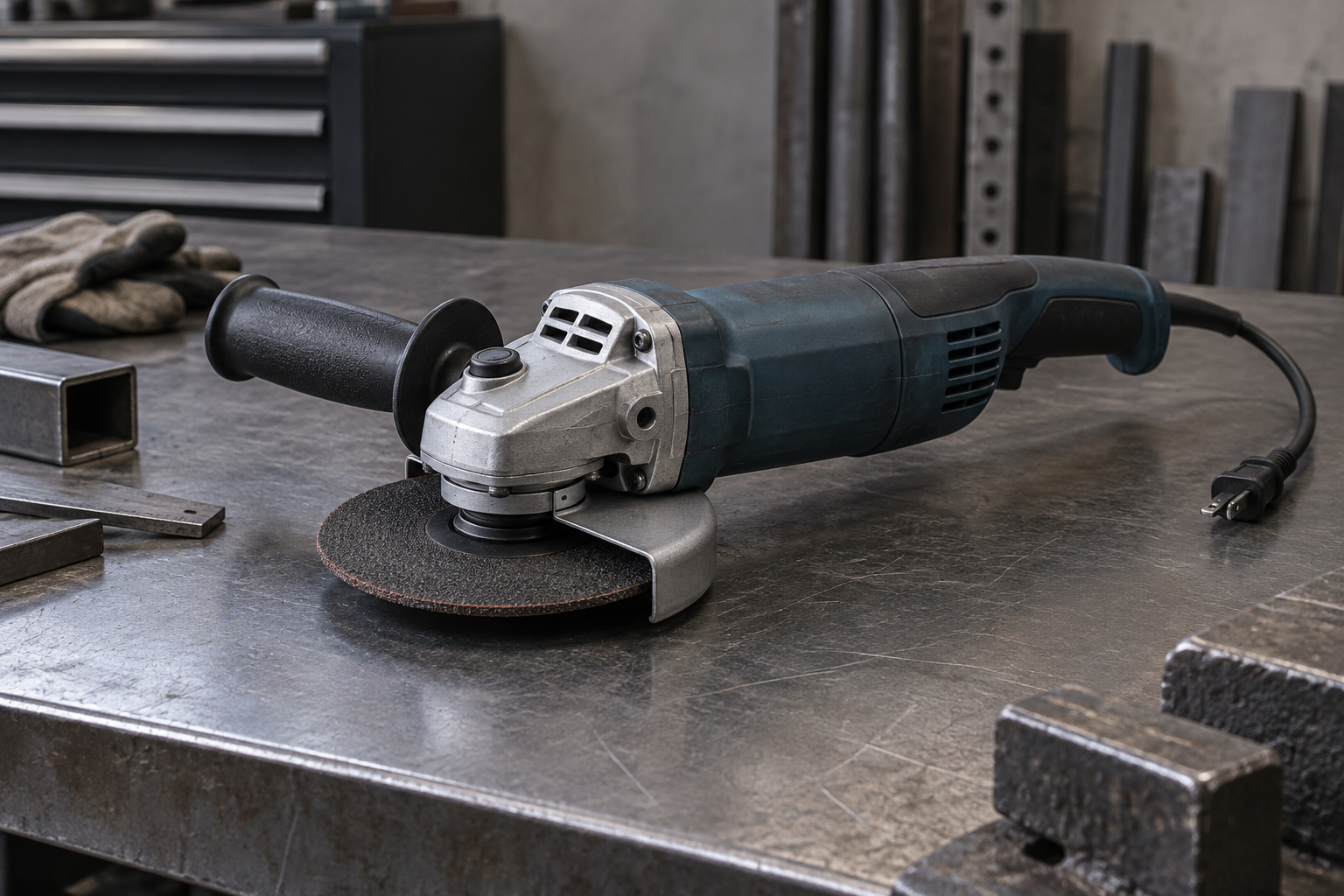
Grinder kickback during metal cutting isn’t the wheel shattering. It’s the instant when a spinning cutoff wheel binds, stalls, and the grinder body violently rotates or jumps out of the cut. With a 4-1/2″ grinder spinning at 11,000 RPM, that reaction happens in under 0.1 seconds. The motor torque that was driving the wheel has nowhere to go, so it drives the housing instead. If the wheel is pinched at the top, the grinder kicks back toward you. If pinched at the bottom, it climbs and tries to run away from you.
Three things cause almost all kickbacks: the wheel binds in the cut, the wheel twists and side-loads, or the workpiece moves and closes the kerf. Thin cutoff wheels don’t have any tolerance for side load. Even 2-3 degrees of twist while the wheel is deep in steel is enough to grab.
Wheel Selection Matters More Than Anything
The cheapest way to reduce kickback is the right wheel for the material and machine. Don’t use a grinding wheel to cut, and don’t use a masonry or aluminum-specific wheel on steel. For metal cutting you want a Type 1 (flat) or Type 27 (depressed center) cutoff wheel rated for your grinder’s maximum RPM. That rating is stamped on the wheel — if it says 13,300 RPM max, it’s safe on an 11,000 RPM grinder. If there’s no stamp, throw it away.
Thickness is the biggest trade-off:
| Wheel Thickness | Best For | Kickback Risk | Trade-off |
|---|---|---|---|
| 0.045″ (1.0-1.2mm) Thin | Sheet metal, rebar, exhaust pipe, slicing plate steel under 1/4″ | Lower – less friction and heat, faster cut, less binding | Flexes more, shatters easier if you twist it |
| 0.064″ (1.6mm) Medium | General purpose angle iron, tubing, 1/4″ plate | Moderate – good balance for most users | Slower than 0.045″ but more forgiving of wobble |
| 0.090″ – 1/8″ (2.0-3.2mm) Thick | Heavy structural steel, straight cuts where durability matters | Higher – generates more heat and friction, more likely to pinch | Lasts longer, resists bending, but works the grinder harder |
For most people cutting steel under 3/16″ with a 4-1/2″ grinder, a quality 0.045″ wheel is the safest and fastest option. It removes less material, so there’s less surface area to bind. You’ll use more wheels, but each wheel is $1-3 and a thick wheel that binds can cost you control. If you are constantly breaking 0.045″ wheels, you’re twisting the grinder — the wheel is telling you the technique is wrong, not that you need a thicker wheel.
Use the correct diameter for your guard. A 6″ wheel on a 4-1/2″ grinder overhangs the guard and raises the surface speed by 33%, which increases both kickback force and the chance the wheel explodes if it snags. Stainless steel requires an inox-rated wheel (iron and sulfur-free) — standard wheels on stainless will cut, but they glaze and bind faster.
Technique That Prevents Binding
Kickback is almost always user-induced. The physics are simple: keep the wheel perpendicular to the work and let it cut without pressure.
First, cut so the grinder pulls debris away from you and the wheel isn’t climbing. For a right-handed user, that usually means the rotation arrow points away from your body and you cut with the weight of the tool doing the work. Don’t push down hard. A thin cutoff wheel needs only 2-4 pounds of pressure. If you’re leaning on it, the wheel flexes, heats, and grabs when it rebounds.
Second, never cut deep in one pass on thick stock and never use the side of a cutoff wheel to deburr or grind. Cutoff wheels have no fiberglass reinforcement on their sides. Side-loading a 0.045″ wheel at speed will crack it instantly and the grinder will buck hard. If you need to grind after cutting, switch to a type 27 grinding wheel for metal or a flap disc.
Third, make relief cuts on long pieces. When you cut a 4-foot length of angle iron supported only at the ends, the cut closes as the metal sags and pinches the wheel in the last 1/2″. That’s the most common kickback scenario. Support both sides of the cut so the kerf stays open, or wedge the kerf with a flat screwdriver once you’re 3/4 through. On tubing and flat bar, cut 90% through, then roll the piece and finish from the opposite side instead of forcing through the final pinch point.
Cut in short, straight passes. Let the wheel reach full speed before it touches steel, and keep it moving. Dwelling in one spot builds a wide, hot groove that the wheel can wedge inside. If the grinder slows audibly or you see the RPM drop, you’re forcing it — ease off.
Grinder Features That Actually Help
Not all grinders handle binding the same way. Two features measurably reduce kickback injuries:
Anti-kickback or clutch protection. Found on many modern brushless grinders, this electronically cuts power when it senses a sudden wheel stop. It doesn’t prevent the bind, but it stops the motor from driving the housing into your hand. If you cut metal often, it’s worth paying for. A basic 7-amp corded grinder for $39 will cut just as fast as a $129 brushless model, but it won’t save you when the wheel snags.
Paddle switch vs. slide switch. A slide switch stays on if the grinder is torn from your grip. A paddle (dead-man) switch shuts off the instant you let go. For cutoff work where kickback is most likely, the paddle is objectively safer. Look for an angle grinder with paddle switch and anti-kickback if you’re buying specifically for metal cutting.
Guard position and handle: Keep the guard between you and the wheel, rotated to deflect sparks away from you but still covering the side facing your body. Always use the side handle for cutoff work — it gives you two-handed leverage against rotation. Set it on the side that lets you keep your wrist straight. A bent wrist is a weak wrist when the tool tries to twist.
Work Holding and Setup
The workpiece must not move. A piece of 1″ square tube held with your foot or a knee is a guarantee of kickback when it finally lets go and pinches. Clamp it in a vise or to a table with at least two points of contact. If you’re using a vise, clamp close to the cut — within 3-4 inches — so the offcut doesn’t vibrate and close the kerf.
Check direction of the cut waste. The small cutoff piece should be free to fall away, not trapped between the wheel and the vise. Trapped offcuts spin and jam, which is how wheels shatter.
Wear a face shield over safety glasses, hearing protection, and tight-fitting gloves that still let you grip. Loose leather gloves that catch on the guard are worse than snug mechanics gloves. Never wear cloth gloves that can wrap around the spindle. Keep the cord behind you — on a corded grinder, the cord draped over the work is often what pulls your hand into a bad angle.
Inspect wheels before mounting. Do the ring test on vitrified wheels (they should ring clear, not thud), but resin cutoff wheels won’t ring — instead check for chips, cracks, or moisture damage. A wheel dropped on concrete is a wheel you discard. Store wheels flat and dry; a damp 0.045″ wheel loses strength dramatically.
When It Starts to Bind
You’ll feel binding before full kickback: the pitch drops, vibration increases, and the grinder wants to wander off the line. Don’t try to muscle through it. Release pressure immediately, let the wheel spin free for a second, then re-enter the cut from a slightly different angle with almost no force.
If kickback does happen, your reaction should be to let off the paddle and let the grinder stop. Don’t fight to hold it in the cut — that’s how wrists get sprained and guards get hit. After a bind, stop and inspect. Check the wheel for a missing edge or hairline crack, recheck the guard tightness, and open the kerf before restarting.
For repetitive straight cuts in steel over 1/4″ thick, consider whether an angle grinder is the right tool at all. A portable bandsaw or a 14″ chop saw holds the workpiece and wheel in a fixed plane and essentially eliminates human-induced twist. The cheaper option is fine for one-off cuts, but if you’re cutting a lot of 2x2x1/4″ tubing, a portable band saw for metal cutting will be slower per cut but far less likely to kick.